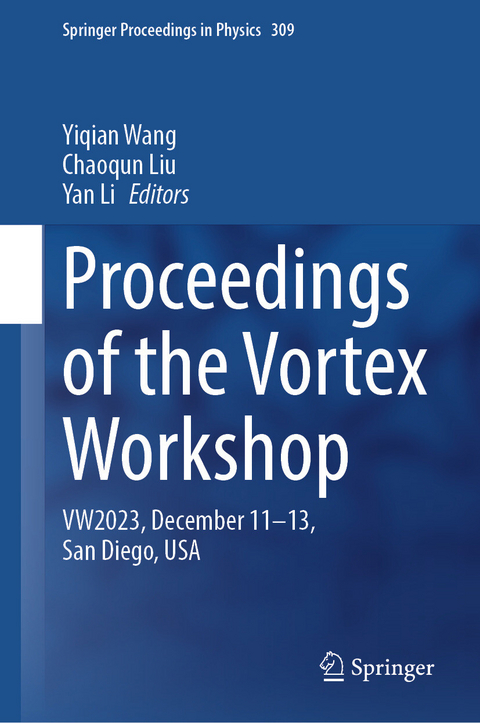
Proceedings of the Vortex Workshop (eBook)
246 Seiten
Springer Nature Singapore (Verlag)
978-981-97-8608-4 (ISBN)
Written by the leading experts in the field, this book results from Vortex Workshop 2023 which took place in San Diego, the USA, on December 11-13.
Vortex is ubiquitous in the universe such as tornado, hurricane, airplane tip vortex, and even star vortex in Galaxy. Vortices are also building blocks, muscles, and sinews of turbulent flows. A vortex is intuitively recognized as a rotational/swirling motion of fluids but until recently had no rigidly mathematical definition. In 1858, Helmholtz first defined vortex as composed of so-called vortex filaments, which are infinitesimal vorticity tubes, which is called as the first generation of vortex definition and identification, or G1. Although G1 has been accepted by the fluid dynamics community and almost all textbooks for over a century, we can find many immediate counterexamples, for example, in the laminar boundary layer, where the vorticity (shear) is very large near the wall, but not rotation (no vortex) exists. To solve these contradictions, many vortex criteria methods have been developed during the past 4 decades. More popular methods are represented by the Q, ?, criteria methods. These methods have achieved part of success in vortex identification, which are called the second generation of vortex identification or G2. However, G2 has several critical drawbacks. First, they are all scalars which have no rotation axis directions, but vortex is a vector. It is hard or impossible to use a scalar to represent a vector. Second, like vorticity, these criteria methods are all contaminated by shear in different degrees. Third, they are all very sensitive on threshold selections. The recently developed Liutex is called the third generation of vortex definition and identification, or G3, which is a uniquely defined vector.
Written by the leading experts in the field, this book results from Vortex Workshop 2023 which took place in San Diego, the USA, on December 11-13.Vortex is ubiquitous in the universe such as tornado, hurricane, airplane tip vortex, and even star vortex in Galaxy. Vortices are also building blocks, muscles, and sinews of turbulent flows. A vortex is intuitively recognized as a rotational/swirling motion of fluids but until recently had no rigidly mathematical definition. In 1858, Helmholtz first defined vortex as composed of so-called vortex filaments, which are infinitesimal vorticity tubes, which is called as the first generation of vortex definition and identification, or G1. Although G1 has been accepted by the fluid dynamics community and almost all textbooks for over a century, we can find many immediate counterexamples, for example, in the laminar boundary layer, where the vorticity (shear) is very large near the wall, but not rotation (no vortex) exists. To solve these contradictions, many vortex criteria methods have been developed during the past 4 decades. More popular methods are represented by the Q, ?, criteria methods. These methods have achieved part of success in vortex identification, which are called the second generation of vortex identification or G2. However, G2 has several critical drawbacks. First, they are all scalars which have no rotation axis directions, but vortex is a vector. It is hard or impossible to use a scalar to represent a vector. Second, like vorticity, these criteria methods are all contaminated by shear in different degrees. Third, they are all very sensitive on threshold selections. The recently developed Liutex is called the third generation of vortex definition and identification, or G3, which is a uniquely defined vector.
| Erscheint lt. Verlag | 15.11.2024 |
|---|---|
| Reihe/Serie | Springer Proceedings in Physics |
| Zusatzinfo | XXI, 246 p. 175 illus., 150 illus. in color. |
| Sprache | englisch |
| Themenwelt | Naturwissenschaften ► Physik / Astronomie ► Mechanik |
| Technik ► Bauwesen | |
| Technik ► Fahrzeugbau / Schiffbau | |
| Technik ► Luft- / Raumfahrttechnik | |
| Technik ► Maschinenbau | |
| Schlagworte | Liutex Vector • New Vortex Identification • Vortex Control • Vortex Core Identification • Vortex Identification Methods |
| ISBN-10 | 981-97-8608-8 / 9819786088 |
| ISBN-13 | 978-981-97-8608-4 / 9789819786084 |
| Informationen gemäß Produktsicherheitsverordnung (GPSR) | |
| Haben Sie eine Frage zum Produkt? |
 PDF (Wasserzeichen)
DRM: Digitales Wasserzeichen
Dieses eBook enthält ein digitales Wasserzeichen und ist damit für Sie personalisiert. Bei einer missbräuchlichen Weitergabe des eBooks an Dritte ist eine Rückverfolgung an die Quelle möglich.
Dateiformat: PDF (Portable Document Format)
Mit einem festen Seitenlayout eignet sich die PDF besonders für Fachbücher mit Spalten, Tabellen und Abbildungen. Eine PDF kann auf fast allen Geräten angezeigt werden, ist aber für kleine Displays (Smartphone, eReader) nur eingeschränkt geeignet.
Systemvoraussetzungen:
PC/Mac: Mit einem PC oder Mac können Sie dieses eBook lesen. Sie benötigen dafür einen PDF-Viewer - z.B. den Adobe Reader oder Adobe Digital Editions.
eReader: Dieses eBook kann mit (fast) allen eBook-Readern gelesen werden. Mit dem amazon-Kindle ist es aber nicht kompatibel.
Smartphone/Tablet: Egal ob Apple oder Android, dieses eBook können Sie lesen. Sie benötigen dafür einen PDF-Viewer - z.B. die kostenlose Adobe Digital Editions-App.
Buying eBooks from abroad
For tax law reasons we can sell eBooks just within Germany and Switzerland. Regrettably we cannot fulfill eBook-orders from other countries.
aus dem Bereich