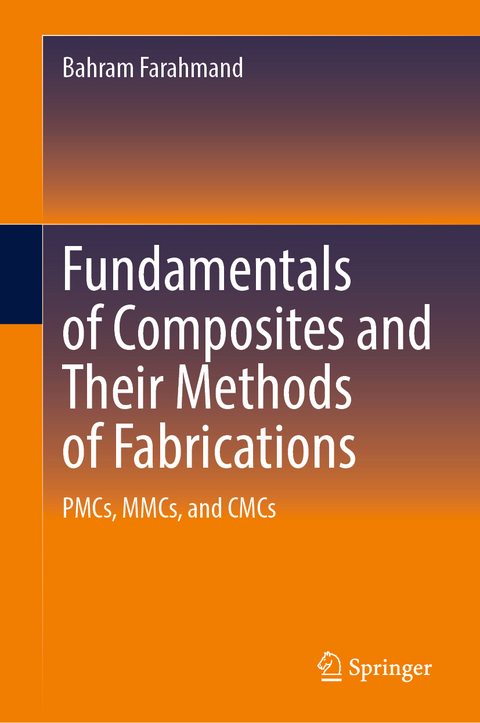
Fundamentals of Composites and Their Methods of Fabrications
Springer International Publishing (Verlag)
978-3-031-80200-3 (ISBN)
This book provides readers with essential insights into composite materials, encompassing methods for fabricating composite parts (PMCs, MMCs, CMCs), determining their mechanical properties via coupon testing and rule of mixtures, and exploring their industrial applications. Additionally, the book covers topics of interest for engineers, including damage tolerance analysis, nondestructive inspections, repairing damaged composite and metallic parts, and fabricating composite parts using additive manufacturing processes. Drawing on his years of experience in the aerospace industry, the author believes the topics presented will be valuable to readers and that engineers in industries, students in academia, and university instructors will find this book beneficial.
- Introduces progressive failure analysis, fatigue, and fracture of composite, molecular dynamics, virtual testing, with several practical example problems
- Explores additive manufacturing methods and their application in fabricating PMCs and assessing mechanical properties
- Introduces nanocomposites and their fabrication methods, detailing advantages and disadvantages of the parts produced
Dr. Bahram Farahmand is a former Boeing Technical Fellow who has made significant contributions to fatigue, fracture mechanics, and material characterization throughout his career. In addition to his work at Boeing, he has consulted several aerospace companies. Dr. Farahmand is the author of five technical books on material science and has contributed to four others. He has authored numerous technical papers, as well as a fracture mechanics handbook, during his tenure with Boeing. His extensive research in virtual testing aims to reduce costly and time-consuming tests by relying on analytical methods. Dr. Farahmand also developed two computer codes, FTD and FCG, used for estimating material fracture properties efficiently without physical testing. Additionally, he has worked on nanotechnology, focusing on computational materials, which he discussed in depth in his previous book, Virtual Testing & Predictive Modeling.
Chapter 1: Understanding of Composite Material (Constituents of Composites).- Chapter 2: Understanding Lamina Through Micromechanics (The Rule-of-Mixtures Approach).- Chapter 3: Types of Matrices and Fibers Used in Composites.- Chapter 4: Polymer Matrix Composites (PMCs) and Nanocomposites (Methods of Manufacturing PMCs Parts).- Chapter 5: Metal Matrix Composites (MMCs) (Methods of Manufacturing MMCs Parts).- Chapter 6: Ceramic Matrix Composites (CMCs) (Methods of Manufacturing CMCs Parts).- Chapter 7: Delamination in Laminated Composites.- Chapter 8: Progressive Failure Analysis (PFA) of Laminated Composites.- Chapter 9: The Application of Fracture Mechanics to Composite.- Chapter 10: Obtaining Fracture Properties Through Virtual Testing Approach.- Chapter 11: Composites Under High Cycle Fatigue (Industrial Applications).- Chapter 12: Damage Accumulation of Composite Materials Under to Fatigue Loading.- Chapter 13: Composite Repairs (Industrial Applications and Analysis).- Chapter 14: Application of Nondestructive Inspection For Composite Materials.- Chapter 15: 3D Printing and its Applications to Composites (Additive Manufacturing).
| Erscheinungsdatum | 09.04.2025 |
|---|---|
| Zusatzinfo | XXXII, 394 p. 219 illus., 122 illus. in color. |
| Verlagsort | Cham |
| Sprache | englisch |
| Maße | 155 x 235 mm |
| Themenwelt | Technik ► Maschinenbau |
| Schlagworte | composite materials • coupon testing • fabrication methods of composites • mechanical properties • rule of mixtures |
| ISBN-10 | 3-031-80200-4 / 3031802004 |
| ISBN-13 | 978-3-031-80200-3 / 9783031802003 |
| Zustand | Neuware |
| Informationen gemäß Produktsicherheitsverordnung (GPSR) | |
| Haben Sie eine Frage zum Produkt? |
aus dem Bereich