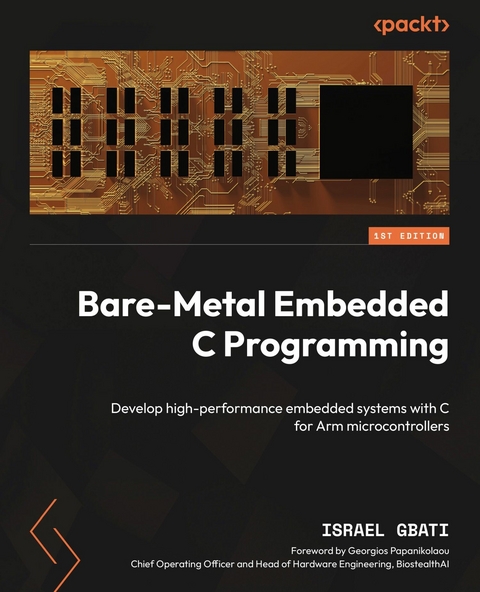
Bare-Metal Embedded C Programming (eBook)
448 Seiten
Packt Publishing (Verlag)
978-1-83546-356-7 (ISBN)
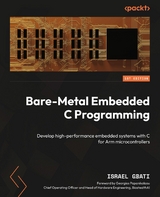
Bare-Metal Embedded C Programming takes you on an unparalleled journey to equip you with the skills and knowledge to excel in the world of embedded systems. The author, with over a decade of hands-on experience in engineering, takes a unique, practical approach to teach you how to decode microcontroller datasheets so that you're able to extract vital information for precise firmware development. Register manipulation will become second nature to you as you learn to craft optimized code from scratch.
The book provides in-depth insights into the hardware intricacies of microcontrollers. You'll navigate user manuals and documentation with ease, ensuring a profound understanding of the underlying technology. The true uniqueness of this book lies in its commitment to fostering independent expertise. Instead of simply copy pasting, you'll develop the capability to create firmware with confidence, paving the way for professional-grade mastery.
By the end of this book, you'll have honed your skills in reading datasheets, performing register manipulations, and crafting optimized code, as well as gained the confidence needed to navigate hardware intricacies and write optimized firmware independently, making you a proficient and self-reliant embedded systems developer.
No detailed description available for "e;Bare-Metal Embedded C Programming"e;.
Preface
In a tech-driven world where embedded systems power nearly every modern device and innovation, the ability to develop efficient and reliable firmware is a prized skill. The journey from writing basic code to mastering low-level firmware development can be daunting, but the rewards are substantial. Whether it’s a home appliance, an industrial control system, or a sophisticated IoT device, embedded systems serve as the silent, hardworking engines behind modern technology.
This book, Bare-Metal Embedded C Programming, was born out of a desire to help you not only write functional firmware but also to deeply understand the underlying mechanisms that govern how microcontrollers work at their core. My goal is to take you on an in-depth, technical journey into the heart of ARM-based microcontroller firmware development, specifically focusing on the STM32 family. This is not a book for the faint of heart, nor is it one for those looking for quick shortcuts. Instead, it is designed for individuals who are ready to step away from the comforts of pre-built libraries and tools to develop the skills necessary for writing efficient, bare-metal code from scratch.
So, what exactly is bare-metal programming? Simply put, it’s the art of writing firmware that interacts directly with the hardware—without the abstraction layers provided by third-party libraries. This approach requires precision, a deep understanding of microcontroller architecture, and the ability to read and manipulate registers to achieve the exact behavior you want from your hardware.
Why I Wrote This Book
As someone with years of experience in embedded systems development, I’ve often noticed a gap in the way firmware development is taught. Many texts and courses focus on high-level development, promoting the use of pre-built libraries that abstract away the complexities of hardware interaction. While this approach is undoubtedly convenient and practical in many cases, it leaves a void for those who truly wish to understand how things work at the lowest level. I believe that understanding the “bare-metal” aspect of embedded systems development is essential for becoming a truly skilled firmware engineer.
This book is my effort to fill that gap. Through step-by-step guidance, I’ll show you how to build your own drivers, manipulate registers, and write code that takes full control of the microcontroller. This is not just about learning a new skill—it’s about achieving mastery.
Who this book is for
If you’re a developer, engineer, or a student eager to dive deep into the world of microcontroller firmware development, this book is for you. You’ll find it especially valuable if you’re the kind of person who prefers to understand what’s happening under the hood, rather than relying on copy-paste solutions from online forums. Whether you’re transitioning from other platforms or seeking to build a strong foundation in bare-metal development, this book will give you the hands-on experience you need.
What This Book Covers
Chapter 1, Setting Up the Tools of the Trade
This chapter introduces the essential tools you’ll need for development. From navigating datasheets to setting up your Integrated Development Environment (IDE), this chapter lays the groundwork for everything that follows.
Chapter 2, Constructing Peripheral Registers from Memory Addresses
In this chapter, we dive into the core of bare-metal programming. You’ll learn how to define and access peripheral registers directly from memory addresses, using the official microcontroller documentation as your guide.
Chapter 3, Understanding the Build Process and Exploring the GNU Toolchain
In this chapter, we take a closer look at the embedded C build process. You’ll explore how to compile and link code manually using the GNU Toolchain, gaining complete control over how your firmware is created.
Chapter 4, Developing the Linker Script and Startup File
In this chapter, you will learn how to write a custom linker script to define how your firmware is placed in the microcontroller’s memory, including allocating sections like code, data, and stack. Additionally, you’ll develop a startup file that configures the microcontroller’s initial state, sets up the stack, initializes memory, and jumps to your main code.
Chapter 5, The “Make” Build System
Automating the build process is a critical part of embedded development. This chapter teaches you how to use the Make build system to streamline your workflow by creating custom Makefiles that automate repetitive tasks.
Chapter 6, The Common Microcontroller Software Interface Standard (CMSIS)
CMSIS simplifies development on ARM Cortex microcontrollers. In this chapter, you’ll learn how to leverage CMSIS to write efficient code that takes advantage of the microcontroller’s features while maintaining simplicity.
Chapter 7, The General-Purpose Input/Output (GPIO) Peripheral
GPIO allows your microcontroller to interact with external devices. This chapter guides you through developing both input and output drivers for GPIO, one of the most frequently used peripherals in embedded systems.
Chapter 8, System Tick (SysTick) Timer
Timing is essential in embedded systems, and the SysTick timer provides an easy way to generate precise time delays and system ticks. This chapter walks you through developing SysTick drivers for use in your embedded applications.
Chapter 9, General-Purpose Timers (TIM)
This chapter introduces you to the general-purpose timers (TIM) in STM32 microcontrollers, teaching you how to develop timer drivers for tasks that require precise timing.
Chapter 10, The Universal Asynchronous Receiver/Transmitter Protocol
Communication is a key aspect of embedded systems. This chapter focuses on the UART protocol, one of the most widely used communication protocols. You’ll learn how to develop UART drivers, enabling your microcontroller to send and receive data from external devices.
Chapter 11, Analog-to-Digital Converter (ADC)
Many embedded applications require converting analog signals into digital data that your microcontroller can process. This chapter covers how to configure the ADC peripheral, allowing you to read and convert analog inputs into meaningful digital values.
Chapter 12, Serial Peripheral Interface (SPI)
SPI is a high-speed communication protocol commonly used in embedded systems. This chapter guides you through developing SPI drivers, enabling efficient communication between your microcontroller and other peripherals, such as sensors or memory devices.
Chapter 13, Inter-Integrated Circuit (I2C)
I2C is another popular communication protocol for connecting devices, it is often used for short-distance communication in embedded systems. This chapter covers the development of I2C drivers, allowing your microcontroller to communicate with multiple devices over a shared bus.
Chapter 14, External Interrupts and Events (EXTI)
Responsiveness is critical in embedded systems, and external interrupts allow your system to react to changes in its environment. This chapter covers how to configure and manage external interrupts and events (EXTI) for timely and efficient responses to external stimuli.
Chapter 15, The Real-Time Clock (RTC)
For systems that require accurate timekeeping, the RTC peripheral is indispensable. In this chapter, you’ll learn how to set up and use the RTC to track time in low-power systems, even when the microcontroller is in sleep mode.
Chapter 16, Independent Watchdog (IWDG)
Stability is crucial for embedded systems, and the Independent Watchdog Timer (IWDG) ensures that your system can recover from unexpected malfunctions. This chapter teaches you how to configure the IWDG to automatically reset your microcontroller if it stops responding, ensuring reliable operation.
Chapter 17, Direct Memory Access (DMA)
Direct Memory Access (DMA) allows data transfers to occur independently of the CPU, significantly improving system efficiency. This chapter covers how to configure and use DMA for memory-to-memory transfers, as well as for peripherals like ADC and UART, offloading the work from...
| Erscheint lt. Verlag | 14.10.2024 |
|---|---|
| Vorwort | Georgios Papanikolaou |
| Sprache | englisch |
| Themenwelt | Informatik ► Programmiersprachen / -werkzeuge ► C / C++ |
| Mathematik / Informatik ► Informatik ► Theorie / Studium | |
| Technik ► Elektrotechnik / Energietechnik | |
| ISBN-10 | 1-83546-356-8 / 1835463568 |
| ISBN-13 | 978-1-83546-356-7 / 9781835463567 |
| Informationen gemäß Produktsicherheitsverordnung (GPSR) | |
| Haben Sie eine Frage zum Produkt? |
 EPUB (Ohne DRM)
Digital Rights Management: ohne DRM
Dieses eBook enthält kein DRM oder Kopierschutz. Eine Weitergabe an Dritte ist jedoch rechtlich nicht zulässig, weil Sie beim Kauf nur die Rechte an der persönlichen Nutzung erwerben.
Dateiformat: EPUB (Electronic Publication)
EPUB ist ein offener Standard für eBooks und eignet sich besonders zur Darstellung von Belletristik und Sachbüchern. Der Fließtext wird dynamisch an die Display- und Schriftgröße angepasst. Auch für mobile Lesegeräte ist EPUB daher gut geeignet.
Systemvoraussetzungen:
PC/Mac: Mit einem PC oder Mac können Sie dieses eBook lesen. Sie benötigen dafür die kostenlose Software Adobe Digital Editions.
eReader: Dieses eBook kann mit (fast) allen eBook-Readern gelesen werden. Mit dem amazon-Kindle ist es aber nicht kompatibel.
Smartphone/Tablet: Egal ob Apple oder Android, dieses eBook können Sie lesen. Sie benötigen dafür eine kostenlose App.
Geräteliste und zusätzliche Hinweise
Buying eBooks from abroad
For tax law reasons we can sell eBooks just within Germany and Switzerland. Regrettably we cannot fulfill eBook-orders from other countries.
aus dem Bereich