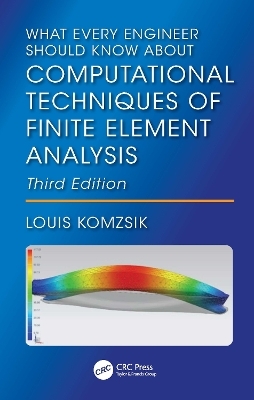
What Every Engineer Should Know About Computational Techniques of Finite Element Analysis
CRC Press (Verlag)
978-1-032-94749-5 (ISBN)
This book is a concise, self-contained treatment of the finite element method and all the computational techniques needed for its efficient use and practical implementation. This book describes the process of transforming the physical problem into a mathematical model, the reduction of the mathematical model to a numerically solvable computational form, and many practical engineering analysis solution techniques applied in various industries.
The first edition of this book was published in 2004, two decades ago. Since then, finite element analysis (FEA) has become a fundamental component of product development software tools (CAD, CAE, CAM) used in many industrial fields of engineering, particularly in mechanical and aerospace engineering. It has also become a popular text in computational science in engineering (CSE) and applied mathematics courses in academia, one of the reasons for the new edition.
This new edition presents finite element solutions to advanced industrial applications in response to readers of the earlier editions. These are heat transfer, wave propagation, topology optimization, and fluid dynamics. These topics were requested both by engineering and applied mathematics students as well as practicing mechanical and aerospace engineers. It also contains the numerical solution of a structural example to aid the teaching of finite element analysis using this textbook.
Louis Komzsik is a graduate of the Technical University of Budapest with an engineering degree and the Eötvös University of Sciences in Budapest with a mathematics degree, both in Hungary. From 1974 to 2016, he worked in various industries in Europe and in the United States in finite element analysis of ships, airplanes, automobiles, satellites, and windmills. His work on numerical computational techniques for industrial finite element analysis has been captured in the NASTRAN numerical methods handbook. He pioneered the introduction of several numerical techniques that became de-facto industrial standards, and his book about one of those topics, The Lanczos Method, has also been published in Chinese, Japanese, and Hungarian. He also worked on the topic of rotor dynamics and on the mathematical solution of structural topology optimization. He is the author of several technical books in second or third editions. His Approximation Techniques for Engineers, 2nd ed. (2016); Applied Calculus of Variations for Engineers, 3rd ed. (2018); and Computational Techniques of Finite Element Analysis, 2nd ed. (2009) are all used in industry and in academia worldwide. He is also the coauthor of Computational Techniques of Rotor Dynamics with the Finite Element Method, originally published in 2012 and a second edition to be published later this year. After his retirement from industry, he lectured at the Mathematics Department of the University of California in Irvine from 2017 to 2020. Since 2021 he has served as Professor Emeritus of Applied Mathematics and teaches finite element analysis using this book as the class text at Obuda University in Budapest, Hungary. In 2024, he received the gold diploma from the Technical University of Budapest celebrating his 50-year engineering career.
I: Numerical Model Generation. 1. Finite Element Analysis. 2. Finite Element Model Generation. 3. Modeling of Physical Phenomena. 4. Constraints and Boundary Conditions. 5. Singularity Detection of Finite Element Models. 6. Coupling Physical Phenomena. II: Computational Reduction Techniques. 7. Matrix Factorization and Linear Systems. 8. Static Condensation. 9. Real Spectral Computations. 10. Complex Spectral Computations. 11. Dynamic Reduction. 12. Component Mode Synthesis. III: Engineering Solution Computations. 13. Modal Solution Technique. 14. Transient Response Analysis. 15. Frequency Domain Analysis. 16. Nonlinear Analysis. 17. Sensitivity and Optimization. 18. Engineering Result Computations. IV: Advanced Industrial Solutions. 19. Heat Transfer. 20. Wave Propagation. 21. Topology Optimization. 22. Fluid Dynamics.
| Erscheinungsdatum | 10.04.2025 |
|---|---|
| Zusatzinfo | 20 Tables, black and white; 62 Line drawings, black and white; 30 Halftones, black and white; 92 Illustrations, black and white |
| Verlagsort | London |
| Sprache | englisch |
| Maße | 156 x 234 mm |
| Gewicht | 890 g |
| Themenwelt | Mathematik / Informatik ► Mathematik ► Analysis |
| Mathematik / Informatik ► Mathematik ► Angewandte Mathematik | |
| Technik ► Elektrotechnik / Energietechnik | |
| ISBN-10 | 1-032-94749-7 / 1032947497 |
| ISBN-13 | 978-1-032-94749-5 / 9781032947495 |
| Zustand | Neuware |
| Informationen gemäß Produktsicherheitsverordnung (GPSR) | |
| Haben Sie eine Frage zum Produkt? |
aus dem Bereich