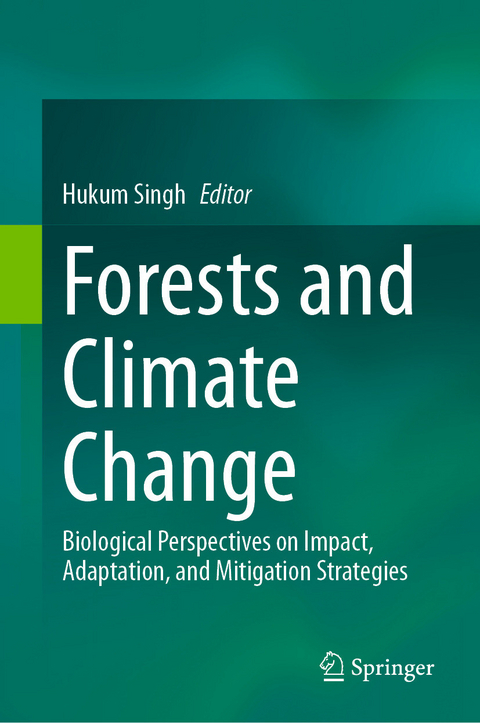
Forests and Climate Change (eBook)
895 Seiten
Springer Nature Singapore (Verlag)
978-981-97-3905-9 (ISBN)
This book comprehensively examines the complex relationship between forests and climate change from a biological perspective. It explores the effects of climate change, such as rising temperatures, greenhouse gas emissions, changing rainfall patterns, droughts, and cold spells, on individual trees and forest ecosystems. It considers how climate change affects forest structure, function, composition, and biodiversity, and the adaptive strategies forests employ to cope with changing conditions.
The book focuses on understanding the adaptive capacity of forests and explores different mechanisms at stand and ecosystem levels that enable forests to respond to changing climatic conditions. It discusses how forests acclimate and adapt to new climates by modulating growth rates, morphology, phenology, physiology, biochemistry, and species composition. The role of genetic diversity and evolutionary processes in shaping forest resilience and adaptation is also explored. The book also explores potential mitigation strategies to reduce the impacts of climate change. Besides, this book discusses the ecological principles and the involvement of local communities in conservation and restoration efforts as alternative strategies to enhance the resilience of forest ecosystems against climate change.
The book provides practical recommendations for policy makers, forest managers, and conservation practitioners to develop effective climate change adaptation and mitigation strategies in forest landscapes. This book serves as a valuable resource and a guide for researchers, students, and professionals in various fields to protect and sustainably manage vital ecosystems in a rapidly changing climate.
This book comprehensively examines the complex relationship between forests and climate change from a biological perspective. It explores the effects of climate change, such as rising temperatures, greenhouse gas emissions, changing rainfall patterns, droughts, and cold spells, on individual trees and forest ecosystems. It considers how climate change affects forest structure, function, composition, and biodiversity, and the adaptive strategies forests employ to cope with changing conditions.The book focuses on understanding the adaptive capacity of forests and explores different mechanisms at stand and ecosystem levels that enable forests to respond to changing climatic conditions. It discusses how forests acclimate and adapt to new climates by modulating growth rates, morphology, phenology, physiology, biochemistry, and species composition. The role of genetic diversity and evolutionary processes in shaping forest resilience and adaptation is also explored. The book also explores potential mitigation strategies to reduce the impacts of climate change. Besides, this book discusses the ecological principles and the involvement of local communities in conservation and restoration efforts as alternative strategies to enhance the resilience of forest ecosystems against climate change.The book provides practical recommendations for policy makers, forest managers, and conservation practitioners to develop effective climate change adaptation and mitigation strategies in forest landscapes. This book serves as a valuable resource and a guide for researchers, students, and professionals in various fields to protect and sustainably manage vital ecosystems in a rapidly changing climate.
| Erscheint lt. Verlag | 18.9.2024 |
|---|---|
| Zusatzinfo | XI, 895 p. 138 illus., 128 illus. in color. |
| Sprache | englisch |
| Themenwelt | Naturwissenschaften ► Biologie ► Ökologie / Naturschutz |
| Naturwissenschaften ► Geowissenschaften ► Geografie / Kartografie | |
| Naturwissenschaften ► Geowissenschaften ► Meteorologie / Klimatologie | |
| Technik | |
| Weitere Fachgebiete ► Land- / Forstwirtschaft / Fischerei | |
| Schlagworte | Circular bioeconomy • climate change • Crop physiology • ecophysiology • Elevated CO2 Concentration • Elevated Temperature • nutrient uptake • PGPR • Physiological traits • Rue • Water Stress |
| ISBN-10 | 981-97-3905-5 / 9819739055 |
| ISBN-13 | 978-981-97-3905-9 / 9789819739059 |
| Informationen gemäß Produktsicherheitsverordnung (GPSR) | |
| Haben Sie eine Frage zum Produkt? |
 PDF (Wasserzeichen)
DRM: Digitales Wasserzeichen
Dieses eBook enthält ein digitales Wasserzeichen und ist damit für Sie personalisiert. Bei einer missbräuchlichen Weitergabe des eBooks an Dritte ist eine Rückverfolgung an die Quelle möglich.
Dateiformat: PDF (Portable Document Format)
Mit einem festen Seitenlayout eignet sich die PDF besonders für Fachbücher mit Spalten, Tabellen und Abbildungen. Eine PDF kann auf fast allen Geräten angezeigt werden, ist aber für kleine Displays (Smartphone, eReader) nur eingeschränkt geeignet.
Systemvoraussetzungen:
PC/Mac: Mit einem PC oder Mac können Sie dieses eBook lesen. Sie benötigen dafür einen PDF-Viewer - z.B. den Adobe Reader oder Adobe Digital Editions.
eReader: Dieses eBook kann mit (fast) allen eBook-Readern gelesen werden. Mit dem amazon-Kindle ist es aber nicht kompatibel.
Smartphone/Tablet: Egal ob Apple oder Android, dieses eBook können Sie lesen. Sie benötigen dafür einen PDF-Viewer - z.B. die kostenlose Adobe Digital Editions-App.
Buying eBooks from abroad
For tax law reasons we can sell eBooks just within Germany and Switzerland. Regrettably we cannot fulfill eBook-orders from other countries.
aus dem Bereich