


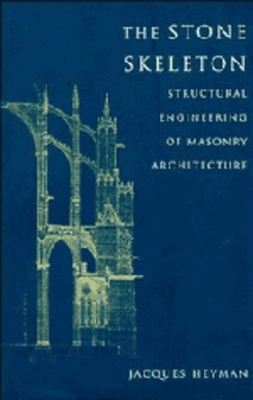
The Stone Skeleton
Structural Engineering of Masonry Architecture
Seiten
1997
Cambridge University Press (Verlag)
978-0-521-62963-8 (ISBN)
Cambridge University Press (Verlag)
978-0-521-62963-8 (ISBN)
- Titel erscheint in neuer Auflage
- Artikel merken
Zu diesem Artikel existiert eine Nachauflage
What is the timescale for the settlement and cracking of an old stone building? And how do the elegant flying buttresses of a Gothic cathedral safely transfer thrust to the foundations? These and many other questions are answered in this clear and authoritative guide for structural engineers, practising architects and others involved in the renovation and care of old stone buildings.
What is the timescale for the settlement and cracking of an old stone building? How do the elegant flying buttresses of a Gothic cathedral safely transfer thrust to the foundations? And what is the effect of wind on a stone spire, or bell-ringing on a church tower? These and many other questions pertinent to the upkeep of old stone structures are answered in this clear and authoritative guide. With a firm scientific basis, but without the use of complex mathematics, the author provides a thorough and intuitive understanding of masonry structures. The basis of masonry analysis is introduced in the first two chapters, after which individual structures - including piers, pinnacles, towers, vaults and domes - are considered in more detail. This lucid and informative text will be of particular interest to structural engineers, practising architects and others involved in the renovation and care of old stone buildings.
What is the timescale for the settlement and cracking of an old stone building? How do the elegant flying buttresses of a Gothic cathedral safely transfer thrust to the foundations? And what is the effect of wind on a stone spire, or bell-ringing on a church tower? These and many other questions pertinent to the upkeep of old stone structures are answered in this clear and authoritative guide. With a firm scientific basis, but without the use of complex mathematics, the author provides a thorough and intuitive understanding of masonry structures. The basis of masonry analysis is introduced in the first two chapters, after which individual structures - including piers, pinnacles, towers, vaults and domes - are considered in more detail. This lucid and informative text will be of particular interest to structural engineers, practising architects and others involved in the renovation and care of old stone buildings.
Preface; 1. Introduction; 2. Structural theory of masonry; 3. Domes; 4. The masonry vault; 5. Some structural elements; 6. Towers and bells; 7. Spires; 8. Some historical notes; Bibliography; Index.
| Erscheint lt. Verlag | 3.7.1997 |
|---|---|
| Zusatzinfo | 3 Tables, unspecified; 5 Halftones, unspecified; 100 Line drawings, unspecified |
| Verlagsort | Cambridge |
| Sprache | englisch |
| Maße | 153 x 228 mm |
| Gewicht | 290 g |
| Themenwelt | Technik ► Bauwesen |
| Technik ► Maschinenbau | |
| ISBN-10 | 0-521-62963-2 / 0521629632 |
| ISBN-13 | 978-0-521-62963-8 / 9780521629638 |
| Zustand | Neuware |
| Informationen gemäß Produktsicherheitsverordnung (GPSR) | |
| Haben Sie eine Frage zum Produkt? |
Mehr entdecken
aus dem Bereich


aus dem Bereich
Statik, Reibung, Dynamik, Festigkeitslehre, Fluidmechanik
Buch | Hardcover (2024)
Springer Vieweg (Verlag)
CHF 55,95
Buch | Softcover (2024)
Springer Vieweg (Verlag)
CHF 26,55


