The Coca-Cola Trail (eBook)
224 Seiten
Modern History Press (Verlag)
978-1-61599-838-8 (ISBN)

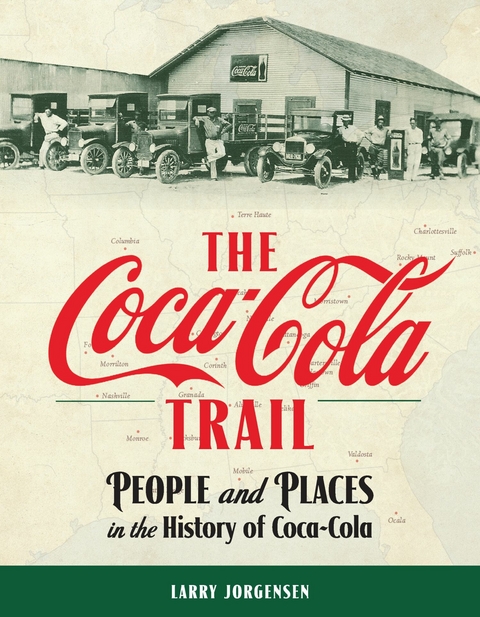
The Coca-Cola Trail is a journey for anyone interested in discovering the history and growth of the world's most recognized product. The trail will take readers to the places in America that tell the story - places where you can see, touch, and remember. Whether a serious Coca-Cola memorabilia collector, a person interested in American business history, or simply a fan--The Coca-Cola Trail provides a fresh new look at a trusted old friend. 30 chapters cover each bottling plant location in meticulous detail, including unique and ghost billboard signage.
So, what is a Coca-Cola Bottler? Well, from a legal standpoint, it's a franchisee of the Coca-Cola company, who has been granted the right to bottle and sell Coca-Cola in an exclusive territory. This franchise or contract has been amended and otherwise changed somewhat over the years to add many additional brands, but in the beginning, it was granted for the sole purpose of bottling and distributing Coca-Cola throughout the bottler's territory.
In the early years, it was bottled one bottle at a time, placed in wooden cases, and hauled to the customer in horse or mule-drawn wagons. The bottling plants were crude and the task was difficult but by acquiring these franchises, these entrepreneurs had unknowingly won the lottery. They had settled on investing in a product that would change the world. A fabulous beverage with a delicious, unique taste profile that provided a refreshing boost to the drinker. Even in today's world, with thousands of brands of both non-alcoholic and alcoholic beverages, Coca-Cola remains at the top in providing that unique taste and special experience in a beverage. You combine this great product with brilliant advertising and marketing from The Coca-Cola Company and 'voila' you have a brand and company and a bottling and distribution system that has been so successful that books upon books have been written about it for over 100 years. That is unique in itself.
'If you like history of any type, you must read this book. Part history, part travel guide but always interesting, and when you've finished you'll be a master of some particular trivia questions.The Coca-Cola Trail is chockfull of very interesting - every page brings a new delight of some lesser-known areas of the US. A wonderful book that I highly recommend to all history buffs.'
-- Linda Thompson, host of The Authors Show
'I would highly recommend this book to anyone who is interested in Coke memorabilia and also to anyone who is interested in learning a different portion of the history of the South. Of course, Coke extended past the southern states, even in the beginning, with one of the earliest bottling plants being located in Leadville, Colorado. If you grew up drinking Coke, this is somewhat like a trip down memory lane as well; filled with pictures of old places and people who were active in the first years of Coke.'
-- S. Byrd, Atlanta, GA
'Coca-Cola is an international sensation, and Larry Jorgensen of Lafayette, Louisiana, has written a book documenting the many places in the United States showcasing Coke history or attractions unique to Coca-Cola. Jorgensen spent two years researching this book, which is also filled with historic photos and recent shots of places and people.'
-- Louisiana Book News
From Modern History Press
The Coca-Cola Trail is a journey for anyone interested in discovering the history and growth of the world's most recognized product. The trail will take readers to the places in America that tell the story - places where you can see, touch, and remember. Whether a serious Coca-Cola memorabilia collector, a person interested in American business history, or simply a fan--The Coca-Cola Trail provides a fresh new look at a trusted old friend. 30 chapters cover each bottling plant location in meticulous detail, including unique and ghost billboard signage. So, what is a Coca-Cola Bottler? Well, from a legal standpoint, it's a franchisee of the Coca-Cola company, who has been granted the right to bottle and sell Coca-Cola in an exclusive territory. This franchise or contract has been amended and otherwise changed somewhat over the years to add many additional brands, but in the beginning, it was granted for the sole purpose of bottling and distributing Coca-Cola throughout the bottler's territory. In the early years, it was bottled one bottle at a time, placed in wooden cases, and hauled to the customer in horse or mule-drawn wagons. The bottling plants were crude and the task was difficult but by acquiring these franchises, these entrepreneurs had unknowingly won the lottery. They had settled on investing in a product that would change the world. A fabulous beverage with a delicious, unique taste profile that provided a refreshing boost to the drinker. Even in today's world, with thousands of brands of both non-alcoholic and alcoholic beverages, Coca-Cola remains at the top in providing that unique taste and special experience in a beverage. You combine this great product with brilliant advertising and marketing from The Coca-Cola Company and "e;voila"e; you have a brand and company and a bottling and distribution system that has been so successful that books upon books have been written about it for over 100 years. That is unique in itself. "e;If you like history of any type, you must read this book. Part history, part travel guide but always interesting, and when you've finished you'll be a master of some particular trivia questions.The Coca-Cola Trail is chockfull of very interesting - every page brings a new delight of some lesser-known areas of the US. A wonderful book that I highly recommend to all history buffs."e; -- Linda Thompson, host of The Authors Show "e;I would highly recommend this book to anyone who is interested in Coke memorabilia and also to anyone who is interested in learning a different portion of the history of the South. Of course, Coke extended past the southern states, even in the beginning, with one of the earliest bottling plants being located in Leadville, Colorado. If you grew up drinking Coke, this is somewhat like a trip down memory lane as well; filled with pictures of old places and people who were active in the first years of Coke."e; -- S. Byrd, Atlanta, GA "e;Coca-Cola is an international sensation, and Larry Jorgensen of Lafayette, Louisiana, has written a book documenting the many places in the United States showcasing Coke history or attractions unique to Coca-Cola. Jorgensen spent two years researching this book, which is also filled with historic photos and recent shots of places and people."e; -- Louisiana Book News From Modern History Press
Chapter 1
Vicksburg, MS
The Coca-Cola Trail starts in Vicksburg, Mississippi where in the summer of 1894 Joseph A. Biedenharn first put Coca-Cola in a bottle, and consequently started the world's first Coca-Cola bottling business.
Joseph was the son of a German emigrant, Herman Henry Biedenharn who arrived in Louisiana in 1852. After working in several Louisiana cities, Herman settled in Monroe, Louisiana where he met and married Joe's mother, Louisa Lundberg, who had emigrated from Denmark.
The Civil War took Herman Biedenharn to Vicksburg where his skill as a boot maker was pressed into service making and repairing boots and shoes for the Confederate soldiers. Louisa joined her husband in Vicksburg after the war, and Joseph Augustus Biedenharn, their first son, was born in 1866.
Joe's father continued his shoe and boot business, but the future Coca-Cola business would eventually become a reality because Herman also decided to open a confectionery store.
Herman's brother arrived from Germany to run the store, and at the age of 14 Joe dropped out of school to work full time with his uncle in the store. Joe became manager of the store when his uncle died in 1888. The first telephone in Vicksburg was installed in the Biedenharn business in 1889.
Joe added a soda fountain to the store, and in 1890 he and his father built a two story brick building at 218-220 Washington Street to house both the boot and shoe and the confectionery businesses. Joe's store had a long soda fountain where carbonated water drinks flavored with syrup were sold by the glass.
A difficult business situation resulted in Joe getting into the bottling business in 1891. He had received customer orders for 30 cases of soda water, and as he had in the past, went to the local bottling company to have his orders filled. However Joe's large order could not be done due to a heavy demand for soda created by the July 4th picnics being held that weekend.
That incident caused Joe to decide to begin bottling his own soda water. Second hand equipment was purchased in St. Louis and within 30 days he was in the business of bottling and distributing lemon, strawberry and sarsaparilla soda water.
A few years before the Vicksburg soda water incident, a pharmacist in Atlanta, John S. Pemberton had created the “secret formula” for Coca-Cola syrup. Pemberton had been injured in the civil war, and developed an addiction to morphine. He decided to invent a tonic to cure him of his habit. He created a “coca wine” made from coca leaves (the basis for cocaine) and kola nuts, a source of caffeine.
The syrup drink was offered for sale at drug store soda fountains, as Pemberton claimed it would cure several ailments. The first advertisement for Pemberton's Coca-Cola appeared in 1886.
In 1890 Coca-Cola traveling salesman Samuel Candler Dobbs persuaded Joe Biedenharn to buy a five gallon keg of syrup to serve as a new drink at his fountain. The salesman was the nephew of Asa Candler of Atlanta, who had recently purchased Coca-Cola from Pemberton for $2300. Samuel probably was Candler's first salesman.
The Biedenharn soda fountain served a 10 ounce and a 12 ounce glass of Coca-Cola, your choice for a nickel. In addition the bakery made jelly rolls and pound cake. A half-pound slice of cake also sold for a nickel.
The popularity of the fountain drink grew in Vicksburg and larger syrup orders were being placed. Asa Candler then paid a visit to Joe in 1891, and convinced him to become a wholesale distributor for the syrup. Owners of soda fountains up and down the Mississippi River and the surrounding area were solicited and became repeat customers for the syrup. Candler made at least two more visits to Vicksburg. The Biedenharns would give him a tour by delivery wagon to visit other soda fountains in the area. At that time Vicksburg had about a dozen soda fountains and a population of 20,000 people.
The fountain syrup sales continued to grow even after the bottling began. By 1897 the Coca-Cola Company owed the Biedenharn Company over $500 in commissions for the syrup sales. At that time Candler was offering his distributors one share of stock in his Coca-Cola Company for every $100 he owed them. This would have given Biedenharn Candy Company five shares . There were only 500 shares outstanding, which meant the Biedenharns would have owned one- percent of the company. However Joe needed cash to finance the growing needs of his company, and declined the stock offer. It was later estimated that in 1990 one-percent of the Coca-Cola Company was valued at over $300 million.
In the meantime, the Coca-Cola fountain drink had become such a success that Joe concluded it would be just as popular with people living outside of Vicksburg if they could have access to it. Thus the decision to bottle the drink was easy, as Joe already had purchased the necessary bottling equipment.
“The world’s first Coca-Cola delivery man”. Andrew Butler making a delivery in 1896 in Vicksburg.
The Coca-Cola syrup would arrive in wooden barrels. When empty the barrels were sawed in half, with one half being used to wash bottles. The other half would become a cooler where bottled Coca-Cola was placed in ice for sale.
Twenty seven year old Joe Biedenharn did not realize that summer of 1894, the far-reaching future impact of what he was doing when he poured the Coca-Cola syrup and shot the carbonated water into that first bottle. Joe had six younger brothers, most of them already involved at that time in the various activities of the Biedenharn family business. William was 21 years old, followed by Harry age 17, Lawrence 15, Herman Henry 13, Ollie 11, and Albert 7 years old. That simple decision to bottle Coca-Cola was the beginning of the Biedenharn Coca-Cola family legacy for those brothers and generations to follow.
Those first cases of Coca-Cola sold for 75 cents. Joe sent two of his first cases of bottled Coca-Cola to Asa Candler in Atlanta, who wrote back that it was fine. Joe later remembered that Candler never returned the empty bottles. As the bottling sales grew, the Biedenharns used metal cases which held four dozen bottles for shipping. Wooden cases which held two dozen bottles were used for local delivery. Metal cases which held six dozen bottles were used for a short time, but were too heavy. A full case of four dozen bottles weighed about 100 pounds. The bottles were packed upside down in the cases so the Coca-Cola would be mixed, and it was mixed again when the bottles were removed and turned right side up.
The plant also continued to bottle their other flavored sodas. It was said that sometimes to get a dealer interested in buying Coca-Cola, a few free samples might be included in a flavored water order.
Joe took time away from the Vicksburg business in 1903 when he went to New Orleans to establish and operate the Biedenharn Burnette Candy Company. While he was gone brother Harry took over management in Vicksburg. However the New Orleans venture was not a success and three years later Joe returned to begin traveling and selling wholesale the products of the Vicksburg business, which included Coca-Cola, soda waters, candy, bakery and some wholesale groceries.
It was during this time the Biedenharn company increased its capabilities with the purchase of the equipment and inventory of the Hill City Bottling Works of Vicksburg. The owner, W. E. Beck had decided to go out of business.
It is interesting to note that while Joe Biedenharn was the first to bottle Coca-Cola in 1894, he did not become a licensed Coca-Cola bottler until 1906. The rights to establish bottlers in the States had been sold in 1899 to Ben Thomas and Joseph Whitehead of Chattanooga. However, when Asa Candler of Atlanta granted those rights, he did not include portions of Mississippi where, he explained Coca-Cola already was being bottled. (See Chattanooga Chapter)
Whitehead acquired the rights to the southern half of the United States, after he and Thomas agreed to divide their business.
Whitehead died in 1906, and his close associate Charles Veazey Rainwater was designated secretary-treasurer of the parent bottler in Atlanta. Whitehead’s business partner John Lupton selected Rainwater for the position because he realized Rainwater had worked extensively with Whitehead to establish the Atlanta plant and sign bottling territory agreements.
One of Rainwater’s first projects was to convince Joe Biedenharn to sign the standard bottling agreements.
Rainwater, made several trips to Vicksburg to meet with Joe and discuss the issue of becoming a licensed bottler. Rainwater finally convinced Joe to sign a bottling contract by convincing him the contract would provide perpetuity for the business, along with advertising allowances and other privileges offered by the parent company.
Joe Biedenharn was first, but many around the world, would follow in his footsteps. Brother Albert once said, “it grew right from the grass roots, started by people with very little financial means.”
The Coca-Cola museum in Vicksburg, located in the original soda fountain building, features bottling equipment like that used in 1894. The display includes one of the original bottles which is embossed with the identification “Biedenharn Candy Company, Vicksburg, Miss”.
That first bottle was called the Hutchinson blob-top bottle because it was sealed with a rubber disk pushed into the bottle neck and held with a wire. The problem of cleaning the Hutchinson bottle was recalled by Albert Biedenharn during an interview before he died. He was seven years old when one of his jobs in the family business...
| Erscheint lt. Verlag | 1.9.2024 |
|---|---|
| Sprache | englisch |
| Themenwelt | Sachbuch/Ratgeber ► Essen / Trinken ► Getränke |
| Geschichte ► Allgemeine Geschichte ► Neuzeit (bis 1918) | |
| Geisteswissenschaften ► Geschichte ► Regional- / Ländergeschichte | |
| Technik ► Lebensmitteltechnologie | |
| Wirtschaft ► Betriebswirtschaft / Management ► Marketing / Vertrieb | |
| Schlagworte | Advertising • beverages • business • cooking • Design • Economics • Graphic arts • Industrial • Marketing • Non-alcoholic |
| ISBN-10 | 1-61599-838-1 / 1615998381 |
| ISBN-13 | 978-1-61599-838-8 / 9781615998388 |
| Informationen gemäß Produktsicherheitsverordnung (GPSR) | |
| Haben Sie eine Frage zum Produkt? |
 EPUB (Ohne DRM)
Digital Rights Management: ohne DRM
Dieses eBook enthält kein DRM oder Kopierschutz. Eine Weitergabe an Dritte ist jedoch rechtlich nicht zulässig, weil Sie beim Kauf nur die Rechte an der persönlichen Nutzung erwerben.
Dateiformat: EPUB (Electronic Publication)
EPUB ist ein offener Standard für eBooks und eignet sich besonders zur Darstellung von Belletristik und Sachbüchern. Der Fließtext wird dynamisch an die Display- und Schriftgröße angepasst. Auch für mobile Lesegeräte ist EPUB daher gut geeignet.
Systemvoraussetzungen:
PC/Mac: Mit einem PC oder Mac können Sie dieses eBook lesen. Sie benötigen dafür die kostenlose Software Adobe Digital Editions.
eReader: Dieses eBook kann mit (fast) allen eBook-Readern gelesen werden. Mit dem amazon-Kindle ist es aber nicht kompatibel.
Smartphone/Tablet: Egal ob Apple oder Android, dieses eBook können Sie lesen. Sie benötigen dafür eine kostenlose App.
Geräteliste und zusätzliche Hinweise
Buying eBooks from abroad
For tax law reasons we can sell eBooks just within Germany and Switzerland. Regrettably we cannot fulfill eBook-orders from other countries.
aus dem Bereich