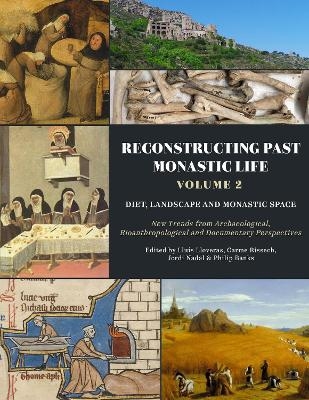
Reconstructing Past Monastic Life: Volume 2: Diet, Landscape and Monastic Space
Casemate Publishers (Verlag)
979-8-88857-175-0 (ISBN)
Monasticism is a form of religious life in which participants renounce worldly activities to dedicate themselves primarily to spiritual matters, living in small communities subject to a set of rules and isolated from the secular world. Christian monasticism, which originated at the end of the 3rd century in Egypt and North Africa, spread to different parts of Europe in the 6th century. However, it was not until the Middle Ages that monastic communities became one of the most powerful institutions in Europe. Monasteries and convents played a very important role not only as centers of spirituality but also as focal points of economic, technological and cultural activity. This multiplicity of activities carried out alongside their religious, social and political roles make monasteries spaces that can be studied from very different perspectives and that unfailingly provide essential information about our history.
This second of two titles originates from an international conference that took place in Barcelona in January 2024, which sought to examine different aspects related to monastic life in the past and to promote and disseminate the results obtained in the latest studies undertaken within the framework of monastic complexes and their environments. These include contributions and multidisciplinary studies from archaeological, bioanthropological and/or documentary perspectives. Specialists from different disciplines present developments on the topic of monasticism from different fields of study, such as zooarchaeology, bioanthropology, palaeopathology, archaeology, history, documentary disciplines, archives, cultural heritage, etc.
Volume 2 focuses on diet, food practices, water management, and the organization and use of space within monastic complexes and landscapes.
Lluís Lloveras is a researcher in the department of Archaeology and History at the University of Barcelona, from which he obtained a PhD. He is a specialist in zooarchaeology and taphonomy, focusing on the procurement of animal foods, past animal hunting and husbandry economies and examining the role of animals in past societies beyond serving as food, employing, in particular, neotaphonomic research, geometric morphometrics, isotopic analysis, animal palaeopathological and forensic taphonomic analysis. Carme Rissech is a senior lecturer in the Department of Basic Medical Sciences, Universitat Rovira i Virgili, Reus, Spain and holds a PhD from the University Autonomous of Barcelona. She is an expert in the fields of palaeoanthropology and forensic anthropology, employing interdisciplinary approaches combining human bone analysis with documentary sources, histological and biomolecular analysis and medicine. Jordi Nadal is a reader in History and Archaeology at the University of Barcelona, from which he obtained his PhD. He specializes in zooarchaeology and taphonomy, focusing on various aspects of past humananimal relationship. He is also interested in the application of neotaphonomic models to better understand the origin of small prey accumulations in prehistoric archaeological sites. Philip Banks is a retired lecturer in English as a Foreign Language at the University of Barcelona, now an independent researcher in medieval history. He obtained a PhD in archaeology and history from Nottingham University, where he studied urban transformations between the 4th and 13th centuries in Catalonia, especially the city of Barcelona. He has translated archaeological and historical texts from Spanish and Catalan to English and collaborated with museums and archaeological services on projects concerning medieval documents and the archaeological interpretation of historical sources, especially as regards townscapes and the periurban zones of medieval cities.
List of contributors
List of reviewers
Introduction by the editors
Part 1: Monastic diet
1. Birds eaten in monastic houses in England in the Middle Ages (1066-1540): the archaeological evidence
Dale Serjeantson
2. Meat and monastic meals: the case of the friary of Santa Caterina in Barcelona (north-eastern Spain) during the medieval and post-medieval periods
Carme Querol, Jordi Nadal, Josefa Huertas, Lluís Lloveras
3. Revisiting dietary rules: animal bone evidence of food practices at the 12th- to 16th-century Abbey of Notre-Dame sous l’Eurin, Hénin-Beaumont (Nord, France)
Tarek Oueslati, Damien Censier
4. Meat and fish in the nuns’ diet at the Monastery of Santa Maria de Pedralbes (Barcelona, Spain) in the medieval and modern periods
Lluís Lloveras, Josep Cruells, Anna Castellano-Tresserra, Santiago Riera, Jordi Nadal
5. Zooarchaeology studies at Sant Agustí Vell (Barcelona): consumption of food of animal origin in a mendicant order
Jordi Nadal, Ricard Marlasca, Philip Banks, Lluís Lloveras
6. An insight into dietary habits at the Monastery of St Barbara (south-western Serbia) during the early modern period: a zooarchaeological perspective)
Teodora Mladenović, Mladen Mladenović, Irina Kajtez
7. Vinum oleum cera spens et mel. What documents can reveal about the medieval monastic diet
Karen Stöber
Part 2: Monastic landscapes, spaces and buildings
8. The uses of water in a Cistercian nunnery through archaeology: the refectory and the kitchen
Ester Penas González
9. To share or not to share. Churches of Regular Canons in the Western Alps (former Diocese of Geneva) from the 13th century onwards
Sidonie Bochaton
10. Interpretation of the archaeological and architectural space of the monastery of Santa Maria de Pedralbes based on space syntax
Yang Mei, Ji Zhiwei
11. The medieval priory of Sant Genís de Rocafort (Martorell, Barcelona): life, death, power and social hierarchy after ten years of archaeological excavation and material analysis.
Esther Travé Allepuz, Josep Socorregut Domènech, Pablo del Fresno Bernal, Rosario Navarro Sáez, Montserrat Farreny Agràs, Alfred Mauri Martí
12. Irrigation and urbanisation. The role of the convent of Sant Pere de les Puel·les (Barcelona) in the 12th and 13th centuries.
Philip Banks
13. Monasteries on Islands – archaeological research approaches across Europe
Sophie Hüglin
14. Socio-economic characterisation of the monastery of Santa Cecília de Els Altimiris (6th–7th centuries): supply areas and material culture
Marta Sancho Planas, Walter Alegría Tejedor
15. Ecclesiastical marriage in the Apostolic Church of the East: a polemic reflected in the Monastery of Mount Îzlâ. New interpretations
David Hernández Jiménez
16. The monastic landscape in Castile in the early Middle Ages: mirage or miracle?
José Ángel Lecanda
| Erscheinungsdatum | 19.03.2025 |
|---|---|
| Zusatzinfo | 70 b/w photos and line illustrations |
| Sprache | englisch |
| Maße | 216 x 280 mm |
| Themenwelt | Geschichte ► Allgemeine Geschichte ► Altertum / Antike |
| Geschichte ► Allgemeine Geschichte ► Mittelalter | |
| Geisteswissenschaften ► Religion / Theologie ► Weitere Religionen | |
| Technik ► Architektur | |
| ISBN-13 | 979-8-88857-175-0 / 9798888571750 |
| Zustand | Neuware |
| Informationen gemäß Produktsicherheitsverordnung (GPSR) | |
| Haben Sie eine Frage zum Produkt? |
aus dem Bereich