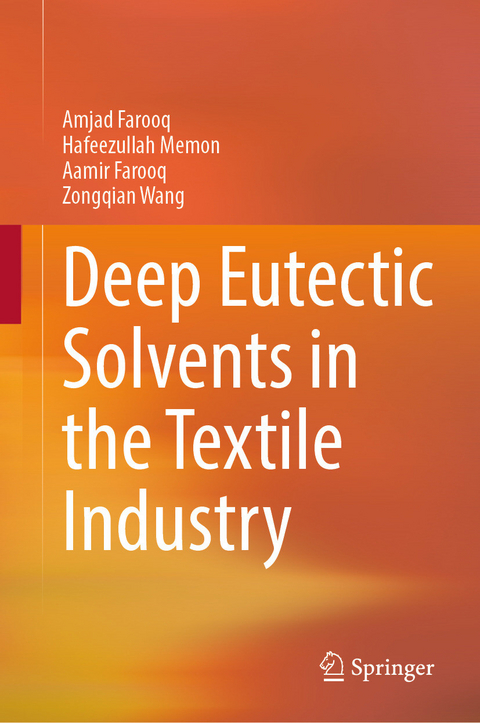
Deep Eutectic Solvents in the Textile Industry (eBook)
88 Seiten
Springer Nature Singapore (Verlag)
978-981-97-6433-4 (ISBN)
This book comprehensively explores the fascinating intersection of deep eutectic solvents (DES) and nanocellulose, focusing specifically on their extraction methods and textile applications. It delves into the revolutionary role of deep eutectic solvents in nanocellulose extraction. Deep eutectic solvents are a class of non-toxic, low-cost, and environmentally friendly solvents formed by combining hydrogen bond donors and acceptors. They possess unique properties that make them highly suitable for dissolving cellulose and facilitating nanocellulose extraction with enhanced efficiency and sustainability. The book begins by providing a thorough overview of nanocellulose, its types, properties, and potential applications in the textile industry. It then delves into the fundamentals of deep eutectic solvents, their composition, properties, and synthesis methods. The subsequent chapters focus on the extraction techniques and strategies employed to obtain nanocellulose using deep eutectic solvents, highlighting the advantages and challenges associated with each method. It also discusses the potential modifications and functionalizations of nanocellulose to enhance its compatibility with textile applications, such as surface grafting, blending, and composite formation. The last part of the book shifts its focus to the applications of deep eutectic solvents in the textile industries. It explores the textile materials fibers, yarns, fabrics, and modification and dyeing and highlights the resulting improvements in mechanical strength, moisture management, thermal insulation, and UV protection.
This book comprehensively explores the fascinating intersection of deep eutectic solvents (DES) and nanocellulose, focusing specifically on their extraction methods and textile applications. It delves into the revolutionary role of deep eutectic solvents in nanocellulose extraction. Deep eutectic solvents are a class of non-toxic, low-cost, and environmentally friendly solvents formed by combining hydrogen bond donors and acceptors. They possess unique properties that make them highly suitable for dissolving cellulose and facilitating nanocellulose extraction with enhanced efficiency and sustainability. The book begins by providing a thorough overview of nanocellulose, its types, properties, and potential applications in the textile industry. It then delves into the fundamentals of deep eutectic solvents, their composition, properties, and synthesis methods. The subsequent chapters focus on the extraction techniques and strategies employed to obtain nanocellulose using deep eutectic solvents, highlighting the advantages and challenges associated with each method. It also discusses the potential modifications and functionalizations of nanocellulose to enhance its compatibility with textile applications, such as surface grafting, blending, and composite formation. The last part of the book shifts its focus to the applications of deep eutectic solvents in the textile industries. It explores the textile materials fibers, yarns, fabrics, and modification and dyeing and highlights the resulting improvements in mechanical strength, moisture management, thermal insulation, and UV protection.
| Erscheint lt. Verlag | 23.8.2024 |
|---|---|
| Zusatzinfo | XIV, 88 p. 26 illus., 25 illus. in color. |
| Sprache | englisch |
| Themenwelt | Naturwissenschaften ► Biologie ► Ökologie / Naturschutz |
| Naturwissenschaften ► Chemie ► Physikalische Chemie | |
| Technik ► Maschinenbau | |
| Schlagworte | Cellulose Nanocrystals • cellulose nanofibrils • Deep Eutectic Solvents • extraction • Nanocellulose • Textile |
| ISBN-10 | 981-97-6433-5 / 9819764335 |
| ISBN-13 | 978-981-97-6433-4 / 9789819764334 |
| Informationen gemäß Produktsicherheitsverordnung (GPSR) | |
| Haben Sie eine Frage zum Produkt? |
 PDF (Wasserzeichen)
DRM: Digitales Wasserzeichen
Dieses eBook enthält ein digitales Wasserzeichen und ist damit für Sie personalisiert. Bei einer missbräuchlichen Weitergabe des eBooks an Dritte ist eine Rückverfolgung an die Quelle möglich.
Dateiformat: PDF (Portable Document Format)
Mit einem festen Seitenlayout eignet sich die PDF besonders für Fachbücher mit Spalten, Tabellen und Abbildungen. Eine PDF kann auf fast allen Geräten angezeigt werden, ist aber für kleine Displays (Smartphone, eReader) nur eingeschränkt geeignet.
Systemvoraussetzungen:
PC/Mac: Mit einem PC oder Mac können Sie dieses eBook lesen. Sie benötigen dafür einen PDF-Viewer - z.B. den Adobe Reader oder Adobe Digital Editions.
eReader: Dieses eBook kann mit (fast) allen eBook-Readern gelesen werden. Mit dem amazon-Kindle ist es aber nicht kompatibel.
Smartphone/Tablet: Egal ob Apple oder Android, dieses eBook können Sie lesen. Sie benötigen dafür einen PDF-Viewer - z.B. die kostenlose Adobe Digital Editions-App.
Buying eBooks from abroad
For tax law reasons we can sell eBooks just within Germany and Switzerland. Regrettably we cannot fulfill eBook-orders from other countries.
aus dem Bereich