


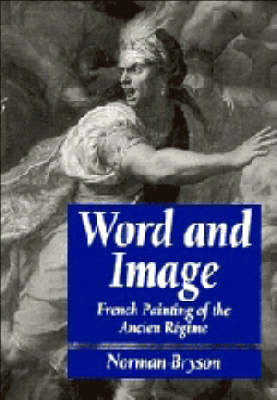
Word and Image
French Painting of the Ancien Régime
Seiten
1982
Cambridge University Press (Verlag)
978-0-521-23776-5 (ISBN)
Cambridge University Press (Verlag)
978-0-521-23776-5 (ISBN)
- Titel erscheint in neuer Auflage
- Artikel merken
In this classic 1982 work, Norman Bryson examines the evolution of narrative styles: the kinds of stories paintings tell, the ways they communicate their information, the different techniques of presenting the body as an instrument for incorporating textual messages.
This 1982 book, now recognised as a classic, has done perhaps more than any other single work to change the face of art criticism in the twentieth century. Whereas previous books on French painting looked only at the history of painting as an evolution of artistic styles (baroque, rococo, neo-classical, and so on), Norman Bryson examines the evolution of narrative styles: the kinds of stories paintings tell, the ways they communicate their information, the different techniques of presenting the body as an instrument for incorporating textual messages. The procedure is applied to a number of painters: LeBrun, Watteau, Greuze, David and others, and the author demonstrates that the relation of formal and 'literary' elements was regarded by painters and critics in the eighteenth century as the primary issue to be confronted in the production of a painting.
This 1982 book, now recognised as a classic, has done perhaps more than any other single work to change the face of art criticism in the twentieth century. Whereas previous books on French painting looked only at the history of painting as an evolution of artistic styles (baroque, rococo, neo-classical, and so on), Norman Bryson examines the evolution of narrative styles: the kinds of stories paintings tell, the ways they communicate their information, the different techniques of presenting the body as an instrument for incorporating textual messages. The procedure is applied to a number of painters: LeBrun, Watteau, Greuze, David and others, and the author demonstrates that the relation of formal and 'literary' elements was regarded by painters and critics in the eighteenth century as the primary issue to be confronted in the production of a painting.
List of illustrations; Preface; Acknowledgements; 1. Discourse, figure; 2. The legible body: LeBrun; 3. Watteau and reverie; 4. Transformations in rococo space; 5. Greuze and the pursuit of happiness; 6. Diderot and the word; 7. Diderot and the image; 8. 1785; Conclusion: style or sign?; Notes; List of societies affiliated to CINOA; Select bibliography; Index.
| Erscheint lt. Verlag | 7.1.1982 |
|---|---|
| Verlagsort | Cambridge |
| Sprache | englisch |
| Maße | 174 x 247 mm |
| Gewicht | 975 g |
| Themenwelt | Technik ► Architektur |
| ISBN-10 | 0-521-23776-9 / 0521237769 |
| ISBN-13 | 978-0-521-23776-5 / 9780521237765 |
| Zustand | Neuware |
| Informationen gemäß Produktsicherheitsverordnung (GPSR) | |
| Haben Sie eine Frage zum Produkt? |
Mehr entdecken
aus dem Bereich

aus dem Bereich
Grundlagen, Normen, Vorschriften
Buch | Hardcover (2024)
Springer Vieweg (Verlag)
CHF 219,95
Tragkonstruktion und Schichtaufbau
Buch | Hardcover (2024)
Birkhäuser (Verlag)
CHF 119,95
Arbeitsschritte - Fallbeispiele - Detailzeichnungen - Dokumente - …
Buch | Hardcover (2024)
DIN Media (Verlag)
CHF 92,40


