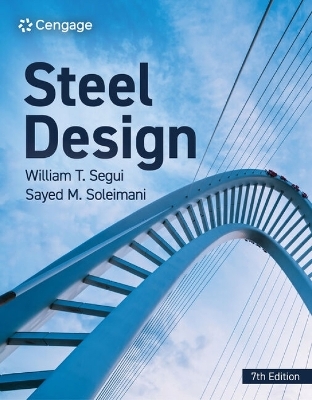
Steel Design
CL Engineering (Verlag)
979-8-214-01222-3 (ISBN)
William T. Segui was Professor Emeritus of Civil Engineering at The University of Memphis, where he served as a member of the faculty from 1968. He held a B.S.C.E, M.S. and Ph.D. from the University of South Carolina. After obtaining his B.S.C.E., he served as a commissioned officer in the U.S. Air Force. He then joined Wilbur Smith Associates, where he was a highway bridge designer. During graduate school, he received an NSF Graduate Traineeship. After joining the Department of Civil Engineering at The University of Memphis, he received two NASA/ASEE Summer Faculty Fellowships at the Marshall Space Flight Center in Huntsville, Alabama. Dr. Segui worked several summers for various consulting firms and for the U.S. Army Corps of Engineers. He received the University of Memphis Distinguished Teaching Award in 2000. Dr. Segui was an emeritus member of the American Institute of Steel Construction and a member of the Committee on Manuals. He received the 2011 AISC Special Achievement Award for his contributions to steel design education. He was a Life Member of the American Society of Civil Engineers and a member of the Tennessee Structural Engineers Association. Dr. Segui was also a licensed professional engineer in Tennessee. Sayed Mohamad Soleimani currently serves as Professor of Engineering Practice within the Lyles School of Civil and Construction Engineering at Purdue University. His academic journey includes earning a B.S.C. in Civil Engineering from Sharif University of Technology in Tehran, Iran, followed by achieving both an M.A.Sc. and a Ph.D. from the University of British Columbia in Vancouver, Canada. Before assuming his position at Purdue University in 2024, Professor Soleimani made notable contributions in academic and industrial settings. He was a Teaching Professor at Penn State University for two years and held the position of Associate Professor and Department Head at the Australian University in Kuwait for nine years. Professor Soleimani boasts over 15 years of rich industrial experience, specializing in bridge engineering, concrete and steel design and construction and project management. His professional credentials include licensure as a professional engineer in California, British Columbia, Ontario and Australia. He has also been honored as a Fellow of the Institution of Engineers Australia.
1. INTRODUCTION.
Structural Design. Loads. Building Codes. Design Specifications. Structural Steel. Standard Cross-Sectional Shapes. Problems.
2. CONCEPTS IN STRUCTURAL STEEL DESIGN.
Design Philosophies. American Institute of Steel Construction Specification. Load Factors, Resistance Factors, and Load Combinations for LRFD. Safety Factors and Load Combinations for ASD. Probabilistic Basis of Load and Resistance Factors. Steel Construction Manual. Design Computations and Precision. Problems.
3. TENSION MEMBERS.
Introduction. Tensile Strength. Effective Area. Staggered Fasteners. Block Shear. Design of Tension Members. Threaded Rods and Cables. Tensions Members in Roof Trusses. Pin-Connected Members. Problems.
4. COMPRESSION MEMBERS.
Introduction. Column Theory. AISC Requirements. Local Stability. Tables for Compression Members. Design. More on Effective Length. Torsional and Flexural-Torsional Buckling. Built-Up Members. Problems.
5. BEAMS.
Introduction. Bending Stress and the Plastic Moment. Stability. Classification of Shapes. Bending Strength of Compact Shapes. Bending Strength of Noncompact Shapes. Summary of Moment Strength. Shear Strength. Deflection. Design. Floor and Roof Framing Systems. Holes in Beams. Open-Web Steel Joists. Beam Bearing Plates and Column Base Plates. Biaxial Bending. Bending Strength of Various Shapes. Problems.
6. BEAM-COLUMNS.
Definition. Interaction Formulas. Methods of Analysis for Required Strength. The Moment Amplification Method. Braced Versus Unbraced Frames. Members in Braced Frames. Members in Unbraced Frames. Design of Beam-Columns. Trusses with Top-Chord Loads Between Joints. Problems.
7. SIMPLE CONNECTIONS.
Introduction. Bolted Shear Connections: Failure Modes. Bearing Strength, Spacing, and Edge-Distance Requirements. Shear Strength. Installation of High-Strength Bolts. Slip-Critical and Bearing-Type Connections. Design Examples. High-Strength Bolts in Tension. Combined Shear and Tension in Fasteners. Welded Connections. Fillet Welds. Problems.
8. ECCENTRIC CONNECTIONS.
Examples of Eccentric Connections. Eccentric Bolted Connections: Shear Only. Eccentric Bolted Connections: Shear Plus Tension. Eccentric Welded Connections: Shear Only. Eccentric Welded Connections: Shear Plus Tension. Moment-Resisting Connections. Column Stiffeners and Other Reinforcement. End-Plate Connections. Concluding Remarks. Problems.
9. COMPOSITE CONSTRUCTION.
Introduction. Shored Versus Unshored Construction. Effective Flange Width. Steel Headed Stud Anchors. Design. Deflections. Composite Beams with Formed Steel Deck. Tables for Composite Beam Analysis and Design. Continuous Beams. Composite Columns. Problems.
10. PLATE GIRDERS.
Introduction. General Considerations. AISE Requirements for Proportions of Plate Girders. Flexural Strength. Shear Strength. Bearing Stiffeners. Design. Problems.
Appendix: Plastic Analysis and Design.
Introduction. AISC Requirements. Analysis. Design.
References.
Answers to Selected Problems.
Index.
| Erscheinungsdatum | 26.03.2025 |
|---|---|
| Sprache | englisch |
| Maße | 195 x 35 mm |
| Gewicht | 1474 g |
| Themenwelt | Technik ► Bauwesen |
| Technik ► Maschinenbau | |
| ISBN-13 | 979-8-214-01222-3 / 9798214012223 |
| Zustand | Neuware |
| Informationen gemäß Produktsicherheitsverordnung (GPSR) | |
| Haben Sie eine Frage zum Produkt? |
aus dem Bereich