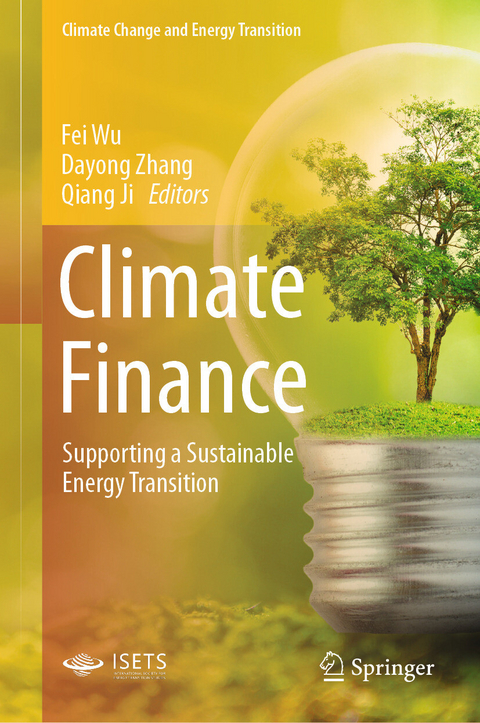
Climate Finance (eBook)
461 Seiten
Springer Nature Singapore (Verlag)
978-981-97-3308-8 (ISBN)
This book focuses on the frontier issues in climate finance and aims to develop a general framework to understand the financial pathways towards a successful energy transition. It builds upon the general descriptions of the current status and future challenges towards carbon neutral targets, and then bring forward a combination of theoretical and empirical analysis on the critical issues related to climate finance.
Estimated by the International Energy Agency (IEA), trillions dollars of investment in energy sector are needed to achieve net-zero emission scenario. It provides a huge opportunity for our economies, meanwhile creates considerable challenges to the existing system. Both financing and investment in such an unprecedented scale cannot possibly be satisfied by the current financial architecture, which creates demands for restructuring in the financial sector, developing innovative financial instruments, building mechanisms to attract private investment, and establishing human resources to facilitate climate financing and investment. This area is essentially interdisciplinary, which requires a fundamental reconsideration of standard approaches.
Aiming to satisfy the broad interests from both academia and policymakers, the contents of this book range from general discussions on critical issues to advanced statistical analyses on key topics. Authors hope to bring forward a general picture about climate finance and facilitate the demands for both academic research and policymaking. It should also provide a good guidance for graduate students interested in this subject. The main contents of this book are based on solid research outcomes but with clear policy relevance. The book combines finance theory and practices in both financial markets and energy sectors to reflect the complex nature of financing for energy transition. While the materials can provide useful knowledge to policymakers, the book can also inspire new research ideas in the relevant area.
This book focuses on the frontier issues in climate finance and aims to develop a general framework to understand the financial pathways towards a successful energy transition. It builds upon the general descriptions of the current status and future challenges towards carbon neutral targets, and then bring forward a combination of theoretical and empirical analysis on the critical issues related to climate finance. Estimated by the International Energy Agency (IEA), trillions dollars of investment in energy sector are needed to achieve net-zero emission scenario. It provides a huge opportunity for our economies, meanwhile creates considerable challenges to the existing system. Both financing and investment in such an unprecedented scale cannot possibly be satisfied by the current financial architecture, which creates demands for restructuring in the financial sector, developing innovative financial instruments, building mechanisms to attract private investment, and establishing human resources to facilitate climate financing and investment. This area is essentially interdisciplinary, which requires a fundamental reconsideration of standard approaches. Aiming to satisfy the broad interests from both academia and policymakers, the contents of this book range from general discussions on critical issues to advanced statistical analyses on key topics. Authors hope to bring forward a general picture about climate finance and facilitate the demands for both academic research and policymaking. It should also provide a good guidance for graduate students interested in this subject. The main contents of this book are based on solid research outcomes but with clear policy relevance. The book combines finance theory and practices in both financial markets and energy sectors to reflect the complex nature of financing for energy transition. While the materials can provide useful knowledge to policymakers, the book can also inspire new research ideas in the relevant area.
| Erscheint lt. Verlag | 27.7.2024 |
|---|---|
| Reihe/Serie | Climate Change and Energy Transition |
| Zusatzinfo | V, 461 p. 54 illus., 50 illus. in color. |
| Sprache | englisch |
| Themenwelt | Sozialwissenschaften ► Politik / Verwaltung ► Staat / Verwaltung |
| Technik | |
| Wirtschaft ► Betriebswirtschaft / Management ► Finanzierung | |
| Wirtschaft ► Volkswirtschaftslehre ► Finanzwissenschaft | |
| Wirtschaft ► Volkswirtschaftslehre ► Makroökonomie | |
| Wirtschaft ► Volkswirtschaftslehre ► Wirtschaftspolitik | |
| Schlagworte | Carbon Finance • climate change • Climate finance • climate investment • Climate Policy • Energy Transition • Green finance • green investment • sustainable development • Sustainable Finance |
| ISBN-10 | 981-97-3308-1 / 9819733081 |
| ISBN-13 | 978-981-97-3308-8 / 9789819733088 |
| Informationen gemäß Produktsicherheitsverordnung (GPSR) | |
| Haben Sie eine Frage zum Produkt? |
 PDF (Wasserzeichen)
DRM: Digitales Wasserzeichen
Dieses eBook enthält ein digitales Wasserzeichen und ist damit für Sie personalisiert. Bei einer missbräuchlichen Weitergabe des eBooks an Dritte ist eine Rückverfolgung an die Quelle möglich.
Dateiformat: PDF (Portable Document Format)
Mit einem festen Seitenlayout eignet sich die PDF besonders für Fachbücher mit Spalten, Tabellen und Abbildungen. Eine PDF kann auf fast allen Geräten angezeigt werden, ist aber für kleine Displays (Smartphone, eReader) nur eingeschränkt geeignet.
Systemvoraussetzungen:
PC/Mac: Mit einem PC oder Mac können Sie dieses eBook lesen. Sie benötigen dafür einen PDF-Viewer - z.B. den Adobe Reader oder Adobe Digital Editions.
eReader: Dieses eBook kann mit (fast) allen eBook-Readern gelesen werden. Mit dem amazon-Kindle ist es aber nicht kompatibel.
Smartphone/Tablet: Egal ob Apple oder Android, dieses eBook können Sie lesen. Sie benötigen dafür einen PDF-Viewer - z.B. die kostenlose Adobe Digital Editions-App.
Buying eBooks from abroad
For tax law reasons we can sell eBooks just within Germany and Switzerland. Regrettably we cannot fulfill eBook-orders from other countries.
aus dem Bereich