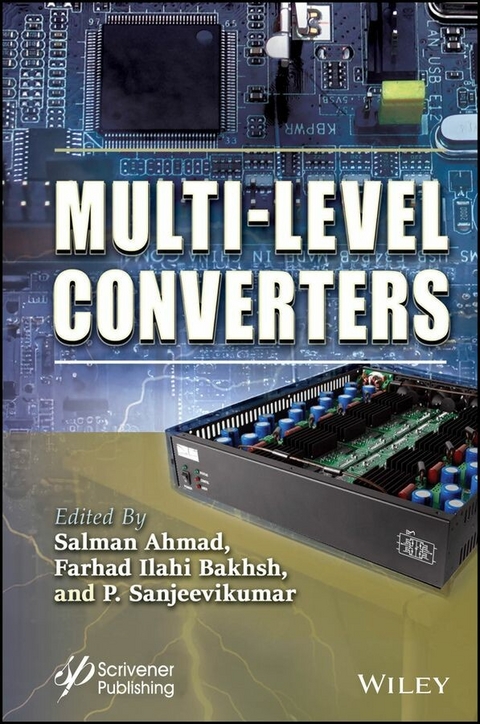
Multilevel Converters (eBook)
400 Seiten
Wiley (Verlag)
978-1-394-16736-4 (ISBN)
Discover the deep insights into the operation, modulation, and control strategies of multilevel converters, alongside their recent applications in variable speed drives, renewable energy generation, and power systems.
Multilevel converters have gained attention in recent years for medium/high voltage and high power industrial and residential applications. The main advantages of multilevel converters over two level converters include less voltage stress on power semiconductors, low dv/dt, low common voltage, reduced electromagnetic interference, and low total harmonics distortion, among others. Better output power quality is ensured by increasing the number of levels in the synthesized output voltage waveform. Several multilevel topologies have been reported in the literature, such as neutral point clamped (NPC), flying capacitor (FC), cascaded H-bridge (CHB), hybrid cascaded H-bridge, asymmetrical cascaded H-bridge, modular multilevel converters (MMC), active neutral point clamped converters (ANPC), and packed U-cell type converters and various reduced device counts and a reduced number of source-based topologies have been proposed in literature.
The multilevel converter, although a proven and enabling technology, still presents numerous challenges in topologies, modulation, and control, as well as in need-based applications. Since multilevel converters offer a wide range of possibilities, research and development in the areas of multilevel converter topologies, modulation, and control in various applications are still growing. To further improve multilevel converter energy efficiency, reliability, power density, and cost, many research groups across the world are working to broaden the application areas of multilevel converters and make them more attractive and competitive compared to classic topologies.
Multilevel Converters intends to provide deep insight about multilevel converter operation, modulation, and control strategies and various recent applications of multilevel converters such as in variable speed drives, renewable energy generation, and power systems.
Salman Ahmad, PhD is an assistant professor in the Department of Electrical Engineering, Islamic University of Science and Technology, India. He worked as a Lecturer with Debre Berhan University and Arba Minch University in Ethiopia from 2012 to 2015 and is an associate member of the Institutions of Engineers and the Institute of Electrical and Electronics Engineers. Additionally, he has published more than 20 technical papers in different journals and conference proceedings, contributed four chapters in edited books, and received four research grants from various government agencies.
Farhad Ilahi Bakhsh, PhD is an assistant professor in the Department of Electrical Engineering, National Institute of Technology Srinagar, Jammu and Kashmir, India. He has developed five new systems, four of which have been officially published by patent offices, and has more than 50 published papers in reputed national and international journals and conferences. During his PhD, he developed a new method for grid integration for wind energy generation systems which has been recognized worldwide.
P. Sanjeevikumar, PhD has been a faculty member in the Department of Energy Technology, Aalborg University, Esbjerg, Denmark since 2018. He has authored over 300 scientific papers. Additionally, he is a fellow of the Institution of Engineers, India, the Institution of Electronics and Telecommunication Engineers, India, and the Institution of Engineering and Technology, U.K.
Discover the deep insights into the operation, modulation, and control strategies of multilevel converters, alongside their recent applications in variable speed drives, renewable energy generation, and power systems. Multilevel converters have gained attention in recent years for medium/high voltage and high power industrial and residential applications. The main advantages of multilevel converters over two level converters include less voltage stress on power semiconductors, low dv/dt, low common voltage, reduced electromagnetic interference, and low total harmonics distortion, among others. Better output power quality is ensured by increasing the number of levels in the synthesized output voltage waveform. Several multilevel topologies have been reported in the literature, such as neutral point clamped (NPC), flying capacitor (FC), cascaded H-bridge (CHB), hybrid cascaded H-bridge, asymmetrical cascaded H-bridge, modular multilevel converters (MMC), active neutral point clamped converters (ANPC), and packed U-cell type converters and various reduced device counts and a reduced number of source-based topologies have been proposed in literature. The multilevel converter, although a proven and enabling technology, still presents numerous challenges in topologies, modulation, and control, as well as in need-based applications. Since multilevel converters offer a wide range of possibilities, research and development in the areas of multilevel converter topologies, modulation, and control in various applications are still growing. To further improve multilevel converter energy efficiency, reliability, power density, and cost, many research groups across the world are working to broaden the application areas of multilevel converters and make them more attractive and competitive compared to classic topologies. Multilevel Converters intends to provide deep insight about multilevel converter operation, modulation, and control strategies and various recent applications of multilevel converters such as in variable speed drives, renewable energy generation, and power systems.
| Erscheint lt. Verlag | 21.6.2024 |
|---|---|
| Sprache | englisch |
| Themenwelt | Technik ► Maschinenbau |
| ISBN-10 | 1-394-16736-9 / 1394167369 |
| ISBN-13 | 978-1-394-16736-4 / 9781394167364 |
| Informationen gemäß Produktsicherheitsverordnung (GPSR) | |
| Haben Sie eine Frage zum Produkt? |
 PDF (Adobe DRM)
Größe: 98,2 MB
Kopierschutz: Adobe-DRM
Adobe-DRM ist ein Kopierschutz, der das eBook vor Mißbrauch schützen soll. Dabei wird das eBook bereits beim Download auf Ihre persönliche Adobe-ID autorisiert. Lesen können Sie das eBook dann nur auf den Geräten, welche ebenfalls auf Ihre Adobe-ID registriert sind.
Details zum Adobe-DRM
Dateiformat: PDF (Portable Document Format)
Mit einem festen Seitenlayout eignet sich die PDF besonders für Fachbücher mit Spalten, Tabellen und Abbildungen. Eine PDF kann auf fast allen Geräten angezeigt werden, ist aber für kleine Displays (Smartphone, eReader) nur eingeschränkt geeignet.
Systemvoraussetzungen:
PC/Mac: Mit einem PC oder Mac können Sie dieses eBook lesen. Sie benötigen eine
eReader: Dieses eBook kann mit (fast) allen eBook-Readern gelesen werden. Mit dem amazon-Kindle ist es aber nicht kompatibel.
Smartphone/Tablet: Egal ob Apple oder Android, dieses eBook können Sie lesen. Sie benötigen eine
Geräteliste und zusätzliche Hinweise
Buying eBooks from abroad
For tax law reasons we can sell eBooks just within Germany and Switzerland. Regrettably we cannot fulfill eBook-orders from other countries.
aus dem Bereich