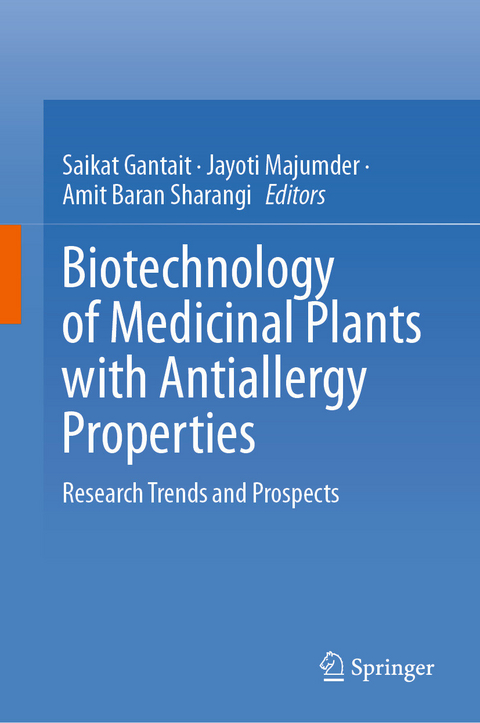
Biotechnology of Medicinal Plants with Antiallergy Properties (eBook)
672 Seiten
Springer Nature Singapore (Verlag)
978-981-97-1467-4 (ISBN)
This book comprehensively covers critically investigated information on medicinal plants prioritized for their anti-allergy properties. It offers insights into strategies related to the distribution, mechanism of action, and assessment of antiallergic medicinal plants, and also delves into crucial aspects of modern biotechnological tools, addressing their implementation challenges, presenting innovative approaches through case studies, and exploring opportunities for nanotechnologies. These elaborated discussions aim to raise awareness and bridge the gap between human health and the biodiversity of antiallergic medicinal plants. As the book navigates the uncertainties of plant-based medicines in the post-COVID-19 era, it provides real-world applications showcasing the specific utility of medicinal plants through advanced biotechnological insights. This book covers several medicinal plants associated with antiallergy, exploring their modes of action, available secondary metabolites,and estimation methods. It also emphasizes all modern biotechnological interventions aimed at propagating, multiplying, and conserving this unique treasure trove of medicinal plants.
The World Health Organization estimated that 80% of the populations of developing countries rely on traditional medicines, mostly plant drugs, for their primary health care needs. Increasing demand in both developing and developed countries resulted in the expanding trade of medicinal plants and has serious implications for the survival of several plant species, with many under threat of becoming extinct. This book describes various approaches to conserving these genetic resources. It discusses the whole spectrum of biotechnological tools from micro-propagation for large-scale multiplication and cell-culture techniques to the biosynthesis and enhancement of pharmaceutical compounds in plants. It also discusses the genetic transformation as well as short- to long-term conservation of plant genetic resources via synthetic seed production and cryopreservation, respectively. This reference book is useful for researchers in the pharmaceutical and biotechnological industries, medicinal chemists, biochemists, botanists, molecular biologists, academicians, students as well as allergic patients, traditional medicine practitioners, scientists in medicinal and aromatic plants, and other traditional medical practitioners.
This book comprehensively covers critically investigated information on medicinal plants prioritized for their anti-allergy properties. It offers insights into strategies related to the distribution, mechanism of action, and assessment of antiallergic medicinal plants, and also delves into crucial aspects of modern biotechnological tools, addressing their implementation challenges, presenting innovative approaches through case studies, and exploring opportunities for nanotechnologies. These elaborated discussions aim to raise awareness and bridge the gap between human health and the biodiversity of antiallergic medicinal plants. As the book navigates the uncertainties of plant-based medicines in the post-COVID-19 era, it provides real-world applications showcasing the specific utility of medicinal plants through advanced biotechnological insights. This book covers several medicinal plants associated with antiallergy, exploring their modes of action, available secondary metabolites,and estimation methods. It also emphasizes all modern biotechnological interventions aimed at propagating, multiplying, and conserving this unique treasure trove of medicinal plants.The World Health Organization estimated that 80% of the populations of developing countries rely on traditional medicines, mostly plant drugs, for their primary health care needs. Increasing demand in both developing and developed countries resulted in the expanding trade of medicinal plants and has serious implications for the survival of several plant species, with many under threat of becoming extinct. This book describes various approaches to conserving these genetic resources. It discusses the whole spectrum of biotechnological tools from micro-propagation for large-scale multiplication and cell-culture techniques to the biosynthesis and enhancement of pharmaceutical compounds in plants. It also discusses the genetic transformation as well as short- to long-term conservation of plant genetic resources via synthetic seed production and cryopreservation, respectively. This reference book is useful for researchers in the pharmaceutical and biotechnological industries, medicinal chemists, biochemists, botanists, molecular biologists, academicians, students as well as allergic patients, traditional medicine practitioners, scientists in medicinal and aromatic plants, and other traditional medical practitioners.
| Erscheint lt. Verlag | 30.5.2024 |
|---|---|
| Zusatzinfo | XXII, 672 p. 99 illus., 86 illus. in color. |
| Sprache | englisch |
| Themenwelt | Medizin / Pharmazie ► Medizinische Fachgebiete ► Pharmakologie / Pharmakotherapie |
| Medizin / Pharmazie ► Studium ► 1. Studienabschnitt (Vorklinik) | |
| Naturwissenschaften ► Biologie ► Biochemie | |
| Naturwissenschaften ► Biologie ► Botanik | |
| Naturwissenschaften ► Biologie ► Genetik / Molekularbiologie | |
| Naturwissenschaften ► Chemie ► Organische Chemie | |
| Technik ► Umwelttechnik / Biotechnologie | |
| Schlagworte | Biopharmaceutical • Ethnopharmacology • gene transfer • Germplasm conservation • plant cell • Tissue culture |
| ISBN-10 | 981-97-1467-2 / 9819714672 |
| ISBN-13 | 978-981-97-1467-4 / 9789819714674 |
| Informationen gemäß Produktsicherheitsverordnung (GPSR) | |
| Haben Sie eine Frage zum Produkt? |
 PDF (Wasserzeichen)
DRM: Digitales Wasserzeichen
Dieses eBook enthält ein digitales Wasserzeichen und ist damit für Sie personalisiert. Bei einer missbräuchlichen Weitergabe des eBooks an Dritte ist eine Rückverfolgung an die Quelle möglich.
Dateiformat: PDF (Portable Document Format)
Mit einem festen Seitenlayout eignet sich die PDF besonders für Fachbücher mit Spalten, Tabellen und Abbildungen. Eine PDF kann auf fast allen Geräten angezeigt werden, ist aber für kleine Displays (Smartphone, eReader) nur eingeschränkt geeignet.
Systemvoraussetzungen:
PC/Mac: Mit einem PC oder Mac können Sie dieses eBook lesen. Sie benötigen dafür einen PDF-Viewer - z.B. den Adobe Reader oder Adobe Digital Editions.
eReader: Dieses eBook kann mit (fast) allen eBook-Readern gelesen werden. Mit dem amazon-Kindle ist es aber nicht kompatibel.
Smartphone/Tablet: Egal ob Apple oder Android, dieses eBook können Sie lesen. Sie benötigen dafür einen PDF-Viewer - z.B. die kostenlose Adobe Digital Editions-App.
Buying eBooks from abroad
For tax law reasons we can sell eBooks just within Germany and Switzerland. Regrettably we cannot fulfill eBook-orders from other countries.
aus dem Bereich