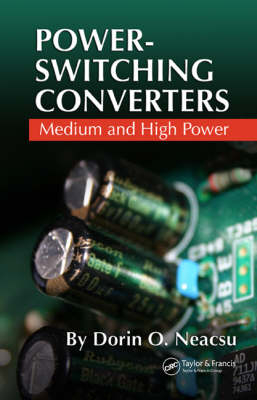
Power-Switching Converters
Marcel Dekker Inc (Verlag)
978-0-8247-2625-6 (ISBN)
- Titel erscheint in neuer Auflage
- Artikel merken
Power converters are at the heart of modern power electronics. From automotive power systems to propulsion for large ships, their use permeates through industrial, commercial, military, and aerospace applications of various scales. Having reached a point of saturation where we are unlikely to see many new and revolutionary technologies, industry now seeks to optimize and standardize the performance of these devices. Power-Switching Converters: Medium and High Power examines the characteristics and operating principles of these systems in terms of how to increase their efficiency and produce them at lower cost.
This book begins with an introduction to the field, placing the technology in its business context to highlight the current trends and issues facing the modern power engineer. The remainder of the book provides a detailed examination of three-phase power switching converters, including the various problems and solutions involved in different applications. It discusses high-power semiconductor devices, pulse-width modulation (PWM) principles and algorithms for various implementations, closed-loop current control, component-minimized topologies, power grid interface, parallel and interleaved power converters, and practical aspects such as protection and thermal management.
Filling the gap between textbooks and technical papers, Power-Switching Converters: Medium and High Power offers practical solutions to current industrial demands with a focus on the particular business needs of performance quality and cost efficiency. It also serves as an excellent textbook for graduate study.
INTRODUCTION TO MEDIUM- AND HIGH-POWER SWITCHING CONVERTERS
Market for Medium- and High-Power Converters
Adjustable Speed Drives
Grid Interfaces or Distributed Generation
Multi-Converter Power Electronic Systems
Conclusion
References
HIGH-POWER SEMICONDUCTOR DEVICES
A View of the Power Semiconductor Market
Power MOSFETs
Insular Gate Bipolar Transistors
Gate Turn-Off Thyristors
Advanced Power Devices
Problems
References
BASIC THREE-PHASE INVERTERS
High-Power Devices Operated as Simple Switches
Inverter Leg with Inductive Load Operation
What Is a PWM Algorithm?
Basic Three-Phase Voltage Source Inverter: Operation and Functions
Performance Indices: Definitions and Terms Used in Different Countries
Direct Calculation of Harmonic Spectrum from Inverter Waveforms
Preprogrammed PWM for Three-Phase Inverters
Modeling a Three-Phase Inverter with Switching Functions
Braking Leg in Power Converters for Motor Drives
DC Bus Capacitor within an AC/DC/AC Power Converter
Conclusion
Problems
References
CARRIER-BASED PULSE WIDTH MODULATION AND OPERATION LIMITS
Carrier-Based Pulse Width Modulation Algorithms: Historical Importance
Carrier-Based PWM Algorithms with Improved Reference
PWM Used within Volt/Hertz Drives: Choice of Number of Pulses Based on the Desired Current Harmonic Factor
Implementation of Harmonic Reduction with Carrier PWM
Limits of Operation: Minimum Pulse-Width
Limits of Operation
Conclusion
Problems
References
VECTORIAL PULSE WIDTH MODULATION FOR BASIC THREE-PHASE INVERTERS
Review of Space Vector Theory
Vectorial Analysis of the Three-Phase Inverter
SVM Theory: Derivation of the Time Intervals Associated to the Active and Zero States by Averaging
Adaptive SVM: DC Ripple Compensation
Link to Vector Control: Different Forms and Expressions of Time Interval Equations in the (d,q) Coordinate System
Definition of the Switching Reference Function
Definition of the Switching Sequence
Comparison between Different Vectorial PWM
Overmodulation for SVM
Volt-per-Hertz Control of PWM Inverters
Conclusion
Problems
References
PRACTICAL ASPECTS IN BUILDING THREE-PHASE POWER CONVERTERS
Selection of the Power Devices in a Three-Phase Inverter
Protection
System Protection Management
Reduction of Common-Mode EMI through Inverter Techniques
Typical Building Structures of Conventional Inverters Depending on Power Level
Thermal Management
Conclusion
Problems
References
IMPLEMENTATION OF PULSE WIDTH MODULATION ALGORITHMS
Analog Pulse Width Modulation Controllers
Mixed-Mode Motor Controller ICs
Digital Structures with Counters: FPGA Implementation
Markets for General-Purpose and Dedicated Digital Processors
Software Implementation in Low-Cost Microcontrollers
Microcontrollers with Power Converter Interfaces
Motor Control Co-Processors
Using the Event Manager within Texas Instruments' DSPs
Conclusion
References
PRACTICAL ASPECTS OF IMPLEMENTING CLOSED-LOOP CURRENT CONTROL
Role and Schematics
Current Measurement: Synchronization with Pulse Width Modulation
Current Sampling Rate: Oversampling
Current Control in (a,b,c) Coordinates
Current Transforms (3->2): Software Calculation of Transforms
Current Control in (d,q) Models: PI Calibration
Antiwind-Up Protection: Output Limitation and Range Definition
Conclusion
References
RESONANT THREE-PHASE CONVERTERS
Reducing Switching Losses through Resonance vs. Advanced Pulse-Width Multiple Devices
Do We Still Get Advantages from Resonant High-Power Converters?
Zero Voltage Transition of IGBT Devices
Zero Current Transition of IGBT Devices
Possible Topologies of Quasi-Resonant Converters
Special PWM for Three-Phase Resonant Converters
Problems
References
COMPONENT-MINIMIZED THREE-PHASE POWER CONVERTERS
Solutions for Reduction of Number of Components
Generalized Vector Transform
Vectorial Analysis of the B4 Inverter
Definition of PWM Algorithms for the B4 Inverter
Influence of DC Voltage Variations and Method for Their Compensation
Two-Leg Converter Used in Feeding a Two-Phase Induction Machine
Conclusion
Problems
References
AC/DC GRID INTERFACE BASED ON THE THREE-PHASE VOLTAGE SOURCE CONVERTER
Particularities, Control Objectives, and Active Power Control
PWM in the Control System
Closed-Loop Current Control Methods
Grid Synchronization
Problems
References
PARALLEL AND INTERLEAVED POWER CONVERTERS
Comparison between Converters Built of High-Power Devices and Solutions Based on Multiple Parallel Lower-Power Devices
Hardware Constraints in Paralleling IGBTs
Gate Control Designs for Equal Current Sharing
Advantages and Disadvantages of Paralleling Inverter Legs in Respect to Using Parallel Devices
Interleaved Operation of Power Converters
Circulating Currents
Selection of the PWM Algorithm
System Controller
Conclusion
Problems
References
INDEX
| Erscheint lt. Verlag | 25.5.2006 |
|---|---|
| Zusatzinfo | 306 equations; 20 Tables, black and white; 289 Illustrations, color |
| Verlagsort | New York |
| Sprache | englisch |
| Maße | 156 x 235 mm |
| Gewicht | 680 g |
| Themenwelt | Technik ► Elektrotechnik / Energietechnik |
| ISBN-10 | 0-8247-2625-1 / 0824726251 |
| ISBN-13 | 978-0-8247-2625-6 / 9780824726256 |
| Zustand | Neuware |
| Informationen gemäß Produktsicherheitsverordnung (GPSR) | |
| Haben Sie eine Frage zum Produkt? |
aus dem Bereich