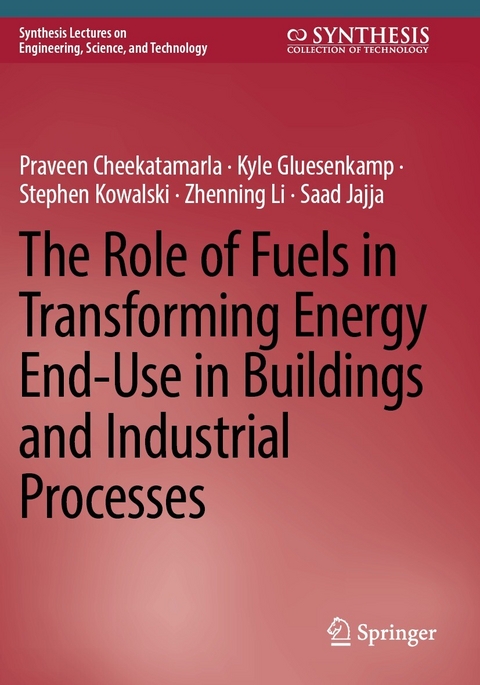
The Role of Fuels in Transforming Energy End-Use in Buildings and Industrial Processes (eBook)
XVIII, 58 Seiten
Springer-Verlag
978-3-031-45365-6 (ISBN)

Energy-efficient technologies are necessary to lower the carbon footprint for a transition towards clean energy in a sustainable manner. This book examines what role fuels have in the transformation of end-use in buildings and industrial processes. Energy-efficient technologies are necessary to lower the carbon footprint for a transition towards clean energy in a sustainable manner. Efficient utilization of primary energy resources, including renewables, to support the current and future energy needs while targeting grid resiliency, energy, and environmental security at an affordable cost is of significant value. The author analyzes heat pumps, fuel-driven thermal providers, and power systems configurations and looks at the sensitivity of the electrical grid's carbon intensity and tariff towards carbon footprint and energy costs compared with fuel-driven technologies. The role of low-carbon, zero-carbon, and carbon-negative fuels, such as power-to-gas (P2G), power-to-liquid (PtL), hydrogen, and biogas, in conjunction with polygeneration technologies, are discussed. This book also examines two different scenarios focused on the sensitivity of the pace of decarbonization of the electrical grid and fuel supply on operational energy-related carbon emissions.
- Compares electricity versus fuel as a primary energy source
- Explores the role of fuels in the decarbonization journey
- Examines the value proposition of currently available energy solutions
| Erscheint lt. Verlag | 22.4.2024 |
|---|---|
| Reihe/Serie | Synthesis Lectures on Engineering, Science, and Technology |
| Zusatzinfo | XVIII, 58 p. 34 illus., 32 illus. in color. |
| Sprache | englisch |
| Themenwelt | Technik ► Architektur |
| Technik ► Elektrotechnik / Energietechnik | |
| Wirtschaft | |
| Schlagworte | carbon footprint reduction • Cogeneration and combined heat and power • Cost of heating • Decarbonization of buildings • Electric grid versus natural gas • Heat pump versus hydrogen • Hybrid Power Systems • Lifecycle carbon footprint • Microgrid versus central grid • Power-to-gas fuels (P2G) • Thermal energy decarbonization |
| ISBN-10 | 3-031-45365-4 / 3031453654 |
| ISBN-13 | 978-3-031-45365-6 / 9783031453656 |
| Informationen gemäß Produktsicherheitsverordnung (GPSR) | |
| Haben Sie eine Frage zum Produkt? |
 PDF (Wasserzeichen)
DRM: Digitales Wasserzeichen
Dieses eBook enthält ein digitales Wasserzeichen und ist damit für Sie personalisiert. Bei einer missbräuchlichen Weitergabe des eBooks an Dritte ist eine Rückverfolgung an die Quelle möglich.
Dateiformat: PDF (Portable Document Format)
Mit einem festen Seitenlayout eignet sich die PDF besonders für Fachbücher mit Spalten, Tabellen und Abbildungen. Eine PDF kann auf fast allen Geräten angezeigt werden, ist aber für kleine Displays (Smartphone, eReader) nur eingeschränkt geeignet.
Systemvoraussetzungen:
PC/Mac: Mit einem PC oder Mac können Sie dieses eBook lesen. Sie benötigen dafür einen PDF-Viewer - z.B. den Adobe Reader oder Adobe Digital Editions.
eReader: Dieses eBook kann mit (fast) allen eBook-Readern gelesen werden. Mit dem amazon-Kindle ist es aber nicht kompatibel.
Smartphone/Tablet: Egal ob Apple oder Android, dieses eBook können Sie lesen. Sie benötigen dafür einen PDF-Viewer - z.B. die kostenlose Adobe Digital Editions-App.
Buying eBooks from abroad
For tax law reasons we can sell eBooks just within Germany and Switzerland. Regrettably we cannot fulfill eBook-orders from other countries.
aus dem Bereich