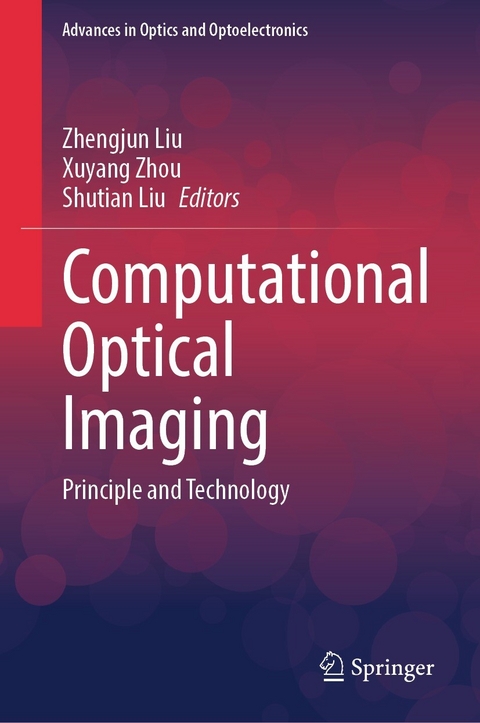
Computational Optical Imaging (eBook)
415 Seiten
Springer Nature Singapore (Verlag)
978-981-97-1455-1 (ISBN)
This book highlights a comprehensive introduction to the principles and calculation methods of computational optical imaging. Integrating optical imaging and computing technology to achieve significant performance improvements, computational optical imaging has become an active research field in optics. It has given rise to the emerging of new concepts such as computational imaging, computational measurement and computational photography. As high-performance image detectors make image measurements discrete and digital, images are mostly recorded in the form of discrete data, almost replacing the continuous medium used for pattern recording. Computational optical imaging technology has become an effective way for people to study microscopic imaging. At present, different imaging systems are composed of continuous optical elements such as lenses and prisms or discrete optical elements such as spatial light modulators or digital micro-mirror devices. The current computing technology has permeated all aspects of imaging systems and gradually promotes the digitization of optical imaging systems. This book summarizes the representative work done in this field and introduces the latest results. Computing technology plays an important bridging role between theories of optics and experimental systems, which inspires more comprehensive and in-depth research. It has the advantages of high repeatability, flexibility, strong computing power and low cost. In this multidisciplinary field, researchers in computer science, optics and information science have joined together to extend its depth and breadth. Targeting cutting-edge issues to be solved in computational optics, this book introduces a variety of methods that involve theoretical innovations and technical breakthroughs in imaging resolution, the field of view, imaging speed, and computing speed. It intends to provide a handy reference and technical support for graduate students, researchers and professionals engaged in the study and practice of computational optical imaging.
This book highlights a comprehensive introduction to the principles and calculation methods of computational optical imaging. Integrating optical imaging and computing technology to achieve significant performance improvements, computational optical imaging has become an active research field in optics. It has given rise to the emerging of new concepts such as computational imaging, computational measurement and computational photography. As high-performance image detectors make image measurements discrete and digital, images are mostly recorded in the form of discrete data, almost replacing the continuous medium used for pattern recording. Computational optical imaging technology has become an effective way for people to study microscopic imaging. At present, different imaging systems are composed of continuous optical elements such as lenses and prisms or discrete optical elements such as spatial light modulators or digital micro-mirror devices. The current computing technology has permeated all aspects of imaging systems and gradually promotes the digitization of optical imaging systems. This book summarizes the representative work done in this field and introduces the latest results. Computing technology plays an important bridging role between theories of optics and experimental systems, which inspires more comprehensive and in-depth research. It has the advantages of high repeatability, flexibility, strong computing power and low cost. In this multidisciplinary field, researchers in computer science, optics and information science have joined together to extend its depth and breadth. Targeting cutting-edge issues to be solved in computational optics, this book introduces a variety of methods that involve theoretical innovations and technical breakthroughs in imaging resolution, the field of view, imaging speed, and computing speed. It intends to provide a handy reference and technical support for graduate students, researchers and professionals engaged in the study and practice of computational optical imaging.
| Erscheint lt. Verlag | 22.4.2024 |
|---|---|
| Reihe/Serie | Advances in Optics and Optoelectronics |
| Zusatzinfo | VIII, 415 p. 210 illus., 169 illus. in color. |
| Sprache | englisch |
| Themenwelt | Mathematik / Informatik ► Informatik |
| Mathematik / Informatik ► Mathematik ► Analysis | |
| Naturwissenschaften ► Physik / Astronomie ► Optik | |
| Technik ► Elektrotechnik / Energietechnik | |
| Technik ► Maschinenbau | |
| Schlagworte | Adaptive Optical Imaging • Coded Aperture Imaging • compressed sensing • Computer Generated Holography • Computerized Tomograph • Fluorescence Imaging • Ghost Imaging • light field camera • Non-line-of-sight Imaging • phase imaging • Polarization Imaging • Stimulated Emission Depletion • Synthetic Aperture Imaging |
| ISBN-10 | 981-97-1455-9 / 9819714559 |
| ISBN-13 | 978-981-97-1455-1 / 9789819714551 |
| Informationen gemäß Produktsicherheitsverordnung (GPSR) | |
| Haben Sie eine Frage zum Produkt? |
 PDF (Wasserzeichen)
DRM: Digitales Wasserzeichen
Dieses eBook enthält ein digitales Wasserzeichen und ist damit für Sie personalisiert. Bei einer missbräuchlichen Weitergabe des eBooks an Dritte ist eine Rückverfolgung an die Quelle möglich.
Dateiformat: PDF (Portable Document Format)
Mit einem festen Seitenlayout eignet sich die PDF besonders für Fachbücher mit Spalten, Tabellen und Abbildungen. Eine PDF kann auf fast allen Geräten angezeigt werden, ist aber für kleine Displays (Smartphone, eReader) nur eingeschränkt geeignet.
Systemvoraussetzungen:
PC/Mac: Mit einem PC oder Mac können Sie dieses eBook lesen. Sie benötigen dafür einen PDF-Viewer - z.B. den Adobe Reader oder Adobe Digital Editions.
eReader: Dieses eBook kann mit (fast) allen eBook-Readern gelesen werden. Mit dem amazon-Kindle ist es aber nicht kompatibel.
Smartphone/Tablet: Egal ob Apple oder Android, dieses eBook können Sie lesen. Sie benötigen dafür einen PDF-Viewer - z.B. die kostenlose Adobe Digital Editions-App.
Buying eBooks from abroad
For tax law reasons we can sell eBooks just within Germany and Switzerland. Regrettably we cannot fulfill eBook-orders from other countries.
aus dem Bereich