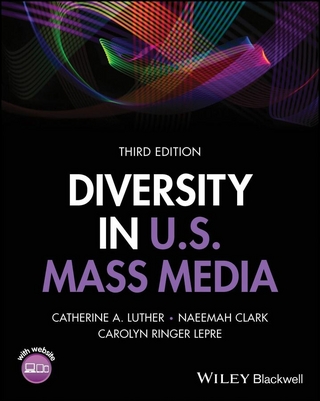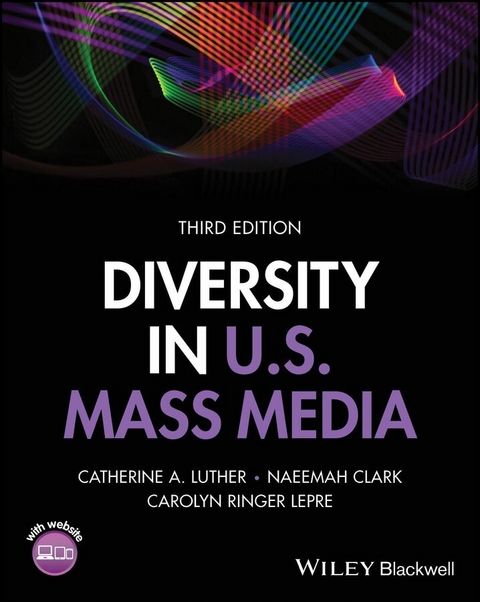
Diversity in U.S. Mass Media (eBook)
1089 Seiten
John Wiley & Sons (Verlag)
978-1-119-84462-4 (ISBN)
Provides students with clear and up-to-date coverage of the various areas associated with representations of diversity within the mass media
Diversity in U.S. Mass Media is designed to help undergraduate and graduate students deepen the conversations around diversity, equity, and inclusion in the media industries. Identifying consistencies and differences in representations of social identity groups in the United States, this comprehensive textbook critically examines a wide range of issues surrounding media portrayals of race, ethnicity, gender, sexual orientation, disability, age, class, and religion. Throughout the text, students are encouraged to contextualize various issues, place one social group within the framework of others, and consider how diverse communities inform and intersect with each other.
Now in its third edition, Diversity in U.S. Mass Media addresses ongoing problematic portrayals, highlights recent progress, presents new research studies and observations, and offers innovative approaches for promoting positive change across the media landscape. Two entirely new chapters explore the ways identity-based social movements, Artificial Intelligence (AI), gaming, social media, and social activism construct, challenge, and defend representations of different groups. Updated references and new examples of social group depictions in streaming services and digital media are accompanied by expanded discussion of intersectionality, social activism, creating inclusive learning and working environments, media depictions of mixed-race individuals and couples, and more.
Offering fresh insights into the contemporary issues surrounding depictions of social groups in films, television, and the press, Diversity in U.S. Mass Media:
- Examines the historical evolution and current media depictions of American Indians, African Americans, Latino/Hispanic Americans, Arab Americans, and Asian Americans
- Helps prepare students in Journalism and Mass Communication programs to work in diverse teams
- Covers the theoretical foundations of research in mass media representations, including social comparison theory and feminist theory
- Contains a wealth of real-world examples illustrating the concepts and perspectives discussed in each chapter
- Includes access to an instructor's website with a test bank, viewing list, exercises, sample syllabi, and other useful pedagogical tools
Diversity in U.S. Mass Media, Third Edition, remains an ideal textbook for upper-level undergraduate and graduate courses in Media Communication, Film and Television Studies, Journalism, American Studies, Entertainment and Media Research, and Diversity, Equity, and Inclusion (DEI).
CATHERINE A. LUTHER is Director of the Information Integrity Institute and Minnie Doty Goddard Distinguished Professor in the School of Journalism and Media at the University of Tennessee. She has published in numerous journals, such as the Journal of International Communication and Journalism & Mass Communication Quarterly.
NAEEMAH CLARK is a Professor of Cinema & TV Arts at Elon University, currently serving as Associate Provost focusing on equity, inclusion, and belonging in teaching, pedagogy, recruitment, and retention. She has published in the Huffington Post and the Atlanta Journal-Constitution and has presented two TedTalks related to media representations.
CAROLYN RINGER LEPRE is President of Salisbury University. She previously served as Dean of the School of Communication Arts at Marist College and as interim President, Provost, and Vice President for Academic Affairs at Radford University. She has written numerous book chapters, encyclopedia entries, and journal articles on media and representation.
CATHERINE A. LUTHER is Director of the Information Integrity Institute and Minnie Doty Goddard Distinguished Professor in the School of Journalism and Media at the University of Tennessee. She has published in numerous journals, such as the Journal of International Communication and Journalism & Mass Communication Quarterly. NAEEMAH CLARK is a Professor of Cinema & TV Arts at Elon University, currently serving as Associate Provost focusing on equity, inclusion, and belonging in teaching, pedagogy, recruitment, and retention. She has published in the Huffington Post and the Atlanta Journal-Constitution and has presented two TedTalks related to media representations. CAROLYN RINGER LEPRE is President of Salisbury University. She previously served as Dean of the School of Communication Arts at Marist College and as interim President, Provost, and Vice President for Academic Affairs at Radford University. She has written numerous book chapters, encyclopedia entries, and journal articles on media and representation.
1
Introduction
In 2020 and 2021, protests across the United States ensued following the racist‐fueled killings and harassments of individuals from the Black and Asian communities. On college campuses, students, faculty, and staff joined in those protests and called for their academic institutions to more rigorously address issues related to diversity, equity, and inclusion (DEI) and asked that underrepresented student populations be better served. Universities and colleges suddenly found themselves scrambling to set up new programs and ways to enhance campus diversity.
When you were exposed to news or creative representations (e.g., through music or television episodes) about the above events and movements, what sort of thoughts came to your mind? What emotions did you find yourself feeling? How people interpret information and images that they encounter is shaped by their own backgrounds and personal identities as well as their perceptions of other individuals. Every day, individuals make judgments about others based on embedded ideas regarding race or ethnicity, gender, disabilities, sexual orientation, class, and age. These judgments, whether fair or unfair, accurate or inaccurate, are based on information gathered not only over years of experience and interactions with family, friends, and other social networks but also from the constant bombardment of media images and messages that most humans encounter from an early age. The extent of diversity that is reflected in these images and messages is at the core of this book.
But what exactly is meant by the word “diversity”? According to the Merriam‐Webster Dictionary (2021), diversity is defined as “the condition of having or being composed of differing elements.” Incorporating the social aspect of the term, the Cambridge Dictionary (2021) defines diversity as “the fact of many different types of things or people being included in something; a range of different things or people.” The concept of diversity in relation to social groups embraces the ideals of acceptance and respect and an understanding that groups are made up of unique individuals. When considering diversity within the context of mass media, it is important to consider the degree to which an array of representations of individuals or social groups are being presented and if a multiplicity of voices are being heard or reflected. This importance is underscored by research (e.g., Bandura 2002; Bissell and Zhou 2004; Grogan 2008; Leavitt et al. 2015) that has shown that the mass media play significant roles in contouring how individuals perceive and feel about themselves and others.
Exploring and discussing media representations of social groups can be quite complicated. Clear‐cut social groups actually do not exist. They run across each other, with each individual being a composite of various social groups. For example, you might be a Latina lesbian female college student whose family background is upper middle class. Which part of your identity is most important in defining you is really your decision. Nevertheless, as a society, we tend to identify individuals with a main social group. So, although you might believe that your identity of being a female college student is most important to you, another person may consider that your main identity is that of a Latina.
Thus, one of the challenges in writing this book was to decide which social groups to focus on and how to avoid the tendency to oversimplify these social groups and disregard how they relate to each other. We address the following major social group categories: race or ethnicity, gender, sexual orientation, age, disability, and class. For race/ethnicity, the book covers American Indians, African Americans, Latino/Hispanic Americans, Arab Americans, and Asian Americans. The selection includes groups that had the earliest experiences of underrepresentation or distorted portrayals in the US mass media (i.e., American Indians and African Americans) and also includes those groups that are growing in population in the United States and that are increasingly being represented in the mass media (i.e., Asian Americans, Latino/Hispanic Americans, and Arab Americans). Within the United States, the number of individuals who identify themselves as being of mixed race has grown. Thus, an additional chapter is devoted to mass media representations of mixed‐race individuals and couples.
The authors acknowledge that many other social groups could have potentially been discussed in this book, including such groups as Russian Americans, Italian Americans, lawyers, Uber drivers, or doctors. The list is endless. Think of this book as a starting point for you to go on and explore some of the other social groups in society. As you read through the text, consider issues of intersectionality. It is our combination of identities that makes us individuals. Social groups do not experience things as a monolithic entity, reacting as one mind. One race, gender, age, or class of people will not respond as one mind to a media representation of their group. As you read about the media examples in this book, consider them critically, and make connections for yourself, in addition to considering the connections the authors of this text have tried to make for you between social groups. Think about how one depiction might be viewed positively by some and negatively by others, and how there are varying levels along this continuum. It is important to contextualize issues, placing one social group within the framework of others, and to consider how diverse communities inform and intersect with one another.
To provide you with a basis for understanding why it is important to consider how social groups are being represented in the mass media, in the remaining sections of this introductory chapter, we will first introduce you to the concept of social identity and then present you with a preliminary picture of why the social group categories we explore in the book should be examined.
Social Identity
Social identity is a concept that came to the fore in the 1960s and early 1970s, primarily due to increased concerns regarding group conflict. With events such as the Vietnam War, civil and women’s rights movements, and the Arab–Israeli conflicts, researchers began to make efforts to understand the roots of the conflicts and how identities might come into play in these group conflicts. Social psychologist Henri Tajfel was one of the more prominent scholars to delve into this question. He was interested in understanding the sources of group conflict and the role of social identity. In his influential work on social identity, Tajfel defines social identity as a self‐concept that is based on group membership and the emotional attachments associated with that membership (Tajfel 1974). When an individual identifies himself/herself as a group member, his/her beliefs, interests, and actions tend to become aligned with those of the group.
Social identity develops as a social process whereby people categorize not only themselves but also the people around them (Abrams and Hogg 2004). Humans have a natural drive to categorize or partition the world into units in order to cut down and simplify the amount of information they need to deal with and process. They create schemas or interrelated conceptual units of information that help them encode, remember, and react to incoming information. What often results is the emphasis on differences between the schemas and a de‐emphasis on differences within them. In terms of the categorization of people, the same process occurs. Individuals have an inclination to accentuate the shared qualities that they have with members of their own group while stressing the differences they have with people belonging to other groups. What results is a clear distinction between in‐group members and out‐group members.
As stated earlier, the groups to which an individual belongs and with which identification takes place can be widespread. An individual’s social identity can be considered as being made up of multiple identities. Some of the core identities recognized by researchers (e.g., McCann et al. 2004; Wander, Martin, and Nakayama 1999) include gender, age, racial/ethnic, sexual orientation, national, religious, and class, with many of these identities intersecting. Given the understanding that identities are developed through a social process, one can see the potential role of mass media and social media in influencing the development of each of these identities. Through various forms of media, individuals can be exposed to information related to their identities. The information can play a part in creating, reinforcing, modifying, negotiating, or adding to identities.
Racial/Ethnic Identity
When discussing the social inequities that exist within societies and between nations, one of the most often discussed underlying reasons for the inequities is race or ethnicity. In such discussions, the terms “race” and “ethnicity” are often used interchangeably, even though in actuality they are distinct.
Race was originally understood as a classification of individual genetics. An assumption was made that if a person was of a particular geographic origin, he or she would have certain physiological characteristics. With a better awareness of the variance that exists across individuals, the categorization of individuals based on biology was recognized as unrealistic. Several scholars from the social scientific...
| Erscheint lt. Verlag | 2.4.2024 |
|---|---|
| Sprache | englisch |
| Themenwelt | Sozialwissenschaften ► Kommunikation / Medien ► Allgemeines / Lexika |
| Sozialwissenschaften ► Politik / Verwaltung | |
| Technik ► Elektrotechnik / Energietechnik | |
| Schlagworte | Communication & Media Studies • DEI mass media textbook • Diversität • diversity film television textbook • diversity mass media depictions • diversity mass media research • diversity mass media textbook • Kommunikation • Kommunikation u. Medienforschung • Massenmedien u. Gesellschaft • Mass Media & Society • mass media social identity • Mediensoziologie • representation mass media textbook • social identity media issues • Sociology • Sociology of the Media • Soziologie • USA |
| ISBN-10 | 1-119-84462-2 / 1119844622 |
| ISBN-13 | 978-1-119-84462-4 / 9781119844624 |
| Informationen gemäß Produktsicherheitsverordnung (GPSR) | |
| Haben Sie eine Frage zum Produkt? |
 EPUB (Adobe DRM)
Kopierschutz: Adobe-DRM
Adobe-DRM ist ein Kopierschutz, der das eBook vor Mißbrauch schützen soll. Dabei wird das eBook bereits beim Download auf Ihre persönliche Adobe-ID autorisiert. Lesen können Sie das eBook dann nur auf den Geräten, welche ebenfalls auf Ihre Adobe-ID registriert sind.
Details zum Adobe-DRM
Dateiformat: EPUB (Electronic Publication)
EPUB ist ein offener Standard für eBooks und eignet sich besonders zur Darstellung von Belletristik und Sachbüchern. Der Fließtext wird dynamisch an die Display- und Schriftgröße angepasst. Auch für mobile Lesegeräte ist EPUB daher gut geeignet.
Systemvoraussetzungen:
PC/Mac: Mit einem PC oder Mac können Sie dieses eBook lesen. Sie benötigen eine
eReader: Dieses eBook kann mit (fast) allen eBook-Readern gelesen werden. Mit dem amazon-Kindle ist es aber nicht kompatibel.
Smartphone/Tablet: Egal ob Apple oder Android, dieses eBook können Sie lesen. Sie benötigen eine
Geräteliste und zusätzliche Hinweise
Buying eBooks from abroad
For tax law reasons we can sell eBooks just within Germany and Switzerland. Regrettably we cannot fulfill eBook-orders from other countries.
aus dem Bereich