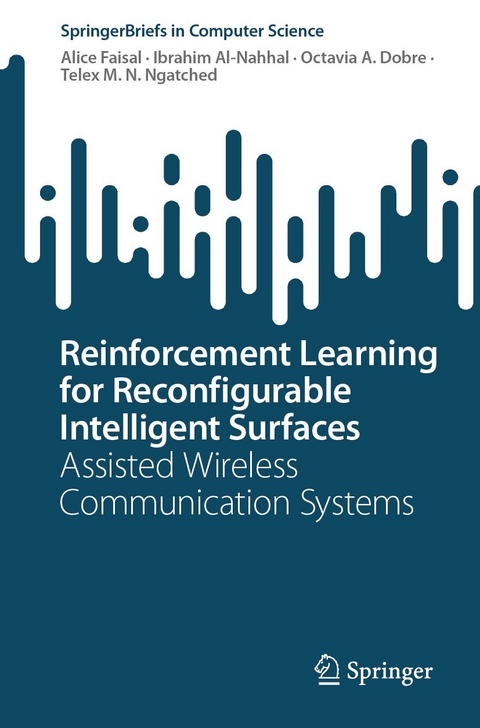
Reinforcement Learning for Reconfigurable Intelligent Surfaces (eBook)
IX, 57 Seiten
Springer-Verlag
978-3-031-52554-4 (ISBN)
This book presents the intersection of two dynamic fields: Reinforcement Learning (RL) and RIS- Assisted Wireless Communications. With an emphasis on both discrete and continuous problems, it introduces a comprehensive overview of RL techniques and their applications in the evolving world of RIS-assisted wireless communications. Chapter 1 introduces the fundamentals of RL and deep RL (DRL), providing a solid foundation for understanding subsequent chapters. It also presents the Q-learning, deep Q-learning, and deep deterministic policy gradient algorithms. Chapter 2 provides a holistic overview of RIS-assisted systems and details several use cases in wireless communications. Then, Chapters 3 and 4 present various applications of the discrete and continuous DRL to RIS-assisted wireless communications. From maximizing the sum-rate to minimizing, the system resources and maximizing the energy efficiency. These chapters showcase the versatility of the DRL algorithms in tackling arange of challenges. This book concludes with Chapter 5, which introduces the challenges and future directions in this field. It explores the particulars of hyperparameter tuning, problem design, and complexity analysis, while also highlighting the potential of hybrid DRL, multi-agent DRL, and transfer learning techniques for advancing wireless communication systems.
Optimizing RIS-Assisted Wireless Systems requires powerful algorithms to cope with the dynamic propagation environment. DRL is envisioned as one of the key enabling techniques to exploit the full potential of RIS-Assisted Wireless Communication Systems. It empowers these systems to intelligently adapt to dynamic wireless environments, maximize performance metrics, and adjusts their configurations to accommodate diverse use cases efficiently.This book serves as a valuable resource, shedding light on the potential of DRL to optimize RIS-Assisted Wireless Communication, enabling researchers, engineers, advanced level students in computer science and electrical engineering and enthusiasts to grasp the intricacies of this topic. It offers a comprehensive understanding of the principles, applications, and challenges, making it a reference to recognize the full potential of the RIS technology in modern wireless communication systems.
| Erscheint lt. Verlag | 23.2.2024 |
|---|---|
| Reihe/Serie | SpringerBriefs in Computer Science |
| Zusatzinfo | IX, 57 p. 12 illus., 11 illus. in color. |
| Sprache | englisch |
| Themenwelt | Mathematik / Informatik ► Informatik ► Netzwerke |
| Informatik ► Theorie / Studium ► Künstliche Intelligenz / Robotik | |
| Mathematik / Informatik ► Mathematik ► Statistik | |
| Technik | |
| Schlagworte | Deep deterministic policy gradient • deep Q-learning • Deep Reinforcement Learning • energy efficiency maximization • Full-Duplex • Half-duplex • Q-Learning • reconfigurable intelligent surfaces • Reinforcement Learning • resource allocation optimization. • sum-rate maximization • wireless communication |
| ISBN-10 | 3-031-52554-X / 303152554X |
| ISBN-13 | 978-3-031-52554-4 / 9783031525544 |
| Informationen gemäß Produktsicherheitsverordnung (GPSR) | |
| Haben Sie eine Frage zum Produkt? |
 PDF (Wasserzeichen)
DRM: Digitales Wasserzeichen
Dieses eBook enthält ein digitales Wasserzeichen und ist damit für Sie personalisiert. Bei einer missbräuchlichen Weitergabe des eBooks an Dritte ist eine Rückverfolgung an die Quelle möglich.
Dateiformat: PDF (Portable Document Format)
Mit einem festen Seitenlayout eignet sich die PDF besonders für Fachbücher mit Spalten, Tabellen und Abbildungen. Eine PDF kann auf fast allen Geräten angezeigt werden, ist aber für kleine Displays (Smartphone, eReader) nur eingeschränkt geeignet.
Systemvoraussetzungen:
PC/Mac: Mit einem PC oder Mac können Sie dieses eBook lesen. Sie benötigen dafür einen PDF-Viewer - z.B. den Adobe Reader oder Adobe Digital Editions.
eReader: Dieses eBook kann mit (fast) allen eBook-Readern gelesen werden. Mit dem amazon-Kindle ist es aber nicht kompatibel.
Smartphone/Tablet: Egal ob Apple oder Android, dieses eBook können Sie lesen. Sie benötigen dafür einen PDF-Viewer - z.B. die kostenlose Adobe Digital Editions-App.
Buying eBooks from abroad
For tax law reasons we can sell eBooks just within Germany and Switzerland. Regrettably we cannot fulfill eBook-orders from other countries.
aus dem Bereich