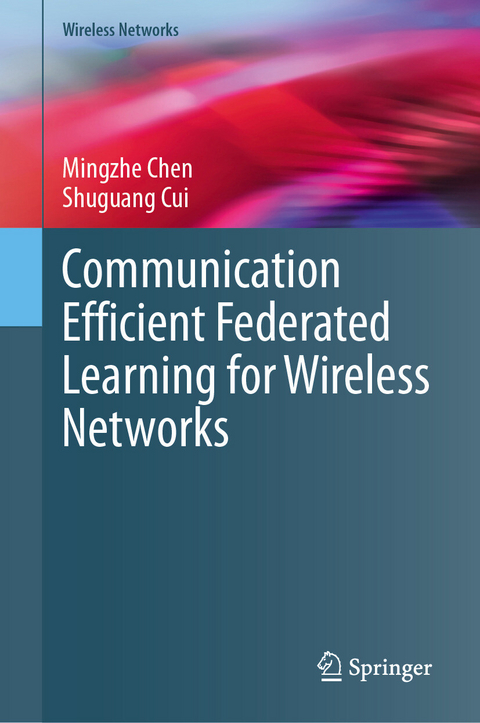
Communication Efficient Federated Learning for Wireless Networks (eBook)
XI, 179 Seiten
Springer-Verlag
978-3-031-51266-7 (ISBN)
This book provides a comprehensive study of Federated Learning (FL) over wireless networks. It consists of three main parts: (a) Fundamentals and preliminaries of FL, (b) analysis and optimization of FL over wireless networks, and (c) applications of wireless FL for Internet-of-Things systems. In particular, in the first part, the authors provide a detailed overview on widely-studied FL framework. In the second part of this book, the authors comprehensively discuss three key wireless techniques including wireless resource management, quantization, and over-the-air computation to support the deployment of FL over realistic wireless networks. It also presents several solutions based on optimization theory, graph theory and machine learning to optimize the performance of FL over wireless networks. In the third part of this book, the authors introduce the use of wireless FL algorithms for autonomous vehicle control and mobile edge computing optimization.
Machine learning and data-driven approaches have recently received considerable attention as key enablers for next-generation intelligent networks. Currently, most existing learning solutions for wireless networks rely on centralizing the training and inference processes by uploading data generated at edge devices to data centers. However, such a centralized paradigm may lead to privacy leakage, violate the latency constraints of mobile applications, or may be infeasible due to limited bandwidth or power constraints of edge devices. To address these issues, distributing machine learning at the network edge provides a promising solution, where edge devices collaboratively train a shared model using real-time generated mobile data. The avoidance of data uploading to a central server not only helps preserve privacy but also reduces network traffic congestion as well as communication cost. Federated learning (FL) is one of most important distributed learning algorithms. In particular, FL enables devices to train a shared machine learning model while keeping data locally. However, in FL, training machine learning models requires communication between wireless devices and edge servers over wireless links. Therefore, wireless impairments such as noise, interference, and uncertainties among wireless channel states will significantly affect the training process and performance of FL. For example, transmission delay can significantly impact the convergence time of FL algorithms. In consequence, it is necessary to optimize wireless network performance for the implementation of FL algorithms.
This book targets researchers and advanced level students in computer science and electrical engineering. Professionals working in signal processing and machine learning will also buy this book.
| Erscheint lt. Verlag | 19.2.2024 |
|---|---|
| Reihe/Serie | Wireless Networks |
| Zusatzinfo | XI, 179 p. 46 illus., 44 illus. in color. |
| Sprache | englisch |
| Themenwelt | Mathematik / Informatik ► Informatik ► Netzwerke |
| Informatik ► Theorie / Studium ► Künstliche Intelligenz / Robotik | |
| Mathematik / Informatik ► Mathematik ► Statistik | |
| Technik | |
| Schlagworte | Autonomous Vehicle Control • distributed learning • federated learning • Mobile Edge Computing • Over the air computation • Quantization • Resource Allocation |
| ISBN-10 | 3-031-51266-9 / 3031512669 |
| ISBN-13 | 978-3-031-51266-7 / 9783031512667 |
| Informationen gemäß Produktsicherheitsverordnung (GPSR) | |
| Haben Sie eine Frage zum Produkt? |
 PDF (Wasserzeichen)
DRM: Digitales Wasserzeichen
Dieses eBook enthält ein digitales Wasserzeichen und ist damit für Sie personalisiert. Bei einer missbräuchlichen Weitergabe des eBooks an Dritte ist eine Rückverfolgung an die Quelle möglich.
Dateiformat: PDF (Portable Document Format)
Mit einem festen Seitenlayout eignet sich die PDF besonders für Fachbücher mit Spalten, Tabellen und Abbildungen. Eine PDF kann auf fast allen Geräten angezeigt werden, ist aber für kleine Displays (Smartphone, eReader) nur eingeschränkt geeignet.
Systemvoraussetzungen:
PC/Mac: Mit einem PC oder Mac können Sie dieses eBook lesen. Sie benötigen dafür einen PDF-Viewer - z.B. den Adobe Reader oder Adobe Digital Editions.
eReader: Dieses eBook kann mit (fast) allen eBook-Readern gelesen werden. Mit dem amazon-Kindle ist es aber nicht kompatibel.
Smartphone/Tablet: Egal ob Apple oder Android, dieses eBook können Sie lesen. Sie benötigen dafür einen PDF-Viewer - z.B. die kostenlose Adobe Digital Editions-App.
Buying eBooks from abroad
For tax law reasons we can sell eBooks just within Germany and Switzerland. Regrettably we cannot fulfill eBook-orders from other countries.
aus dem Bereich