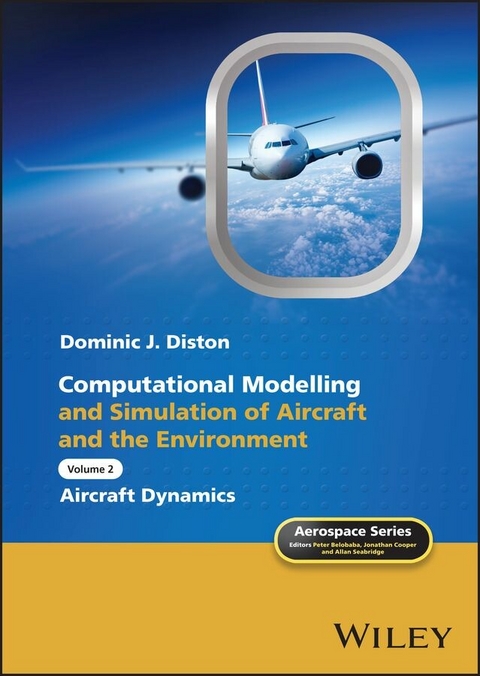
Computational Modelling and Simulation of Aircraft and the Environment, Volume 2 (eBook)
John Wiley & Sons (Verlag)
978-1-118-53641-4 (ISBN)
An in-depth discussion of aircraft dynamics modelling and simulation
This book provides a comprehensive guide to modelling and simulation from basic physical and mathematical principles, giving the reader sufficient information to be able to build computational models of aircraft for the purposes of simulation and evaluation. Highly relevant to practitioners, it takes into account the multi-disciplinary nature of aerospace products and the integrated nature of the models needed in order to represent them. Volume 1- Platform Kinematics and Synthetic Environment focused on the modelling of a synthetic environment in which aircraft operate and its spatial relationship with vehicles that are situated and moving within it. This volume focuses on the modelling of aircraft and the interpretation of their flight dynamics.
Key features:
This book offers a comprehensive guide for senior, graduate and postgraduate students of aerospace engineering as well as professional engineers involved in the modelling and simulation of aircraft.
Dominic J. Diston
was a senior lecturer in aerospace engineering at the University of Liverpool and subsequently associate professor at the University of Nottingham. He also spent 25 years in the aerospace industry and has wide experience in dynamics, control and simulation of vehicles and systems. Major areas of work have included integrated flight/propulsion control, computer-aided engineering and fuel/thermal/power system simulation. All work has been closely linked with projects, most significantly Harrier, Typhoon, Nimrod and F-35.
Computational Modelling and Simulation of Aircraft and the Environment An in-depth discussion of aircraft dynamics modelling and simulation This book provides a comprehensive guide to modelling and simulation from basic physical and mathematical principles, giving the reader sufficient information to be able to build computational models of aircraft for the purposes of simulation and evaluation. Highly relevant to practitioners, it takes into account the multi-disciplinary nature of aerospace products and the integrated nature of the models needed in order to represent them. Volume 1- Platform Kinematics and Synthetic Environment focused on the modelling of a synthetic environment in which aircraft operate and its spatial relationship with vehicles that are situated and moving within it. This volume focuses on the modelling of aircraft and the interpretation of their flight dynamics. Key features: Includes chapters on equations of motion, fixed-wing aerodynamics, longitudinal flight and gas turbines, as well as an opening chapter that presents an overview of flight modelling and a concluding chapter that presents a number of additional topics such as aircraft structures and embedded systems. Serves as both a student text and practitioner reference. Follows on from previous Aerospace Series titles, offering a complementary view of vehicles and systems from the perspectives of mathematics, physics and simulation. This book offers a comprehensive guide for senior, graduate and postgraduate students of aerospace engineering as well as professional engineers involved in the modelling and simulation of aircraft.
Dominic J. Diston was a senior lecturer in aerospace engineering at the University of Liverpool and subsequently associate professor at the University of Nottingham. He also spent 25 years in the aerospace industry and has wide experience in dynamics, control and simulation of vehicles and systems. Major areas of work have included integrated flight/propulsion control, computer-aided engineering and fuel/thermal/power system simulation. All work has been closely linked with projects, most significantly Harrier, Typhoon, Nimrod and F-35.
1
A Simple Flight Model
1.1 Introduction
1.1.1 General Introduction to Volume 2
Welcome to Volume 2 of Computational Modelling and Simulation of Aircraft and the Environment. This volume will present and explain the main theories that enable the dynamics of fixed‐wing aircraft to be modelled using mathematical and computational methods. The aim is to establish the heuristic basis for education in aeronautical engineering that provides a ‘handbook’ of concepts and interpretations, together with a formulary to support practical application. It is appropriate and convenient to commence with a simple flight model that brings together all the essential components without too much detail. This covers aircraft motion, atmosphere, aerodynamics, and propulsion. More detailed expositions are given in Chapters 2–5. These focus on Equations of Motion, Wing Aerodynamics, Longitudinal Flight and Gas Turbines.
The significant omission is lateral‐directional aerodynamics, apart from rolling a wing in flight (later in Chapter 1). This is because the formulary tends to be complicated and abstract, with no easily recognisable link to the underlying physics. Also, there is no inherent value in just repeating what other books [e.g. Pamadi] already provide. Also, supersonic flight is not discussed because it is a specialised area of aircraft design. The vast majority of aircraft are not supersonic.
The final chapter offers a brief introduction to several topics that are important in whole‐aircraft modelling but that sit outside the usual scope of flight physics. The discussion is brief because these subjects have substantial content and could easily expand to fill another two or three textbooks.
1.1.2 What Chapter 1 Includes
This chapter includes:
- Equations of motions expressed with respect to flight path parameters.
- Summary of the International Standard Atmosphere up to 20 km (roughly 50 000 ft).
- Simple propulsion model that enables thrust calculations at given altitude and Mach number.
- Simple aerodynamic model that is applicable to idealised wing geometry plus trailing‐edge flaps.
- A short introduction to spanwise lift distribution for an idealised wing.
- Aerodynamic model for wing/tail combinations (as an approximation to a complete aircraft).
- A set of airspeed definitions.
- One of many possible architectures for a flight model (i.e. a whole‐aircraft model).
1.1.3 What Chapter 1 Excludes
This chapter excludes:
- Six degree‐of‐freedom (6‐DOF) equations of motion [go to Chapter 2].
- Generalised wing configurations (e.g. taper, twist) [go to Chapter 3].
- Flight mechanics of wing/tail combinations [go to Chapter 4].
- Fuselage aerodynamic effects [go to Chapter 4].
- Physics‐based models of gas turbines [go to Chapter 5].
- Lateral‐directional aerodynamics [not covered by this book].
- Supersonic flight [not covered by this book].
1.1.4 Overall Aim
Chapter 1 should provide ‘enough of everything’ that is needed to create a complete representation of aircraft flight behaviour, from ground up to 20 km and from low‐speed up to about 0.85 Mach number. This includes the essential flight physics without too much detail, such that computations can be verified by manual calculation and that parametric trend should be readily discernible. In short, this should provide a compact aircraft model for the purpose of preliminary concept evaluation and simulation.
1.2 Flight Path
The simplest possible flight path model is shown in Figure 1.1. This represents symmetric flight (with wings level) in a vertical plane. Motion parameters are defined at the centre of mass for an instantaneous pull‐up (which is turn in the vertical plane). Airspeed V is aligned (or tangential) with the flight path, which is normal to the radius of turn. The tangential acceleration varies the airspeed while the centripetal acceleration varies the flight path angle. The pitch angle θ defines the orientation of the aircraft horizontal datum and the angle of attack (AOA) is defined by:
where γ is the climb/dive angle. The rate of change of pitch angle is the pitch rate , such that
Figure 1.1 Symmetric Flight Trajectory.
The force/moment system is shown in Figure 1.2 (referred to the centre of gravity, CG). Thus, aircraft motion is governed by the following equations when aircraft mass is constant:
where m is aircraft mass, J is moment of inertia, X is tangential force, Z is normal force and M is pitching moment. Altenatively, these equations can be written as:
Figure 1.2 Symmetric Force/Moment System.
The forces X and Z are composed as:
where L is total lift, D is total drag, W is aircraft weight and T is the total nett thrust from all engines. For convenience, the thrust line is drawn through the centre of mass. Also, for convenience, the thrust is aligned with the velocity vector and not the aircraft datum. This is true if AOA is zero (which it rarely is) and almost true if AOA is small (which it usually is).
Currently, the flight path is constrained to lie within a single vertical plane, tracing a straight line course across the surface of the Earth. Horizontal turns would be useful! So, a reference system is defined for the Earth, with its axes aligned with North, East, and Down, shown in Figure 1.3. Flight path angles are defined as γ3 (setting the course direction), γ2 (setting the climb/dive angle), and γ1 (setting a rotation about the velocity vector). The resulting ‘flight path axes’ are shown as xyz. The vertical turn rate is now written as [cf. Figure 1.1] and a horizontal turn rate is introduced as . In fact, can be redefined as the variation in flight path angle measured in the plane of symmetry (which is inclined at an angle γ1 with respect to the vertical):
Figure 1.3 Generalised Flight Path Parameters.
The force/moment system is modified and extended, as shown in Figure 1.4. The lift vector is inclined at an angle γ1 with respect to the vertical. This generates the horizontal acceleration, thereby providing a bank‐to‐turn capability. Rotation about the velocity vector is produced by a rolling moment K about the velocity vector, such that the roll rate p is equal to .
The generalised equations of motion are given by:
where m is the aircraft mass, g is the gravitational acceleration, J1 is the roll moment of inertia, J2 is the pitch moment of inertia, and the other symbols have their previously defined meanings.
Figure 1.4 Generalised Force/Moment System.
The flight path angles are (γ1, γ2, γ3). In addition, aircraft position (expressed as e = East, n = North, and h = Altitude) is given by simple trigonometry:
1.3 Flight Environment <20 km
Atmosphere models were explained and developed in Volume 1. The International Standard Atmosphere is underpinned by parametric values given in Table 1.1. Temperature T [measured in Kelvin] decreases with altitude up to 11 km (at the top of the troposphere) and remains constant up to 20 km (at the top of the lower stratosphere), such that:
where H is the geopotential altitude. This altitude scale is used because the variation of pressure P can be expressed with a constant value for gravitational acceleration g0 (at sea level):
where ρ is air density. The relationship with altitude h (from Section 1.2) is as follows:
and where r0 is the mean radius of the Earth.
The relationship between pressure P and temperature T is given by the Ideal Gas Law:
Accordingly, Equation 1.11 gives:
Table 1.1 Selected Parameters for the International Standard Atmosphere.
| Parameter | Symbol | Value | Units |
|---|
| Mean Earth radius | r0 | 6356766 | m |
| Gravitational acceleration at sea level | g0 | 9.80665 | m s–2 |
| Gas constant (dry air) | R | 287.05287 | (J kg–1 ) K–1 |
| Erscheint lt. Verlag | 6.2.2024 |
|---|---|
| Reihe/Serie | Aerospace Series |
| Aerospace Series (PEP) | Aerospace Series (PEP) |
| Mitarbeit |
Herausgeber (Serie): Peter Belobaba, Jonathan Cooper, Allan Seabridge |
| Sprache | englisch |
| Themenwelt | Technik ► Maschinenbau |
| Schlagworte | Aeronautic & Aerospace Engineering • aircraft dynamics simulation • Aircraft modelling • aircraft simulation • Aircraft Structures • Bildgebende Systeme u. Verfahren • Circuit Theory & Design • computational aircraft simulation • Electrical & Electronics Engineering • Elektrotechnik u. Elektronik • embedded aircraft systems • Equations of motion • fixed-wing aerodynamics • flight modelling • Imaging Systems & Technology • longitudinal flight • Luftfahrttechnik • Luft- u. Raumfahrttechnik • Maschinenbau • mechanical engineering • Schaltkreise - Theorie u. Entwurf |
| ISBN-10 | 1-118-53641-X / 111853641X |
| ISBN-13 | 978-1-118-53641-4 / 9781118536414 |
| Informationen gemäß Produktsicherheitsverordnung (GPSR) | |
| Haben Sie eine Frage zum Produkt? |
 EPUB (Adobe DRM)
Kopierschutz: Adobe-DRM
Adobe-DRM ist ein Kopierschutz, der das eBook vor Mißbrauch schützen soll. Dabei wird das eBook bereits beim Download auf Ihre persönliche Adobe-ID autorisiert. Lesen können Sie das eBook dann nur auf den Geräten, welche ebenfalls auf Ihre Adobe-ID registriert sind.
Details zum Adobe-DRM
Dateiformat: EPUB (Electronic Publication)
EPUB ist ein offener Standard für eBooks und eignet sich besonders zur Darstellung von Belletristik und Sachbüchern. Der Fließtext wird dynamisch an die Display- und Schriftgröße angepasst. Auch für mobile Lesegeräte ist EPUB daher gut geeignet.
Systemvoraussetzungen:
PC/Mac: Mit einem PC oder Mac können Sie dieses eBook lesen. Sie benötigen eine
eReader: Dieses eBook kann mit (fast) allen eBook-Readern gelesen werden. Mit dem amazon-Kindle ist es aber nicht kompatibel.
Smartphone/Tablet: Egal ob Apple oder Android, dieses eBook können Sie lesen. Sie benötigen eine
Geräteliste und zusätzliche Hinweise
Buying eBooks from abroad
For tax law reasons we can sell eBooks just within Germany and Switzerland. Regrettably we cannot fulfill eBook-orders from other countries.
aus dem Bereich