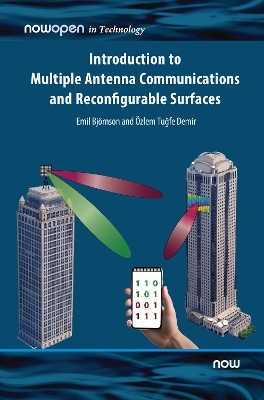
Introduction to Multiple Antenna Communications and Reconfigurable Surfaces
now publishers Inc (Verlag)
978-1-63828-314-0 (ISBN)
- Titel nicht im Sortiment
- Artikel merken
This textbook gives a gentle introduction to multiple antenna communications with a focus on system modeling, channel capacity theory, algorithms, and practical implications.
The ebook edition of this title is Open Access and freely available to read online.
Wireless communication is the backbone of the digitized society, where everything is connected and intelligent. Access points and devices are nowadays equipped with multiple antennas to achieve higher data rates, better reliability, and support more users than in the past. This book gives a gentle introduction to multiple antenna communications with a focus on system modeling, channel capacity theory, algorithms, and practical implications. The basics of wireless localization, radar sensing, and controllable reflection through reconfigurable surfaces are also covered. The goal is to provide the reader with a solid understanding of this transformative technology that changes how wireless networks are designed and operated, today and in the future.
The first three chapters cover the fundamentals of wireless channels, and the main benefits of using multiple antennas are identified: beamforming, diversity, and spatial multiplexing. The theory and signal processing algorithms for multiple-input multiple-output (MIMO) communications with antenna arrays at the transmitter and receiver are progressively developed. The next two chapters utilize these results to study point-to-point MIMO channels under line-of-sight (LOS) and non-LOS conditions, covering the shape of signal beams, impact of array geometry, polarization, and ways to achieve reliable communication over fading channels. The book then shifts focus to multi-user MIMO channels, where interference between devices is managed by spatial processing. The next chapter extends the theory to multicarrier channels and explains practical digital, analog, and hybrid hardware implementations. The last two chapters cover the role of multiple antennas in localization and sensing, and how reconfigurable surfaces can improve both communication and sensing systems.
The text was developed as the textbook for a university course and builds on the reader's previous knowledge of signals and systems, linear algebra, probability theory, and digital communications. Each chapter contains numerous examples, exercises, and simulation results that can be reproduced using accompanying code.
Dr. Emil Björnson is a Professor of Wireless Communication at the KTH Royal Institute of Technology, Stockholm, Sweden. He is an IEEE Fellow, Digital Futures Fellow, and Wallenberg Academy Fellow. He received his M.S. degree from Lund University, Sweden, in 2007 and his Ph.D. degree from KTH in 2011. He is a co-host of the podcast and YouTube channel called Wireless Future. He has previously authored the textbooks Optimal Resource Allocation in Coordinated Multi-Cell Systems (2013), Massive MIMO Networks: Spectral, Energy, and Hardware Efficiency (2017), and Foundations of User-Centric Cell-Free Massive MIMO (2021). He has published a large amount of simulation code onGitHub related to these books and selected scientific papers.His research focuses on multi-antenna communications, reconfigurable intelligent surfaces, energy-efficient communication, and radio resource management, using methods from communication theory, signal processing, and machine learning. His work on these topics received the 2018 and 2022 IEEE Marconi Prize Paper Awards, the 2019 EURASIP Early Career Award, the 2019 IEEE Fred W. Ellersick Prize, the 2019 IEEE Signal Processing Magazine Best Column Award, the 2020 Pierre-Simon Laplace Early Career Technical Achievement Award, the 2020 CTTC Early Achievement Award, the 2021 IEEE ComSoc RCC Early Achievement Award, and the 2023 IEEE Communications Society Outstanding Paper Award. Dr. Özlem Tuğfe Demir is an Assistant Professor of Electrical and Electronics Engineering at TOBB University of Economics and Technology, Ankara, Türkiye. She received her B.S., M.S., and Ph.D. degrees in Electrical and Electronics Engineering from Middle East Technical University, Ankara, Türkiye, in 2012, 2014, and 2018, respectively. She was a Postdoctoral Researcher at Linköping University, Sweden, in 2019-2020 andat the KTH Royal Institute of Technology, Sweden, in 2021-2022. She has previously co-authored the textbook Foundations of User-Centric Cell-Free Massive MIMO (2021). She is an Associate Editor of the IEEE Transactions on Wireless Communications.Her research interests are on signal processing and optimization in wireless communications, massive MIMO, cell-free massive MIMO, beyond 5G multiple antenna technologies, reconfigurable intelligent surfaces, near-field communications, machine learning for communications, mobile data analysis, and green mobile networks.
Chapter 1. Introduction and motivation
Chapter 2. Theoretical foundations
Chapter 3. Capacity of point-to-point MIMO channels
Chapter 4. MIMO communication over line-of-sight channels
Chapter 5. MIMO communication over non-line-of-sight channels
Chapter 6. Capacity of multi-user MIMO channels
Chapter 7. Wideband MIMO channels and practical aspects
Chapter 8. MIMO localization and sensing
Chapter 9. Reconfigurable intelligent surfaces
| Erscheinungsdatum | 25.01.2024 |
|---|---|
| Sprache | englisch |
| Maße | 156 x 234 mm |
| Gewicht | 1148 g |
| Themenwelt | Technik ► Nachrichtentechnik |
| ISBN-10 | 1-63828-314-1 / 1638283141 |
| ISBN-13 | 978-1-63828-314-0 / 9781638283140 |
| Zustand | Neuware |
| Informationen gemäß Produktsicherheitsverordnung (GPSR) | |
| Haben Sie eine Frage zum Produkt? |
aus dem Bereich