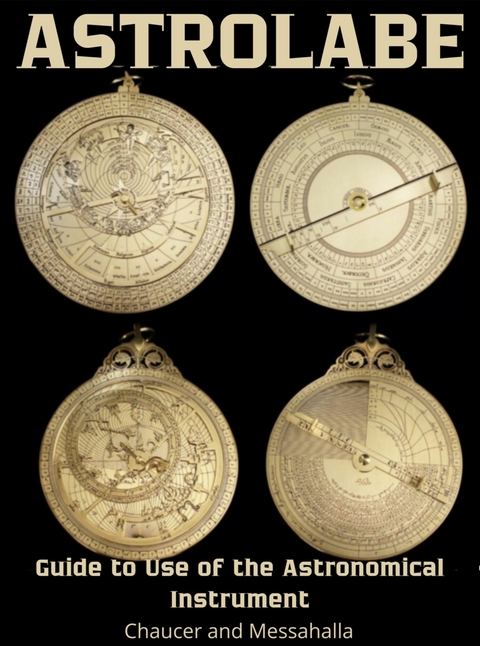
Geoffrey Chaucer wrote his 'Treatise on the Astrolabe' in 1387 for little Lewis, his to learn at Oxford. Manuscript copies of this work of Chaucer approaching completeness are very few in number and inaccessible to the general reader. He undoubtedly obtained the greater part of his book from Latin version of the Compositio et Operatio Astrolabii of Messahalla, an Arabian astronomer who is thought to have flourished about the end of the eighth century. Chaucer certainly was of opinion that he had achieved simplicity in his explanations, for he gave his Treatise the title of 'Bread and Milk for Children.'
Geoffrey Chaucer wrote his "Treatise on the Astrolabe" in 1387 for little Lewis, his to learn at Oxford. Manuscript copies of this work of Chaucer approaching completeness are very few in number and inaccessible to the general reader. He undoubtedly obtained the greater part of his book from Latin version of the Compositio et Operatio Astrolabii of Messahalla, an Arabian astronomer who is thought to have flourished about the end of the eighth century. Chaucer certainly was of opinion that he had achieved simplicity in his explanations, for he gave his Treatise the title of "Bread and Milk for Children."
PART I
Here beginneth the Description of the Astrolabe
I. Thy astrolabe hath a ring to put on the thumb of thy right hand when taking the height of things.
And note that from henceforward, I will call the height of any thing that is taken by thy 'rule', the altitude, without more words.
2. This ring runs in a kind of eyelet, fastened to the ' mother ' of thy astrolabe, in so roomy a space that it does not prevent the instrument from hanging plumb.
3. The mother of thy astrolabe is a very thick plate, hollowed out with a large cavity, which receives within it the thin plates, marked for different climates, and thy rete, shaped like a net or the web of a spider. For more explanation, lo here the figure :
Figure showing the Rete lying in the Mother.
Like the other text-figures it has been taken from MS. Cambridge Dd.3. 53, and is obviously from the same source as the Rete on p. 4, with the head of the Dogstar, Alhabor, reversed.
4. This mother is divided on the backhalf with a line, which descends from the ring down to the lowest border. This line, from the aforesaid ring to the centre of the large cavity in the middle, is called the south line, or the line meridional. And the remainder of this line down to the border is called the north line, or the line of midnight. And for more explanation, lo here the figure :
5. At right angles to the meridional line, there crosses it another line of the same length from east to west. This, from a little cross + in the border to the centre of the large cavity, is called the east line, or line oriental; and the remainder of the line from the aforesaid + to the border, is called the west line, or line occidental. Now hast thou here the 4 quarters of thy astrolabe, divided according to the 4 principal quarters of the compass, or quarters of the firmament. And for more explanation, lo here thy figure :
6. The east side of thy astrolabe is called the right side, and the west side is called the left side. Forget not this, little Lewis. Put the ring of thy astrolabe upon the thumb of thy right hand, and then its right side will be towards thy left side, and its left side will be towards thy right side ; take this as a general rule, as well on the back as on the hollow side. Upon the end of the east line, as I first said, is marked a little +, which is always regarded as the beginning of the first degree in which the sun rises. And for more explanation, lo here the figure:
7. From this little + up to the end of the meridional line, under the ring, thou wilt find the border divided into go degrees ; and every quarter of thy astrolabe is divided in the same proportion. Over these degrees are numbers, and the degrees are divided into fives as shown by long lines between. The space between the long lines containeth a mile-way. (The time it takes to walk a mile.) And every degree of the border contains 4 minutes, that is to say, minutes of an hour. And for more explanation, lo here the figure :
[The Figure is similar to the figure drawn above].
8. Under the circle of these degrees are written the names of the 12 Signs, as Aries, Taurus, Gemini, Cancer, Leo, Virgo, Libra, Scorpio, Sagittarius, Capricornus, Aquarius, Pisces ; and the numbers of the degrees of the Signs are written in Arabic numerals above, and with long divisions, from 5 to 5, divided from the time that the Sign entereth unto the last end. But understand well, that these degrees of Signs are each of them considered to be of 60 minutes, and every minute of 60 seconds, and so forth into small fractions infinite, as saith Alkabucius, (Abdilazi Alchabitius, Introdiictorium ad scientiam judicialem astronomiae, printed 1473.) and therefore, know well, that a degree of the border containeth 4 minutes, and a degree of a Sign containeth 60 minutes ; remember this. And for more explanation, lo here thy figure :
9. Next follows the Circle of the Days, in number 365 that are numbered as are the degrees, and divided also by long lines from 5 to 5; and the numbers under that circle are written in Arabic numerals. And for more explanation, lo here thy figure:
10. Next the circle of the days follows the Circle of the Months) that is to say, January, February, March, April, May, June, July, August, September, October, November, December. These months were named amongst the Arabians, some for their prophets, and some by statutes of lords, some by other lords of Rome. Also, as it pleased Julius Caesar and Caesar Augustus, some months were composed of different numbers of days, as July and August. Then hath January 31 days, February 28, March 31, April 30, May 31, June 30, July 31, August 31, September 30, October 31, November 30, December 31. Nevertheless, although Julius Caesar took 2 days out of February and put them in his month of July (This is not right. Julius Caesar added 2 days to January, August, and December, and i day to April, June, September, and November.) and Augustus Caesar called the month of August after his own name and ordained it of 31 days ; yet trust well, that the sun never dwelleth on that account more or less in one sign than in another.
11. Then follow the names of the Holydays in the calendar, and next them the letters of the a. b. c. on which they fall. And for more explanation, lo here thy figure :
[The Festivals marked in the figure are those of St. Paul (Jan. 25), Purification (Feb. 2), Annunciation (March 25), Invention of the Cross (May 3), St. John Baptist (June 24), St. James (July 25), St. Lawrence (Aug. 10)?, Nativity B.V.M. (Sept. 8), St. Luke (Oct. 18), All Souls (Nov. 2), Conception B.V.M. (Dec. 8). But the scribe has put them in the wrong months.]
12. Next to the aforesaid circle of the a. b. c, and under the crossline is marked a scale, like 2 measur-ing-rules or else like ladders, that serveth by its 12 points and its divisions for full many a subtle conclusion. Of this aforesaid scale, the part from the cross-line to the right angle, is called umbra versa, and the nether part is called umbra recta, or else umbra extensa. (The names are transposed in the original MS. and in the figure.) And for more explanation, lo here the figure :
13. Then hast thou a broad rule, that hath on either end a square plate pierced with certain holes, to receive the streams of the sun by day, and also by means of thy eye, to know the altitude of stars by night. And for more explanation, lo here thy figure :
14. Then is there a larg pin like an axle-tree, that goeth through the hole, and holdeth the tables of the climates and the rete in the cavity of the mother. Through this pin there goeth a little wedge, called the horse, which compresses all the parts in a heap ; the pin which resembles an axle-tree, is imagined to be the pole arctic (north pole) in thy astrolabe. And for the more explanation, lo here the figure :
15. The hollow side of thy astrolabe is also divided with a long cross into 4 quarters from east to west, from south to north, from right side to left side, as is the back-side. And for the more explanation, lo here thy figure :
16. The border of the hollow-side is divided from the point of the east line to the point of the south line under the ring, into 90 degrees; and every quarter is divided by that same proportion. So too is the back-side divided,, and that amounteth to 360 degrees. And understand well, that degrees of this border correspond with, and are concentric to, the degrees of the equinoctial, that is divided into the same number as is every other circle in the high heaven. This same border is also divided with 23 capital letters and a small cross -f above the south line, so as to show the 24 equal hours of the clock ; and, as I have said, 5 of these degrees make a mile-way, and 3 mile-ways make an hour. And every degree of this border contains 4 minutes of time, and every minute contains 60 seconds. Now have I told thee twice, and for more explanation, lo here the figure :
17. The plate under thy rete is marked with 3 principal circles; of which the least is called the Circle of Cancer, because that the head of Cancer, or the beginning of the Sign of Cancer in the rete, turneth evermore concentric upon this same circle.
In this head of Cancer is the greatest declination northward of the sun. And therefore is it called the solstice of summer ; which dechnation, according to Ptolemy is 23 degrees and 50 minutes, as well in Cancer as in Capricorn. This sign of Cancer is called the tropic of summer, from tropos, that is to say a turning, for then beginneth the sun to pass away from us; and for the more explanation, lo here the figure :
Alternative Figure of the Mother of Chaucer's Astrolabe. MS. Rawlinson D. 913.
The middle circle in wideness, of these 3, is called the Equinoctial Circle, upon which turns evermore the heads of Aries and Libra. And understand well, that evermore this equinoctial circle turns exactly from very east to very west ; as I have shown thee in the solid sphere. This same circle is called also the weigher, equator, of the day, for when the sun is in the heads of Aries and Libra, then are the days and the nights equal in length in all the world. And therefore are these two signs called the equinoxes. And all that moveth within the heads of these Aries...
| Erscheint lt. Verlag | 19.1.2024 |
|---|---|
| Verlagsort | Vachendorf |
| Sprache | englisch |
| Themenwelt | Schulbuch / Wörterbuch ► Lexikon / Chroniken |
| Technik | |
| Schlagworte | applied astronomy • astrolabe book • instrument astrolabe • use of astrolabe • what is an astrolabe |
| ISBN-13 | 9783988654038 / 9783988654038 |
| Informationen gemäß Produktsicherheitsverordnung (GPSR) | |
| Haben Sie eine Frage zum Produkt? |
 EPUB (Wasserzeichen)
DRM: Digitales Wasserzeichen
Dieses eBook enthält ein digitales Wasserzeichen und ist damit für Sie personalisiert. Bei einer missbräuchlichen Weitergabe des eBooks an Dritte ist eine Rückverfolgung an die Quelle möglich.
Dateiformat: EPUB (Electronic Publication)
EPUB ist ein offener Standard für eBooks und eignet sich besonders zur Darstellung von Belletristik und Sachbüchern. Der Fließtext wird dynamisch an die Display- und Schriftgröße angepasst. Auch für mobile Lesegeräte ist EPUB daher gut geeignet.
Systemvoraussetzungen:
PC/Mac: Mit einem PC oder Mac können Sie dieses eBook lesen. Sie benötigen dafür die kostenlose Software Adobe Digital Editions.
eReader: Dieses eBook kann mit (fast) allen eBook-Readern gelesen werden. Mit dem amazon-Kindle ist es aber nicht kompatibel.
Smartphone/Tablet: Egal ob Apple oder Android, dieses eBook können Sie lesen. Sie benötigen dafür eine kostenlose App.
Geräteliste und zusätzliche Hinweise
Buying eBooks from abroad
For tax law reasons we can sell eBooks just within Germany and Switzerland. Regrettably we cannot fulfill eBook-orders from other countries.
aus dem Bereich