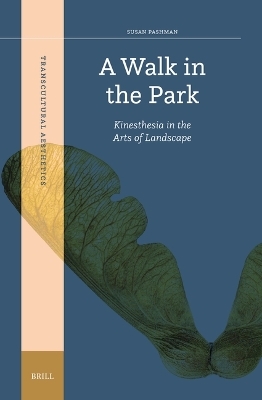
A Walk in the Park: Kinesthesia in the Arts of Landscape
Brill (Verlag)
978-90-04-69692-1 (ISBN)
Current neuroscience discloses that all emotional feeling originates as movement. Kinesthesia, our sixth sense, begins with movement of muscle cells and ends as emotion. Depth perception, which depends on movement, is always feeling-laden. To be expressive, art must somehow move our bodies.
Studies of expressive dance demonstrate that we unconsciously model observed movements, duplicating in ourselves the feelings that generated the dancer's movements. The art of landscape creates choreography for a walk. But each of the fine arts play a role in landscape design. Here, then, is a new theory of landscape that easily extends to all the fine arts, explaining our enjoyment in landscape, as well as aesthetic enjoyment more generally.
Susan Pashman holds a Ph.D. in Philosophy from Stony Brook University, a C.L.D. from Harvard’s Landscape Institute and an M.A. in Landscape History and Design from Inchbald School of Design in London. Her M.A. in Philosophy is from Columbia; her law degree from Brooklyn Law School; her B.A. from N.Y.U. She taught Philosophy at Adelphi University, and Landscape Aesthetics at the Landscape Institute. Articles based on this work appeared in “The Journal of Aesthetic Education” and “Dance Research.” She is the author of two novels, one non-fiction work and many short stories, as well as articles on Jewish themes.
Acknowledgements
List of Figures
Introduction
Part 1: The Double Problem of Landscape
Introduction to Part 1
1 Traditional Concepts of Landscape
2 Modes of Representing Landscape
3 Recent Efforts to Resolve the Conceptual Problem
4 Contemporary Approaches to the Problem of Representation
5 Contributions from an Expanded Field of Philosophical Aesthetics
Part 2: Kinesthesia: the Key to Understanding Landscape’s Medium
Introduction to Part 2
6 Kinesthesia, the “Sixth Sense,” is Based in Bodily Movement
7 Kinesthesia in the Perception of Depth
8 Subjective Evidence of Kinesthesia in Depth Perception: Experiences of Landscape and Painting
9 Considering Kinesthesia Resolves many Problems
10 A Walk in the Forest: Kinesthesia in Landscape’s Aesthetic Medium
Part 3: From Motion to Emotion
Introduction to Part 3
11 Emotion and Feeling: Two Distinct Kinesthetic Phenomena
12 Feelings are Uniquely Correlated with Kinesthetic Patterns
13 Whole-Body Kinesthesia: How Movement Feels
14 The Role of “Mirror Neurons” in Felt Emotion
Part 4: Kinesthesia Lies at the Core of Artistic Expression
Introduction to Part 4
15 Four Theories of Artistic Expression
16 A New Theory of Aesthetics
Part 5: Landscape as Art
Introduction to Part 5
17 Creating Expressive Landscape
18 Do Landscape’s Materials Inhibit Expressivity?
19 Does Landscape Possess “An Artworld” and “An Art History?”
Part 6: Kinesthesia is the Basis of All Artistic Expression
Introduction to Part 6
20 Landscape and the Art of Sculpture
21 Landscape and the Art of Architecture
22 Landscape, Earthworks, and Site-Specific Sculpture
23 Landscape and the Art of Painting
24 Landscape and the Art of Music
25 Landscape and the Art of Dance (for the Spectator)
26 Landscape Art and the Art of Dance (for the Dancer): Two Choreographies
27 Landscape and the Art of Cinema
28 Kinesthesia’s Unique Role in the Art of Landscape
29 Kinesthesia, Expression, Landscape: Some Concluding Thoughts
Bibliography
Index
| Erscheinungsdatum | 20.04.2024 |
|---|---|
| Reihe/Serie | Transcultural Aesthetics ; 3 |
| Verlagsort | Leiden |
| Sprache | englisch |
| Maße | 155 x 235 mm |
| Gewicht | 712 g |
| Themenwelt | Geisteswissenschaften ► Philosophie |
| Technik ► Architektur | |
| ISBN-10 | 90-04-69692-X / 900469692X |
| ISBN-13 | 978-90-04-69692-1 / 9789004696921 |
| Zustand | Neuware |
| Informationen gemäß Produktsicherheitsverordnung (GPSR) | |
| Haben Sie eine Frage zum Produkt? |
aus dem Bereich