ETHICS: Endorse Technologies for Heritage Innovation (eBook)
VII, 363 Seiten
Springer-Verlag
978-3-031-50121-0 (ISBN)
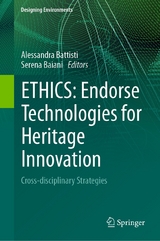
This book outlines, within the Italian national framework, the current and potential paths oriented towards a new concept of Architectural Heritage, through actions referring to Innovation and Experimentation and Protection and Transformation of the Architectural Heritage. The development of the themes is articulated in two sessions dealing with the aspects related to the analysis and mapping of Architectural Heritage to face the context of the current Climate Crisis and the development of projects and experimentations oriented to the Green and Digital Transition.
The evolution of the concept of Heritage, as conceived by the United Nations 2030 Agenda and in the Green Deal and New European Bauhaus, aimed at constructing an inclusive and universally recognised definition to support supranational objectives of sustainable human development, gives rise to innovative strategies, methodologies and technologies that—in a direction of mitigation, contrast and adaptation to climatechange—allow for the safeguard, renewed management and a hope for valorisation of Heritage on a national scale. In this direction, the understanding of Architectural Heritage as a 'non-renewable resource' determines the need to activate design experimentation laboratories oriented towards regeneration, articulated and complex, which require, in order to respond to the challenges posed by our era, a sensitive and dialogic multidisciplinary vision of a holistic type. In fact, on the one hand, it is necessary to redefine the usability and management methods of built heritage through the adoption of digital, mobility, energy, ecological, social, green and blue infrastructures; on the other hand, it is necessary to introduce new qualitative and quantitative parameters and performance indicators, adequate to verify the validity of the implemented strategies in a perspective of adaptation to climate change, able to clarify contents, processes and tools to contrast future risks.
The pursuit of these objectives refers to the innovation of training paths, professionalising procedures, administrative regulations, and public policies that involve citizens and the private partnership towards a different project qualification and empowerment of stakeholders, inhabitants, professionals, and clients. The Technological Project makes it possible to activate different interventions aimed at acting, in an integrated manner, on assets, context and communities, according to an approach that reinterprets them on a common score, as proposed by the European Next Generation programme in three priority aspects: digitalisation and innovation, environmental transition, increased resilience and social sustainability of national economies. In this scenario, the interventions aimed at outlining sustainable development actions will have to place these concepts at the centre in a harmonious vision that starts from the recognition and enhancement of the Architectural Heritage, recognising itas a fundamental asset of the territories.
| Erscheint lt. Verlag | 4.1.2024 |
|---|---|
| Reihe/Serie | Designing Environments | Designing Environments |
| Zusatzinfo | VII, 363 p. 1 illus. |
| Sprache | englisch |
| Themenwelt | Geisteswissenschaften ► Archäologie |
| Technik ► Architektur | |
| Technik ► Bauwesen | |
| Technik ► Elektrotechnik / Energietechnik | |
| Schlagworte | Architectural heritage • Climate change impacts • Digital twins and digital transition • Mapping Models • Mitigation and Adaptation to Climate Change • Net-zero approach to regeneration • Passive strategies for architechtural heritage • Sustainable rehabilitation of heritage buildings |
| ISBN-10 | 3-031-50121-7 / 3031501217 |
| ISBN-13 | 978-3-031-50121-0 / 9783031501210 |
| Informationen gemäß Produktsicherheitsverordnung (GPSR) | |
| Haben Sie eine Frage zum Produkt? |
 PDF (Wasserzeichen)
DRM: Digitales Wasserzeichen
Dieses eBook enthält ein digitales Wasserzeichen und ist damit für Sie personalisiert. Bei einer missbräuchlichen Weitergabe des eBooks an Dritte ist eine Rückverfolgung an die Quelle möglich.
Dateiformat: PDF (Portable Document Format)
Mit einem festen Seitenlayout eignet sich die PDF besonders für Fachbücher mit Spalten, Tabellen und Abbildungen. Eine PDF kann auf fast allen Geräten angezeigt werden, ist aber für kleine Displays (Smartphone, eReader) nur eingeschränkt geeignet.
Systemvoraussetzungen:
PC/Mac: Mit einem PC oder Mac können Sie dieses eBook lesen. Sie benötigen dafür einen PDF-Viewer - z.B. den Adobe Reader oder Adobe Digital Editions.
eReader: Dieses eBook kann mit (fast) allen eBook-Readern gelesen werden. Mit dem amazon-Kindle ist es aber nicht kompatibel.
Smartphone/Tablet: Egal ob Apple oder Android, dieses eBook können Sie lesen. Sie benötigen dafür einen PDF-Viewer - z.B. die kostenlose Adobe Digital Editions-App.
Buying eBooks from abroad
For tax law reasons we can sell eBooks just within Germany and Switzerland. Regrettably we cannot fulfill eBook-orders from other countries.
aus dem Bereich