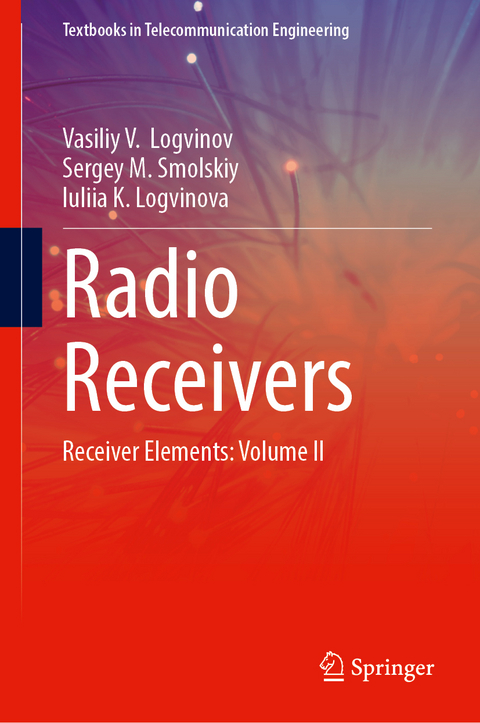
Radio Receivers
Springer International Publishing (Verlag)
978-3-031-52934-4 (ISBN)
- Noch nicht erschienen - erscheint am 02.02.2026
- Versandkostenfrei
- Auch auf Rechnung
- Artikel merken
The book provides a deep analysis of the properties of individual cascades of RF receivers, their design implementation, optimization of characteristics to achieve the highest transfer coefficient and minimum introduced distortions. Particular attention is paid to the characteristics of the preselector, which determines the sensitivity of the receiver, selects the operating frequency band and suppresses spurious channels. Depending on the range of operating frequencies, the bandwidth of the received signal and the selected structural scheme of the receiver, the preselector can be tunable or with a fixed setting of selective devices. Its component part can be a low-noise amplifier, the AE mode of which is selected based on the condition of the minimum noise factor and achieving the greatest gain. The radio path of modern receivers of analog and digital signals and the type of the selected structural implementation always includes a frequency converter of the useful signal to the range of intermediate frequencies or modulation frequencies (Base Band). It is described how the use of orthogonal modulation methods in digital systems allowed to implement optimal signal reception, when the processing of received signals is performed by correlation methods, and the decision on the received information bit is made on the basis of the analysis of a group of symbols (by the method of sequential decoding). It is shown how this allowed to organize the transmission of information flows to a specific subscriber of the cell, which together with the use of MIMO technology increased the SNR at the receiver input.
Provides a comprehensive understanding of the structure of individual radio path cascades, methods of their optimization under the influence of various interferences and parasitic feedback in AE.
Allows students to not only to learn and to assimilate the applied theoretical issues, but to transfer to independent problem solutions.
Includes a full suite of classroom materials including exercises, Q&A, and examples.
Vasliy Logvinov, Ph.D., Associate-Professor of Radio Equipment and Circuitry Department of Moscow State Technical University of Communication and Informatics (MTUCI). After graduation of MTUCI he was directed in the Soviet Union Army and after finishing of which in 1971 he worked as Assistant-Professor of MTUCI. In 1976 he entered at Ph.D.-course of MTUCI and after finishing of this PhD course, he was directed as the Chief of the Education Department of MTUCI. After defending the PhD thesis in 1982, he was elected as the Senior Teacher of MTUCI, and in 1986 as the Associate-Professor of the Multi-Channel Communication Department of MTUCI. In 1989 he moved to the Radio Receiver Department of MTUCI. From 2006 to 2016 he worked as the full Professor of MTUCI Department. At present, he works in MTUCI. He delivers the educational lecture courses: «Circuitry of Telecommunication Devices», «Radio Receiving Devices of Mobile Communication Systems», «Radio Receiving Devices of the Radio Communication and Radio Access Systems», «Radio Receiving Devices of the Protected Radio Communication Systems», «Devices for Reception and Processing of Signals». The list of his scientific publication includes more than thirty papers, thirteen report of conferences and five books. Scientific interests in last five years includes investigation of parts of reception-transmission sections of mobile communication systems and radio access systems.
Sergey M. Smolskiy, Ph.D. in Engineering, Dr.Sc. in Engineering, full professor, Head of the Department of Radio Receivers of Moscow Power Engineering Institute (Technical University). He works at Radio Engineering Faculty of MPEI from 1969 just after graduation. After graduation of Ph.D. course and protection of Ph.D. thesis in 1974 he worked on Department of Radio Transmitting Devices of MPEI, where engaged in theoretical and practical problems of development of transmitting cascades of low distance radar. In 1993 defended the Doctor of Science thesis and now he works as a Head of RR Dept. and as a Vice-Rector of MPEI responsible for international relations. Academic experience - over twenty years. The lecturer on the following courses: "Radio Transmitting Devices", "Devices of generation and control of oscillations of UHF and optical ranges", "Theory of oscillations in Radio Engineering", "Methods of analysis of non-linear radio and electronic systems", "Method of phase plane for analysis non-linear radio devices". The list of scientific works and inventions contains about three hundred of scientific articles, twelve books, three USSR copyright certificates on invention, 76 technological reports on various conferences, including international ones. The active member of International Academy of informatization, International Academy of Electrotechnical Sciences, International Academy of Sciences of Higher Educational Institutions. The active member of IEEE. Honorary doctor of three foreign universities. The scientific work for the latter five years is connected with conversion directions of low distance radar systems, radio measuring systems for fuel and energy complex, telecommunications, radio monitoring, nonlinear dynamics, chaotic signals, and electrodynamics.
Introduction.- Chapter 1. Antennas and Receiver Input Devices.- Chapter 2. Matching devices and filters.- Chapter 3. Radio Electronic Amplifiers.- Chapter 4. Coders and Modulators.- Chapter 5. Freqeuncy Converters And The Optimal Reception.- Chapter 6. Adjustments In Receivers. Frequency Synthesizers.- Chapter 7. Conclusion.
| Erscheinungsdatum | 29.11.2025 |
|---|---|
| Reihe/Serie | Textbooks in Telecommunication Engineering |
| Zusatzinfo | XXX, 675 p. 503 illus., 429 illus. in color. |
| Verlagsort | Cham |
| Sprache | englisch |
| Maße | 155 x 235 mm |
| Themenwelt | Technik ► Elektrotechnik / Energietechnik |
| Technik ► Nachrichtentechnik | |
| Schlagworte | digital types of shift-keying • Mobile Communication Systems • Radio receiver of analog and digital radio communication • receiver of direct conversion • receiver with digital intermediate frequency • sensor and RFID systems • super-heterodyne receiver • Ultra-Wideband Systems |
| ISBN-10 | 3-031-52934-0 / 3031529340 |
| ISBN-13 | 978-3-031-52934-4 / 9783031529344 |
| Zustand | Neuware |
| Informationen gemäß Produktsicherheitsverordnung (GPSR) | |
| Haben Sie eine Frage zum Produkt? |
aus dem Bereich