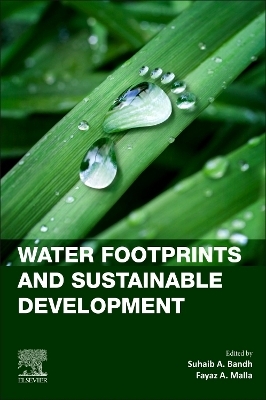
Water Footprints and Sustainable Development
Elsevier - Health Sciences Division (Verlag)
978-0-443-23631-0 (ISBN)
Dr. Suhaib A. Bandh is Associate Professor in the Postgraduate Department of Environmental Science at Sri Pratap College Campus, Cluster University Srinagar (J&K Government). He specializes in freshwater mycology and environmental science, having earned his PhD for pioneering research on fungal diversity in Dal Lake, Kashmir. He teaches postgraduate courses in environmental science and disaster management, actively mentoring future environmental scientists. His contributions include monographs, over 20 edited volumes with leading publishers (Elsevier, Springer Nature, Taylor & Francis) including the Elsevier volume, Freshwater Mycology (2022), as well as numerous peer-reviewed articles on aquatic ecosystems, microbial ecology, and sustainability. An active member of the Academy of Plant Sciences India and the National Environmental Science Academy, he regularly participates in national and international conferences. Dr. Bandh’s work advances understanding of freshwater fungi and environmental sustainability, marking him as a leading expert in microbial (fungal) ecological research and education. Dr. Fayaz Ahmad Malla is an Assistant Professor of Environmental Science at Government Degree College Tral, Jammu and Kashmir, with a Ph.D. in Environmental Sciences from the Indian Agricultural Research Institute, New Delhi. His doctoral research focused on biogas methane enrichment using selective chemical scavengers and microalgae. With expertise in waste management, renewable energy, and water conservation, Dr. Malla has contributed significantly to water auditing and enhancing agricultural water use efficiency during his tenure at The Energy and Resources Institute (TERI). He has published extensively in reputed national and international journals, including Ecological Engineering, Energy, Journal of Cleaner Production, Sustainability, and Recycling. Notable works include studies on biogas conditioning, Phycoremediation, and the role of microalgae in biodiesel production and wastewater treatment. Dr. Malla has co-authored books on biofuels, circular economy, and renewable energy with esteemed publishers like Elsevier, Springer, and CRC Press, and has contributed several book chapters on climate resilience, waste valorization, and environmental governance. Actively involved in academic conferences, Dr. Malla is a recognized scholar dedicated to advancing environmental sustainability and circular economy research.
1. Increasing water footprints: the NextGen Sustainability Challenge
2. Assessment of water footprints in different sectors
3. Comparative water footprint analysis of rural and urban areas
4. Drivers of the Growing Water footprint: A global scenario
5. Global Scenario of Water footprints in water smart cities
6. Water footprints towards global environmental sustainability
7. Industrial water conservation by water footprint and sustainable development goals
8. Sustainable Water Allocation and Water Footprints
9. Equitable water uses and environmental sustainability
10. Agriculture, Water footprints and virtual water trade nexus
11. Water footprint and power generation
12. Potentials and limitations of water footprints for gauging environmental sustainability
13. Strategies for the reduction of water footprints
| Erscheinungsdatum | 22.08.2024 |
|---|---|
| Reihe/Serie | Current Directions in Water Scarcity Research |
| Verlagsort | Philadelphia |
| Sprache | englisch |
| Maße | 216 x 276 mm |
| Gewicht | 890 g |
| Themenwelt | Naturwissenschaften ► Biologie ► Ökologie / Naturschutz |
| Technik ► Umwelttechnik / Biotechnologie | |
| ISBN-10 | 0-443-23631-3 / 0443236313 |
| ISBN-13 | 978-0-443-23631-0 / 9780443236310 |
| Zustand | Neuware |
| Informationen gemäß Produktsicherheitsverordnung (GPSR) | |
| Haben Sie eine Frage zum Produkt? |
aus dem Bereich