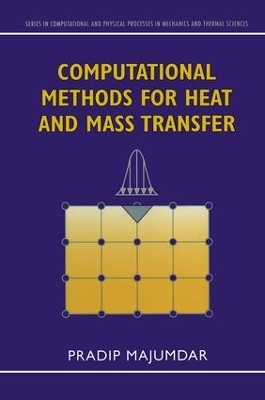
Computational Methods for Heat and Mass Transfer
Crc Press Inc (Verlag)
978-1-56032-994-7 (ISBN)
- Titel ist leider vergriffen;
keine Neuauflage - Artikel merken
The advent of high-speed computers has encouraged a growing demand for newly graduated engineers to possess the basic skills of computational methods for heat and mass transfer and fluid dynamics. Computational fluid dynamics and heat transfer, as well as finite element codes, are standard tools in the computer-aided design and analysis of processes and products involving coupled transport and multi-physic phenomena. This textbook introduces the fundamentals of two important computational techniques for solving heat and mass transfer and fluid flow problems: finite difference and finite element methods.
The objective of the book is to help the students thoroughly understand the basic concepts and procedures of fluid dynamics, heat and mass transfer and implement computational methodology into a computer code and solve more complex problems on their own. Theory and practice are combined in a simple and straightforward manner. Classic problems in heat transfer, mass transfer, and fluid flows are solved and illustrated through step-by-step derivations and numerous figures. End-of-chapter problems are provided at the end of every chapter for extra practice and homework assignments.
The book is divided into three parts: Part One contains a review of basic equations of heat transfer, mass transfer and fluid dynamics; concepts of numerical approximations and errors; numerical solution techniques for systems of linear algebraic equations; and numerical integrations and quadrature formulas. (The last two topics are included primarily for students who have had no prior course on numerical analysis). Part Two introduces the finite difference/control volume method. Part Three presents the finite element method.
As an introductory text, this book is appropriate for senior undergraduate and first-year graduate level courses. Students taking independent study can use the text as a comprehensive reference guide. Others who will find it a useful resource inclu
Majumdar, Pradip; Majumdar, Pradip
Preface
Nomenclature
Part I: Basic Equations and Numerical Analysis
1. Review of Basic Laws and Equations
1.1 Basic Equations
1.2 Fluid Flows
1.2.1 Fluid Properties
1.2.2 Basic Equations in Integral Forms
1.2.3 Differential Analysis of Fluid Motion
1.2.4 Boundary Conditions for Flow Field
1.3 Heat Transfer
1.3.1 Basic Modes and Transport Rate Equation
1.3.2 The First Law of Thermodynamics and Heat Equations
1.3.3 Thermal Initial and Boundary Conditions
1.4 Mass Transfer
1.4.1 Basic Modes and Transport Rate Equation
1.4.2 Conservation of Mass Species and Mass Concentration Equation
1.4.3 Initial and Boundary Conditions for Mass Transfer
1.5 Mathematical Classification of Governing Equation
Problems
2. Approximations and Errors
2.1 Truncation Error
2.2 Round off Error
2.2.1 Significant Figures or Digits
2.2.2 Computers Number System
2.2.3 Machine Epsilon
2.3 Error Definitions
2.4 Approximate Error
2.5 Convergence Criteria
Problems
3. Numerical Solution of Systems of Equations
3.1 Mathematical Background
3.1.1 Representation of the System of Equations
3.1.2 The Cramer's Rule and the Elimination of Unknowns
3.2 Direct Methods
3.2.1 Gauss Elimination
3.2.2 Gauss-Jordon Elimination Method
3.2.3 Decomposition of Factorization Methods
3.2.4 Banded Systems
3.2.5 Error Equations and Iterative Refinement
3.3 Iterative Methods
3.3.1 Jacobi Method
3.3.2 Gauss-Seidel Method
3.3.3 Convergence Criterion for Iterative Methods
3.3.4 Successive Over-Relaxation (SOR) method
3.3.5 Conjugate Gradient Method
3.3.6 Pre-conditioned Conjugate Gradient Method
Problems
4. Numerical Integration
4.1 Newton - Cotes Integration Formulas
4.1.1 The Trapezoidal Rule
4.1.2 Simpson's Integration Formula
4.1.3 Summary of Newton-Cotes Integration Formulas
4.2 Romberg Integration
4.3
| Erscheint lt. Verlag | 3.11.2005 |
|---|---|
| Reihe/Serie | Computational & Physical Processes in Mechanics & Thermal Scienc |
| Verlagsort | Bosa Roca |
| Sprache | englisch |
| Maße | 152 x 229 mm |
| Gewicht | 1088 g |
| Themenwelt | Technik ► Maschinenbau |
| Technik ► Umwelttechnik / Biotechnologie | |
| ISBN-10 | 1-56032-994-7 / 1560329947 |
| ISBN-13 | 978-1-56032-994-7 / 9781560329947 |
| Zustand | Neuware |
| Informationen gemäß Produktsicherheitsverordnung (GPSR) | |
| Haben Sie eine Frage zum Produkt? |
aus dem Bereich