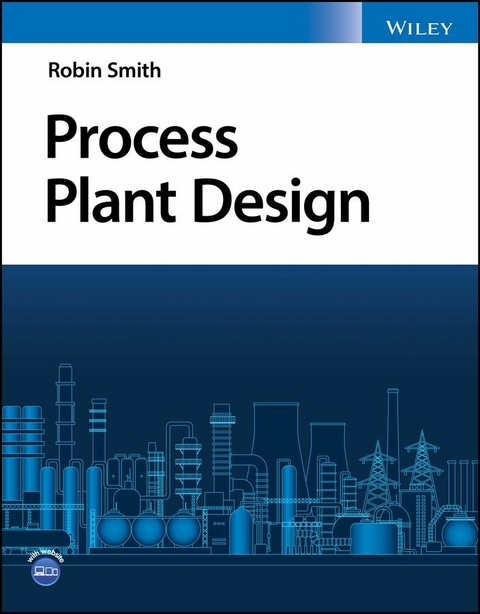
Process Plant Design (eBook)
John Wiley & Sons (Verlag)
978-1-119-69000-9 (ISBN)
An introductory practical guide to process plant design for students of chemical engineering and practicing chemical engineers.
Process Plant Design provides an introductory practical guide to the subject for undergraduate and postgraduate students of chemical engineering, and practicing chemical engineers.
- Process Plant Design starts by presenting general background from the early stages of chemical process projects and moves on to deal with the infrastructure required to support the operation of process plants.
- The reliability, maintainability and availability issues addressed in the text are important for process safety, and the avoidance of high maintenance costs, adverse environmental impact, and unnecessary process breakdowns that might prevent production targets being achieved.
- A practical approach is presented for the systematic synthesis of process control schemes, which has traditionally received little attention, especially when considering overall process control systems.
- The development of preliminary piping and instrumentation diagrams (P&IDs) is addressed, which are key documents in process engineering.
- A guide is presented for the choice of materials of construction, which affects resistance to corrosion, mechanical design and the capital cost of equipment.
- Whilst the final mechanical design of vessels and equipment is normally carried out by specialist mechanical engineers, it is still necessary for process designers to have an understanding of mechanical design for a variety of reasons.
- Finally, Process Plant Design considers layout, which has important implications for safety, environmental impact, and capital and operating costs.
To aid reader comprehension, Process Plant Design features worked examples throughout the text.
Process Plant Design is a valuable resource on the subject for advanced undergraduate and postgraduate students of chemical engineering, as well as practicing chemical engineers working in process design. The text is also useful for industrial disciplines related to chemical engineering working on the design of chemical processes.
Professor Robin Smith is Professor of Chemical Engineering at the University of Manchester. Before joining the University of Manchester he gained extensive industrial experience with different companies in process investigation, production, process design, process modelling and process integration. He has co-founded three spin-out companies from the University of Manchester and has acted extensively as a consultant to industry. He is a Fellow of the Royal Academy of Engineering, a Fellow of the Institution of Chemical Engineers in the UK and a Chartered Engineer. He has published widely in the field of process integration and is author of 'Chemical Process Design and Integration', published by Wiley. He was awarded the Hanson Medal of the Institution of Chemical Engineers, UK for his work on waste minimization, and the Sargent Medal for his work on process integration.
Process Plant Design An introductory practical guide to process plant design for students of chemical engineering and practicing chemical engineers. Process Plant Design provides an introductory practical guide to the subject for undergraduate and postgraduate students of chemical engineering, and practicing chemical engineers. Process Plant Design starts by presenting general background from the early stages of chemical process projects and moves on to deal with the infrastructure required to support the operation of process plants. The reliability, maintainability and availability issues addressed in the text are important for process safety, and the avoidance of high maintenance costs, adverse environmental impact, and unnecessary process breakdowns that might prevent production targets being achieved. A practical approach is presented for the systematic synthesis of process control schemes, which has traditionally received little attention, especially when considering overall process control systems. The development of preliminary piping and instrumentation diagrams (P&IDs) is addressed, which are key documents in process engineering. A guide is presented for the choice of materials of construction, which affects resistance to corrosion, mechanical design and the capital cost of equipment. Whilst the final mechanical design of vessels and equipment is normally carried out by specialist mechanical engineers, it is still necessary for process designers to have an understanding of mechanical design for a variety of reasons. Finally, Process Plant Design considers layout, which has important implications for safety, environmental impact, and capital and operating costs. To aid reader comprehension, Process Plant Design features worked examples throughout the text. Process Plant Design is a valuable resource on the subject for advanced undergraduate and postgraduate students of chemical engineering, as well as practicing chemical engineers working in process design. The text is also useful for industrial disciplines related to chemical engineering working on the design of chemical processes.
| Erscheint lt. Verlag | 8.11.2023 |
|---|---|
| Sprache | englisch |
| Themenwelt | Naturwissenschaften ► Chemie |
| Technik | |
| Schlagworte | chemical engineering • Chemical process projects • Chemie • Chemische Verfahrenstechnik • Chemistry • control of process operations • Control Process & Measurements • cooling utilities • degrees of freedom • Flow Rate • heating utilities • Industrial Chemistry • Inventory Control • Maschinenbau • mechanical engineering • Mess- u. Regeltechnik • Piping and instrumentation diagram • process design concepts • Process Engineering • Prozesssteuerung • Technische u. Industrielle Chemie • Verfahrenstechnik • waste treatment systems |
| ISBN-10 | 1-119-69000-5 / 1119690005 |
| ISBN-13 | 978-1-119-69000-9 / 9781119690009 |
| Informationen gemäß Produktsicherheitsverordnung (GPSR) | |
| Haben Sie eine Frage zum Produkt? |
 PDF (Adobe DRM)
Kopierschutz: Adobe-DRM
Adobe-DRM ist ein Kopierschutz, der das eBook vor Mißbrauch schützen soll. Dabei wird das eBook bereits beim Download auf Ihre persönliche Adobe-ID autorisiert. Lesen können Sie das eBook dann nur auf den Geräten, welche ebenfalls auf Ihre Adobe-ID registriert sind.
Details zum Adobe-DRM
Dateiformat: PDF (Portable Document Format)
Mit einem festen Seitenlayout eignet sich die PDF besonders für Fachbücher mit Spalten, Tabellen und Abbildungen. Eine PDF kann auf fast allen Geräten angezeigt werden, ist aber für kleine Displays (Smartphone, eReader) nur eingeschränkt geeignet.
Systemvoraussetzungen:
PC/Mac: Mit einem PC oder Mac können Sie dieses eBook lesen. Sie benötigen eine
eReader: Dieses eBook kann mit (fast) allen eBook-Readern gelesen werden. Mit dem amazon-Kindle ist es aber nicht kompatibel.
Smartphone/Tablet: Egal ob Apple oder Android, dieses eBook können Sie lesen. Sie benötigen eine
Geräteliste und zusätzliche Hinweise
Buying eBooks from abroad
For tax law reasons we can sell eBooks just within Germany and Switzerland. Regrettably we cannot fulfill eBook-orders from other countries.
aus dem Bereich