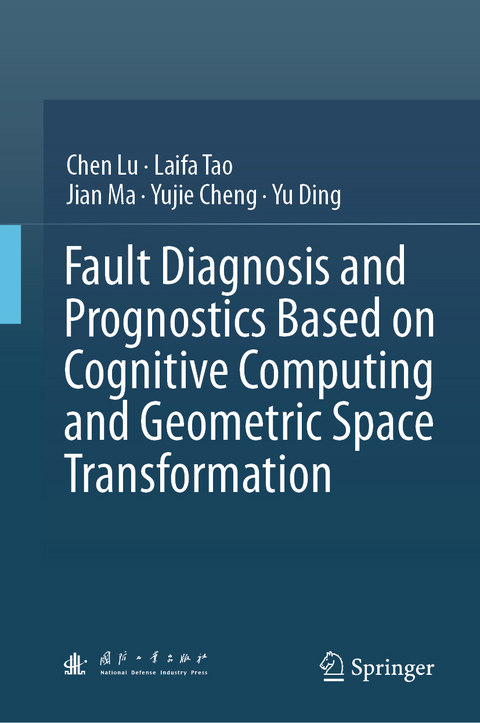
Fault Diagnosis and Prognostics Based on Cognitive Computing and Geometric Space Transformation
Springer Verlag, Singapore
978-981-99-8916-4 (ISBN)
- Titel nicht im Sortiment
- Artikel merken
Chen Lu received his PhD in Power Machinery Engineering from Dalian University of Technology. He is currently the full professor and director of Institute of Reliability Engineering at Beihang University and serves as the executive deputy director of the National Key Laboratory of Reliability and Environmental Engineering Technology (Beihang University) . Prof. Chen Lu has won a number of national and provincial leading talent titles and honors. He is Fellow of IET (Institution of Engineering and Technology) and Fellow of ISEAM (International Society of Engineering Asset Management). His research interests include fault diagnosis, prognostics and health management, and intelligent maintenance systems, where he has published more than 150 refereed papers in journals and conferences, including more than 70 in SCI-indexed journals. He has coauthored three academic books and was granted over 60 invention patents. Laifa Tao received the BSc and PhD degrees from the School of Reliability and Systems Engineering, Beihang University, in 2010 and 2014, respectively. He is currently the full professor with the School of Reliability and Systems Engineering, Beihang University, and has been listed in national youth top talent. His research interests include fault diagnosis, prognostics, health state assessment, optimization and determination, and health management for complex systems. Jian Ma received the BS degree in automation and the MS and PhD degrees in systems engineering from Beihang University, China, in 2009, 2012, and 2015, respectively. He was a visiting scholar with ENSMM, France, from 2018 to 2019. He is currently an associate professor with the School of Reliability and Systems Engineering, Beihang University, and has been listed in national youth top talent. His current interests of research mainly include intelligent fault diagnosis and prognostics and system health management. Yujie Cheng received her PhD degree in the School of Reliability and Systems Engineering at Beihang University in 2016. She was a postdoctor in FEMTO-ST/ ENSMM, Besancon, France, sponsored by China Scholarship Council from 2017 to 2018. Now she is working as an associate professor at Beihang University. Her current interests of research are focusing on intelligent fault diagnosis, prognostics, and maintenance decision for complex systems. Yu Ding received his PhD degree in systems engineering from Beihang University, Beijing, China, in 2019. He is currently an associate professor with the Institute of Reliability Engineering, Beihang University, Beijing, China. His research interests cover prognostics and health management, fault diagnosis, deep learning, and deep reinforcement learning. He has authored or co-authored over 20 publications in journals and received the Excellent Doctoral Dissertation Award in 2021 from the Chinese Society of Aeronautics and Astronautics.
Chapter 1 Introduction.- Chapter 2 Fault Diagnosis and Prognosis based on Deep Learning and Transfer Learning.- Chapter 3 Fault Diagnosis and Evaluation Based on Visual Cognitive Computing.- Chapter 4 Fault Diagnosis Based on Compressed Sensing.- Chapter 5 Fault Diagnosis and Evaluation Based on Differential Geometry.- Chapter 6 Performance Degradation Prediction and Assessment based on Geometric Space Transformation and Morphology Recognition.
| Erscheinungsdatum | 17.02.2024 |
|---|---|
| Zusatzinfo | 281 Illustrations, color; 76 Illustrations, black and white |
| Verlagsort | Singapore |
| Sprache | englisch |
| Maße | 155 x 235 mm |
| Themenwelt | Informatik ► Theorie / Studium ► Künstliche Intelligenz / Robotik |
| Technik ► Elektrotechnik / Energietechnik | |
| Schlagworte | cognitive computing • compressed sensing • Deep learning • Fault Diagnosis • Geometric space transformation • prognostic and health management • transfer learning • visual cognition |
| ISBN-10 | 981-99-8916-7 / 9819989167 |
| ISBN-13 | 978-981-99-8916-4 / 9789819989164 |
| Zustand | Neuware |
| Informationen gemäß Produktsicherheitsverordnung (GPSR) | |
| Haben Sie eine Frage zum Produkt? |
aus dem Bereich