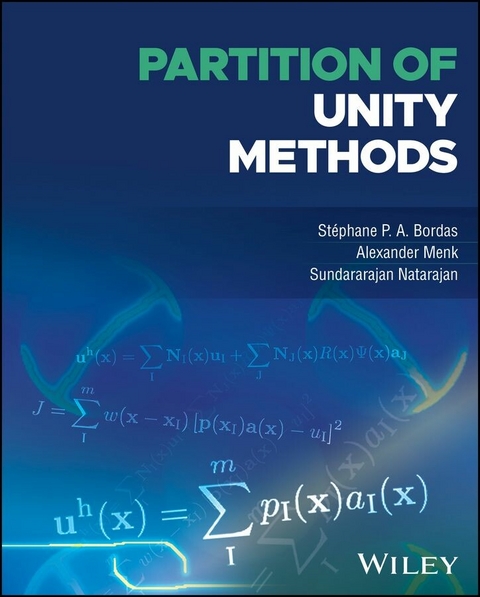
Partition of Unity Methods (eBook)
John Wiley & Sons (Verlag)
978-1-118-53588-2 (ISBN)
Master the latest tool in computational mechanics with this brand-new resource from distinguished leaders in the field
While it is the number one tool for computer aided design and engineering, the finite element method (FEM) has difficulties with discontinuities, singularities, and moving boundaries. Partition of unity methods addresses these challenges and is now increasingly implemented in commercially available software. Partition of Unity Methods delivers a detailed overview of its fundamentals, in particular the extended finite element method for applications in solving moving boundary problems. The distinguished academics and authors introduce the XFEM as a natural extension of the traditional finite element method (FEM), through straightforward one-dimensional examples which form the basis for the subsequent introduction of higher dimensional problems. This book allows readers to fully understand and utilize XFEM just as it becomes ever more crucial to industry practice.
Partition of Unity Methods explores all essential topics on this key new technology, including:
- Coverage of the difficulties faced by the finite element method and the impetus behind the development of XFEM
- The basics of the finite element method, with discussions of finite element formulation of linear elasticity and the calculation of the force vector
- An introduction to the fundamentals of enrichment
- A revisitation of the partition of unity enrichment
- A description of the geometry of enrichment features, with discussions of level sets for stationary interfaces
- Application of XFEM to bio-film, gradient theories, and three dimensional crack propagation
Perfect for researchers and postdoctoral candidates working in the field of computational mechanics, Partition of Unity Methods also has a place in the libraries of senior undergraduate and graduate students working in the field. Finite element and CFD analysts and developers in private industry will also greatly benefit from this book.
Stéphane P. A. Bordas is a Professor in Computational Mechanics and earned his PhD from Northwestern University, USA, in 2004. He has published over 200 papers in unfitted simulation of free boundary problems and data driven modelling of complex systems. He has supervised over 30 PhD students and is Editor- in-Chief of Advances in Applied Mechanics.
Alexander Menk is employed by Bosch GmbH. He is a PhD graduate from Glasgow University, UK, supervised by Prof. Bordas. His contributions range from automatic numerically determined enrichment to preconditioners for extended finite element methods for fracture.
Sundararajan Natarajan has been a Professor of Computational Mechanics since 2014 and earned his PhD from Cardiff University, UK, supervised by Prof. Bordas and Prof. Kerfriden. He has made strong contributions to a number of methods on unfitted methods for free boundary problems, in particular on numerical integration and strain smoothing.
Stéphane P. A. Bordas is a Professor in Computational Mechanics and earned his PhD from Northwestern University, USA, in 2004. He has published over 200 papers in unfitted simulation of free boundary problems and data driven modelling of complex systems. He has supervised over 30 PhD students and is Editor- in-Chief of Advances in Applied Mechanics. Alexander Menk is employed by Bosch GmbH. He is a PhD graduate from Glasgow University, UK, supervised by Prof. Bordas. His contributions range from automatic numerically determined enrichment to preconditioners for extended finite element methods for fracture. Sundararajan Natarajan has been a Professor of Computational Mechanics since 2014 and earned his PhD from Cardiff University, UK, supervised by Prof. Bordas and Prof. Kerfriden. He has made strong contributions to a number of methods on unfitted methods for free boundary problems, in particular on numerical integration and strain smoothing.
List of Contributors xi
Preface xiii
Acknowledgments xv
1 Introduction 1
1.1 The Finite Element Method 2
1.2 Suitability of the Finite Element Method 9
1.3 Some Limitations of the FEM 11
1.4 The Idea of Enrichment 16
1.5 Conclusions 19
2 A Step-by-Step Introduction to Enrichment 23
2.1 History of Enrichment for Singularities and Localized Gradients 25
2.2 Weak Discontinuities for One-dimensional Problems 38
2.3 Strong Discontinuities for One-dimensional Problem 58
2.4 Conclusions 61
3 Partition of Unity Revisited 67
3.1 Completeness, Consistency, and Reproducing Conditions 67
3.2 Partition of Unity 68
3.3 Enrichment 69
3.4 Numerical Examples 86
3.5 Conclusions 95
4 Advanced Topics 99
4.1 Size of the Enrichment Zone 99
4.2 Numerical Integration 100
4.3 Blending Elements and Corrections 108
4.4 Preconditioning Techniques 116
5 Applications 125
5.1 Linear Elastic Fracture in Two Dimensions with XFEM 125
5.2 Numerical Enrichment for Anisotropic Linear Elastic Fracture Mechanics 130
5.3 Creep and Crack Growth in Polycrystals 133
5.4 Fatigue Crack Growth Simulations 138
5.5 Rectangular Plate with an Inclined Crack Subjected to Thermo-Mechanical Loading 140
6 Recovery-Based Error Estimation and Bounding in XFEM 145
6.1 Introduction 145
6.2 Error Estimation in the Energy Norm. The ZZ Error Estimator 147
6.3 Recovery-based Error Estimation in XFEM 151
6.4 Recovery Techniques in Error Bounding. Practical Error Bounds. 174
6.5 Error Estimation in Quantities of Interest 179
7 Phi-FEM: An Efficient Simulation Tool Using Simple Meshes for Problems in Structure Mechanics and Heat Transfer 191
7.1 Introduction 191
7.2 Linear Elasticity 194
7.3 Linear Elasticity with Multiple Materials 204
7.4 Linear Elasticity with Cracks 208
7.5 Heat Equation 212
7.6 Conclusions and Perspectives 214
8 eXtended Boundary Element Method (XBEM) for Fracture Mechanics and Wave Problems 217
8.1 Introduction 217
8.2 Conventional BEM Formulation 218
8.3 Shortcomings of the Conventional Formulations 226
8.4 Partition of Unity BEM Formulation 228
8.5 XBEM for Accurate Fracture Analysis 228
8.6 XBEM for ShortWave Simulation 235
8.7 Conditioning and its Control 243
8.8 Conclusions 245
9 Combined Extended Finite Element and Level Set Method (XFE-LSM) for Free Boundary Problems 249
9.1 Motivation 249
9.2 The Level Set Method 250
9.3 Biofilm Evolution 256
9.4 Conclusion 269
10 XFEM for 3D Fracture Simulation 273
10.1 Introduction 273
10.2 Governing Equations 274
10.3 XFEM Enrichment Approximation 275
10.4 Vector Level Set 280
10.5 Computation of Stress Intensity Factor 282
10.6 Numerical Simulations 288
10.7 Summary 300
11 XFEM Modeling of Cracked Elastic-Plastic Solids 303
11.1 Introduction 303
11.2 Conventional von Mises Plasticity 303
11.3 Strain Gradient Plasticity 312
11.4 Conclusions 323
12 An Introduction to Multiscale analysis with XFEM 329
12.1 Introduction 329
12.2 Molecular Statics 330
12.3 Hierarchical Multiscale Models of Elastic Behavior -- The Cauchy-Born Rule 336
12.4 Current Multiscale Analysis -- The Bridging Domain Method 338
12.5 The eXtended Bridging Domain Method 340
References 344
Index 345
1
Introduction
Stéphane P. A. Bordas1, Alexander Menk2, and Sundararajan Natarajan3
1 University of Luxembourg, Luxembourg, UK
2 Robert Bosch GmbH, Germany
3 Indian Institute of Technology Madras, India
Physical systems are often modeled using partial differential equations (PDEs). The exact solution or closed form or analytical solutions to these PDEs is only available in special cases for specific geometries. Numerical methods can be used to approximate the exact solution in more general settings. The result of a numerical simulation is rarely exact. Nonetheless, computer-based numerical simulation has revolutionalized industrial product development throughout engineering disciplines. When comparing experiments and simulation with the aim of improving a simulation procedure to give more accurate results, it is necessary to understand the different sources of error. Figure 1.1 shows an overview of errors that occur at different stages of modeling and numerical simulation for a given numerical method.
Figure 1.1 Sources of error in simulation.
One of these numerical methods is called the “finite element method” (FEM). It is most commonly used in structural mechanics, although the field of application is much broader. The historic origins of the FEM cannot be uniquely determined. Mathematicians and engineers seemed to develop similar methods simultaneously which laid the foundations for what is now popularly known as the FEM. In the mathematical community, the developments can be summarized as follows. In 1851, Schellbach obtained an approximate solution to Plateaus problem by using piecewise linear functions on a surface. Variational principles to solve partial differential equations were used by Ritz in 1909. Based on the Ritz method, Courant proposed a triangulation of a two-dimensional (2D) structure to solve the plane torsion problem. The first book providing a solid mathematical basis for the FEM is attributed to Babuška and Aziz (Babuška and Aziz,1972). In the engineering community, the developments of FEM are motivated by physical analogies to describe continuous problems in a discrete fashion. Hrenikoff (Hrennikoff, 1941) combined trusses and beams to model plane elasticity problems. Turner, Clough, Martin, and Topp introduced plane elements in 1956. The term “finite element” was coined by Clough in 1960. The first book about the FEM written from an engineering perspective is attributed to Zienkiewicz (Zienkiewicz, 1971) in 1971. We will assume a certain familiarity of the reader with this method throughout the book, but we want to provide a short introduction to the FEM at this point, in order to introduce the main notations.
1.1 The Finite Element Method
Assume to be a domain of . Let us take a look at the following boundary value problem:
where is an unknown scalar field and .
Equation (1.1a) is known as Poisson’s equation when and as Laplace equation when . The open domain could be a region in , bounded by a dimensional surface whose outward normal is . We are looking for a scalar function that fulfills Poisson’s equation everywhere in . On the domain boundary , the function should be zero (c.f. Equation (1.1b)). In physics, this equation can be used to model a variety of phenomena, for example, an elasto-static rod under a torsional load, Newtonian gravity, electrostatics, diffusion, the motion of inviscid fluid, Schrödinger’s equation in Quantum mechanics, the motion of biological organisms in a solution and can also be used in surface reconstruction.
Here, let us assume that the scalar function could for instance be a temperature distribution, , that has come to an equilibrium. Then describes the heat supply inside the domain. It is easy to interpret the equation physically under these assumptions. The heat flux is proportional to , the gradient of . Because the system is in equilibrium, the sum of the heat flowing in and out of an infinitesimal subregion should be the same as the heat supplied by the heat sources inside that region. In other words, the divergence of the heat flux should be equal to at any point, which is equivalent to . Assuming a constant temperature distribution at the domain boundary could be reasonable if a material with a high thermal conductivity is attached to the region of interest. To simplify things, we postulate in Equation (1.1b) that this constant temperature is zero. Please note that once this problem is solved, one can add an arbitrary constant to and Equation (1.1a) is still fulfilled. If the problem is posed this way, then any solution must be differentiable twice in . This is a stronger condition on the choice of and moreover in many situations the solution is not differentiable twice, although the underlying physics is the same.
Let us consider an example. Assume that the temperature does not vary in the -direction. In that case, the problem can be posed in a 2D setting. Let the domain be the open unit square . A scalar function defined on the unit square is shown in Figure 1.2. The function is piecewise constant. We take this function to be the heat supply . A discontinuous heat supply is a realistic assumption in several situations. One could imagine an electric current flowing through a metal. Then the heat is generated at every point inside the metal, but not outside. Assuming that the heat generation at some point is proportional to the electrical current, a function containing jumps really is physically meaningful. Experimentally, one would measure a temperature distribution similar to the one shown in Figure 1.3.
Figure 1.2 A piecewise constant function on the unit square as an example for .
Figure 1.3 Temperature distribution.
The -component of the gradient of this temperature distribution is shown in Figure 1.4.
Figure 1.4 Gradient of the temperature distribution along the and the direction.
It is easily observed that the gradient is not differentiable at certain points. Therefore, the temperature distribution in Figure 1.3 is not a solution of Equation (1.1a), although it is the correct solution from a physical point of view.
This motivates the search for another problem description. Equation (1.1a) will subsequently be referred to as the classical formulation of the problem and a solution is called a classical solution. To obtain a new formulation, we multiply equation Equation (1.1a) by a scalar function defined on the domain and integrate over the whole domain to get:
The function is not completely arbitrary, but for now it suffices to assume certain nice properties such that we can perform the necessary integrations and differentiations in the following discussion. Applying partial integration to the left-hand side of Equation (1.2), we obtain:
It is obvious that Equation (1.3) is fulfilled for any function if is a classical solution. Let us assume that there is a function space which contains all the functions that are physically reasonable. By that we mean especially that the classical solution is in if it exists and that all the functions in vanish at the boundary1. Once such a space is known, the problem could be stated in the following abstract form, known as the weak form:
Weak form: Find , such that for all
where and are the symmetric bilinear and linear forms, respectively.
⨀ Example 1. Find the weak form for the following strong form and identify the linear and bilinear form:
where are constants independent of and subject to the following Dirichlet boundary conditions: .
⨀ Example 2. Repeat the above example, subjected to the following Dirichlet and Neumann boundary conditions: .
Using the weak form gives the function in Figure 1.3 a chance of being a solution to the problem because a solution of Equation (1.1a) needs only one time continuously differentiable. It remains to be checked under which circumstances a solution exists, and if this is a unique solution. Therefore, the term “physically meaningful,” used when initially describing , needs to be defined more precisely. To do this, we need to address the integration and the differentiation in Equation (1.3). To motivate why the classical integration and differentiation operations are not useful for our purpose we take a first step toward the numerical solution of the problem. The function space will generally...
| Erscheint lt. Verlag | 19.10.2023 |
|---|---|
| Sprache | englisch |
| Themenwelt | Technik ► Maschinenbau |
| Schlagworte | Electrical & Electronics Engineering • Elektrotechnik u. Elektronik • extended finite element method • Finite Element • Finite Element Method • Finite-Element-Methode • Maschinenbau • Maschinenbau - Entwurf • Mathematics • Mathematik • mechanical engineering • Mechanical Engineering - Design • Numerical Methods • Numerical Methods & Algorithms • numerische Methoden • Numerische Methoden u. Algorithmen • Numerisches Verfahren • XFEM |
| ISBN-10 | 1-118-53588-X / 111853588X |
| ISBN-13 | 978-1-118-53588-2 / 9781118535882 |
| Informationen gemäß Produktsicherheitsverordnung (GPSR) | |
| Haben Sie eine Frage zum Produkt? |
 EPUB (Adobe DRM)
Kopierschutz: Adobe-DRM
Adobe-DRM ist ein Kopierschutz, der das eBook vor Mißbrauch schützen soll. Dabei wird das eBook bereits beim Download auf Ihre persönliche Adobe-ID autorisiert. Lesen können Sie das eBook dann nur auf den Geräten, welche ebenfalls auf Ihre Adobe-ID registriert sind.
Details zum Adobe-DRM
Dateiformat: EPUB (Electronic Publication)
EPUB ist ein offener Standard für eBooks und eignet sich besonders zur Darstellung von Belletristik und Sachbüchern. Der Fließtext wird dynamisch an die Display- und Schriftgröße angepasst. Auch für mobile Lesegeräte ist EPUB daher gut geeignet.
Systemvoraussetzungen:
PC/Mac: Mit einem PC oder Mac können Sie dieses eBook lesen. Sie benötigen eine
eReader: Dieses eBook kann mit (fast) allen eBook-Readern gelesen werden. Mit dem amazon-Kindle ist es aber nicht kompatibel.
Smartphone/Tablet: Egal ob Apple oder Android, dieses eBook können Sie lesen. Sie benötigen eine
Geräteliste und zusätzliche Hinweise
Buying eBooks from abroad
For tax law reasons we can sell eBooks just within Germany and Switzerland. Regrettably we cannot fulfill eBook-orders from other countries.
aus dem Bereich