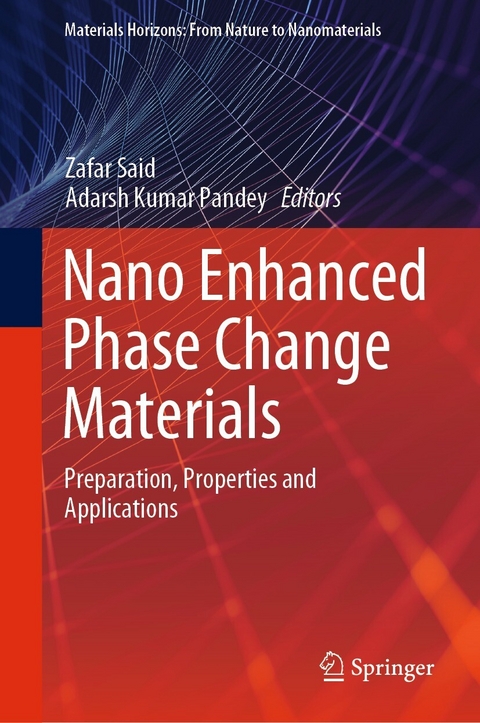
Nano Enhanced Phase Change Materials (eBook)
270 Seiten
Springer Nature Singapore (Verlag)
9789819954759 (ISBN)
This book provides information on thermal energy storage systems incorporating phase change materials (PCMs) which are widely preferred owing to their immense energy storage capacity. The thermal energy storage (TES) potential of PCMs has been deeply explored for a wide range of applications, including solar/electrothermal energy storage, waste heat storage, and utilization, building energy-saving, and thermal regulations. The inherent shortcomings like leakage during phase transition and poor thermal conductivity hamper their extensive usage. Nevertheless, it has been addressed by their shape stabilization with porous materials and dispersing highly conductive nanoparticles. Nanoparticles suspended in traditional phase change materials enhance the thermal conductivity. The addition of these nanoparticles to the conventional PCM enhances the storage. In this book, the history of Nano Enhanced Phase Change Materials (NEPCM), preparation techniques, properties, theoretical modeling and correlations, and the effect of all these factors on the potential applications such as: solar energy, electronics cooling, heat exchangers, building, battery thermal management, thermal energy storage are discussed in detail. Future challenges and future work scope have been included. The information from this book can enable the readers to come up with novel techniques, resolve existing research limitations, and come up with novel NEPCM, that can be implemented for various applications.
This book provides information on thermal energy storage systems incorporating phase change materials (PCMs) which are widely preferred owing to their immense energy storage capacity. The thermal energy storage (TES) potential of PCMs has been deeply explored for a wide range of applications, including solar/electrothermal energy storage, waste heat storage, and utilization, building energy-saving, and thermal regulations. The inherent shortcomings like leakage during phase transition and poor thermal conductivity hamper their extensive usage. Nevertheless, it has been addressed by their shape stabilization with porous materials and dispersing highly conductive nanoparticles. Nanoparticles suspended in traditional phase change materials enhance the thermal conductivity. The addition of these nanoparticles to the conventional PCM enhances the storage. In this book, the history of Nano Enhanced Phase Change Materials (NEPCM), preparation techniques, properties, theoretical modeling and correlations, and the effect of all these factors on the potential applications such as: solar energy, electronics cooling, heat exchangers, building, battery thermal management, thermal energy storage are discussed in detail. Future challenges and future work scope have been included. The information from this book can enable the readers to come up with novel techniques, resolve existing research limitations, and come up with novel NEPCM, that can be implemented for various applications.
| Erscheint lt. Verlag | 14.10.2023 |
|---|---|
| Reihe/Serie | Materials Horizons: From Nature to Nanomaterials | Materials Horizons: From Nature to Nanomaterials |
| Zusatzinfo | VI, 270 p. 93 illus., 81 illus. in color. |
| Sprache | englisch |
| Themenwelt | Naturwissenschaften ► Chemie |
| Naturwissenschaften ► Physik / Astronomie ► Atom- / Kern- / Molekularphysik | |
| Naturwissenschaften ► Physik / Astronomie ► Festkörperphysik | |
| Technik ► Maschinenbau | |
| Schlagworte | Nano Enhanced Phase Change Materials • nanotechnology • Phase Change Material • Solar thermal applications • thermal properties • Thermophysical properties |
| ISBN-13 | 9789819954759 / 9789819954759 |
| Informationen gemäß Produktsicherheitsverordnung (GPSR) | |
| Haben Sie eine Frage zum Produkt? |
 PDF (Wasserzeichen)
DRM: Digitales Wasserzeichen
Dieses eBook enthält ein digitales Wasserzeichen und ist damit für Sie personalisiert. Bei einer missbräuchlichen Weitergabe des eBooks an Dritte ist eine Rückverfolgung an die Quelle möglich.
Dateiformat: PDF (Portable Document Format)
Mit einem festen Seitenlayout eignet sich die PDF besonders für Fachbücher mit Spalten, Tabellen und Abbildungen. Eine PDF kann auf fast allen Geräten angezeigt werden, ist aber für kleine Displays (Smartphone, eReader) nur eingeschränkt geeignet.
Systemvoraussetzungen:
PC/Mac: Mit einem PC oder Mac können Sie dieses eBook lesen. Sie benötigen dafür einen PDF-Viewer - z.B. den Adobe Reader oder Adobe Digital Editions.
eReader: Dieses eBook kann mit (fast) allen eBook-Readern gelesen werden. Mit dem amazon-Kindle ist es aber nicht kompatibel.
Smartphone/Tablet: Egal ob Apple oder Android, dieses eBook können Sie lesen. Sie benötigen dafür einen PDF-Viewer - z.B. die kostenlose Adobe Digital Editions-App.
Buying eBooks from abroad
For tax law reasons we can sell eBooks just within Germany and Switzerland. Regrettably we cannot fulfill eBook-orders from other countries.
aus dem Bereich