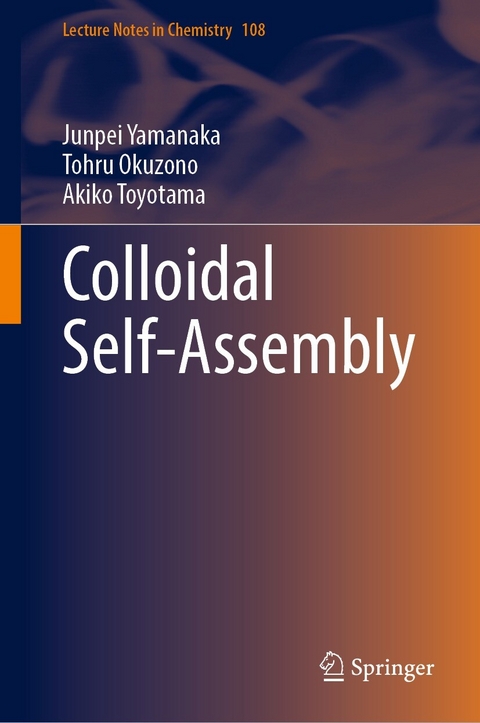
Colloidal Self-Assembly (eBook)
230 Seiten
Springer Nature Singapore (Verlag)
978-981-99-5052-2 (ISBN)
This concise book covers fundamental principles of colloidal self-assembly and overviews of basic and applied research in this field, with abundant illustrations and photographs. Experimental and computer simulation methods to study the colloidal self-assembly are demonstrated. Complementary videos 'Visual Guide to Study Colloidal Self-Assembly' on the research procedures and assembly processes are available via SpringerLink to support learning.
The book explains basic elements of mechanics and electromagnetism required to study the colloidal self-assembly, so that graduate students of chemistry and engineering courses can learn the contents on their own. It reviews important research topics, including the authors' works on the colloidal self-assembly of more than 30 years' work. The principal topics include: (1) crystallization of colloidal dispersions, with the emphasis on the role of surface charges, (2) fabrication of large and high-quality colloidal crystals by applying controlled growth methods, (3) association and crystallization by depletion attraction in the presence of polymers, (4) clustering of colloidal particles, especially those in oppositely charged systems, and (5) two-dimensional colloidal crystals. Furthermore, it covers (6) applications of colloidal crystals, ranging from cosmetics to sensing materials. We also describe space experiments on colloidal self-assembly in the International Space Station.This book will interest graduate school students in colloid and polymer science, pharmaceutics, soft matter physics, material sciences, and chemical engineering courses. It will also be a useful guide for individuals in academia and industry undertaking research in this field.
Junpei Yamanaka received his Ph.D. from Kyoto University in 1991. He is currently a professor in the colloid and polymer laboratory at Nagoya City University, Graduate School of Pharmaceutical Sciences. His research interests are in the self-assembly and structure formation of colloids. He has done research in this field for over 30 years and has published articles in internationally renowned journals including Physical Review Letters and the Journal of the American Chemical Society. He has more than 20 years of teaching experience at Nagoya City University and 5 years at Fukui University.
This concise book covers fundamental principles of colloidal self-assembly and overviews of basic and applied research in this field, with abundant illustrations and photographs. Experimental and computer simulation methods to study the colloidal self-assembly are demonstrated. Complementary videos "e;Visual Guide to Study Colloidal Self-Assembly"e; on the research procedures and assembly processes are available via SpringerLink to support learning.The book explains basic elements of mechanics and electromagnetism required to study the colloidal self-assembly, so that graduate students of chemistry and engineering courses can learn the contents on their own. It reviews important research topics, including the authors' works on the colloidal self-assembly of more than 30 years' work. The principal topics include: (1) crystallization of colloidal dispersions, with the emphasis on the role of surface charges, (2) fabrication of large and high-quality colloidal crystals by applyingcontrolled growth methods, (3) association and crystallization by depletion attraction in the presence of polymers, (4) clustering of colloidal particles, especially those in oppositely charged systems, and (5) two-dimensional colloidal crystals. Furthermore, it covers (6) applications of colloidal crystals, ranging from cosmetics to sensing materials. We also describe space experiments on colloidal self-assembly in the International Space Station.This book will interest graduate school students in colloid and polymer science, pharmaceutics, soft matter physics, material sciences, and chemical engineering courses. It will also be a useful guide for individuals in academia and industry undertaking research in this field.
| Erscheint lt. Verlag | 3.10.2023 |
|---|---|
| Reihe/Serie | Lecture Notes in Chemistry | Lecture Notes in Chemistry |
| Zusatzinfo | IX, 230 p. 176 illus., 151 illus. in color. |
| Sprache | englisch |
| Themenwelt | Naturwissenschaften ► Chemie ► Physikalische Chemie |
| Technik ► Maschinenbau | |
| Schlagworte | colloid • Colloidal Crystal • Colloid Structure Formation • Self-Assembly • Self-Organization |
| ISBN-10 | 981-99-5052-X / 981995052X |
| ISBN-13 | 978-981-99-5052-2 / 9789819950522 |
| Informationen gemäß Produktsicherheitsverordnung (GPSR) | |
| Haben Sie eine Frage zum Produkt? |
 PDF (Wasserzeichen)
Größe: 10,9 MB
DRM: Digitales Wasserzeichen
Dieses eBook enthält ein digitales Wasserzeichen und ist damit für Sie personalisiert. Bei einer missbräuchlichen Weitergabe des eBooks an Dritte ist eine Rückverfolgung an die Quelle möglich.
Dateiformat: PDF (Portable Document Format)
Mit einem festen Seitenlayout eignet sich die PDF besonders für Fachbücher mit Spalten, Tabellen und Abbildungen. Eine PDF kann auf fast allen Geräten angezeigt werden, ist aber für kleine Displays (Smartphone, eReader) nur eingeschränkt geeignet.
Systemvoraussetzungen:
PC/Mac: Mit einem PC oder Mac können Sie dieses eBook lesen. Sie benötigen dafür einen PDF-Viewer - z.B. den Adobe Reader oder Adobe Digital Editions.
eReader: Dieses eBook kann mit (fast) allen eBook-Readern gelesen werden. Mit dem amazon-Kindle ist es aber nicht kompatibel.
Smartphone/Tablet: Egal ob Apple oder Android, dieses eBook können Sie lesen. Sie benötigen dafür einen PDF-Viewer - z.B. die kostenlose Adobe Digital Editions-App.
Buying eBooks from abroad
For tax law reasons we can sell eBooks just within Germany and Switzerland. Regrettably we cannot fulfill eBook-orders from other countries.
aus dem Bereich