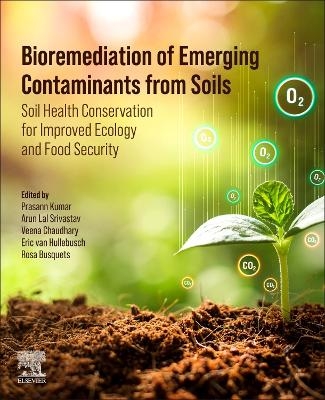
Bioremediation of Emerging Contaminants from Soils
Elsevier - Health Sciences Division (Verlag)
978-0-443-13993-2 (ISBN)
Designed to highlight soil health best practices for both environmental and agricultural sustainability, these approaches are also considered important for improving global food security by ensuring safe growing conditions for crops for food and feed. Presented in two parts, this book first highlights emerging contaminants and their sources. The second part explores a variety of steps and tools for addressing contaminated soils, including bio- and phytoremediation options. Case studies in each part provide real-world insights for practical application.
Dr. Prasann Kumar, assistant professor cum research intensive faculty in the Department of Agronomy, School of Agricultural (ICAR-Accredited), Lovely Professional University, Punjab, specializes in stress physiology, plant tissue culture, physiology of plant?microbe/pathogen interaction, and biodiversity management. Dr. Kumar has completed the International Agricultural Rural Development Programme from Cornell University, Ithaca, New York, United States. He has received a doctorate from Banaras Hindu University, Varanasi. He also has authored 40 books published by national and international publishers, which find a place in national as well as various Overseas Institutions’ libraries. He has guided 19 MSc students for their thesis. Prof. Veena Chaudhary is working as an associate professor in the Department of Chemistry at Meerut College, Meerut, affiliated with CCS University, Meerut. Dr. Chaudhary is deeply attached to chemistry, with a specialization in environmental chemistry. She has to her credit more than 50 research papers, 2 book chapters, and 20 abstracts. She received numerous awards, including a Young Scientist Award, a Fellow Scientist Award, and numerous others, for her contributions to the environmental field for the advancement of the social, welfare, and agricultural sectors. She is a life member of several scientific societies. She also visited abroad several times to attend international conferences and seminars for the purpose of gathering and sharing scientific knowledge. She is handling several research projects funded by DST, UP-CST, and higher education in Uttar Pradesh. Eric D. van Hullebusch is a full professor in biogeochemistry of engineered ecosystems at the Institut de Physique du Globe de Paris, Université Paris Cité, France. His research is currently focusing on the implementation of biohydrometallurgical approaches for the recovery of technology critical elements (including selenium and tellurium) as well as polluted soils (bio)remediation with a particular focus on poly- and perfluoroalkyl substances (PFAS). Dr. Rosa Busquets is currently working as an Associate Professor in the School of Life Sciences, Pharmacy and Chemistry, Faculty of Health Science Social Care and Education, Kingston University, Penrhyn Road Campus, Kingston upon Thames, United Kingdom. She works toward pushing the barriers of analytical chemistry and achieving significant improvements in monitoring molecules of special environmental relevance. Rosa is a specialist in chromatography-mass spectrometry and in the analysis of complex matrices. She is particularly interested in environmental monitoring and remediation. She carries out research to remove contaminants that pose a major threat to ecosystems due to their toxicity and high mobility and can therefore contaminate fresh water and affect our health. Nanoparticles, pesticides, plastic degradation products, and pharmaceuticals are among these contaminants. xxx About the editors Kumar-BECS- Dr. Arun Lal Srivastav is an Associate Professor in the Department of Applied Sciences at Chitkara University, Himachal Pradesh, India.
1 Exponential population growth and global food security: challenges and alternatives
2 Agricultural soil contamination due to industrial discharges: challenges for public
health protection and food security
3 Traditional approaches of agriculture soil remediation: boon or bane for global food security
4 Polycyclic aromatic hydrocarbons bioremediation mechanisms by nonligninolytic fungi: a multiscale approach
5 Phenolic compounds: a significant threat to agricultural soils
6 Pharmaceutical compounds: a recent threat to agricultural soils (sources, transport, and negative impacts on the crop’s quality and other adjacent ecosystems)
7 Sources of inorganic nonmetallic contaminants (synthetic fertilizers, pesticides) in agricultural soil and their impacts on the adjacent ecosystems
8 Sources of inorganic metallic contaminants (lead, cadmium, arsenic, etc.) in agricultural soil and their impacts on the adjacent ecosystems
9 Environmental threats posed by xenobiotics
10 Bioremediation of xenobiotic contamination in soil
11 Transgenic plants as a source of xenobiotic remediation
12 Xenobiotic stress management by microbial endophytes
13 Case studies on emerging contamination of soil
14 Bioremediation of metal-contaminated soil: comparison of microbial agents with plants
15 Phytoremediation of metal contaminated soil using energy crops: soil health maintenance along with biofuel production
16 Phytoremediation of phenolic compounds from soil
17 Phytoremediation of pharmaceutical compounds in soil
18 Alternative natural options of synthesized agrochemicals
19 Role of enzymes in the optimization of traditional phytoremediation processes of soil
20 Optimized phytoremediation process for the sustainable management radionuclides
21 Role of indigenous knowledge in agricultural soil reclamation without disturbing other ecosystems
22 Role of hyperaccumulators in the reduction of emerging industrial pollutants from soil
23 Microbes-assisted bioaugmentation process in the reduction of emerging industrial pollutants from soil
24 Application of genetically modified crops against metallic contaminations
25 Crop rotation patterns and soil health management
26 Application of microphytes for soil reclamation
27 Utilization of genetically modified weed plants against industrial contaminants: a promising tool of phytoremediation
28 Case studies on management practices for emerging contamination of soil, challenges and future scope
| Erscheinungsdatum | 18.05.2024 |
|---|---|
| Verlagsort | Philadelphia |
| Sprache | englisch |
| Maße | 191 x 235 mm |
| Gewicht | 1460 g |
| Themenwelt | Naturwissenschaften ► Geowissenschaften ► Geologie |
| Technik ► Lebensmitteltechnologie | |
| Weitere Fachgebiete ► Land- / Forstwirtschaft / Fischerei | |
| ISBN-10 | 0-443-13993-8 / 0443139938 |
| ISBN-13 | 978-0-443-13993-2 / 9780443139932 |
| Zustand | Neuware |
| Informationen gemäß Produktsicherheitsverordnung (GPSR) | |
| Haben Sie eine Frage zum Produkt? |
aus dem Bereich