


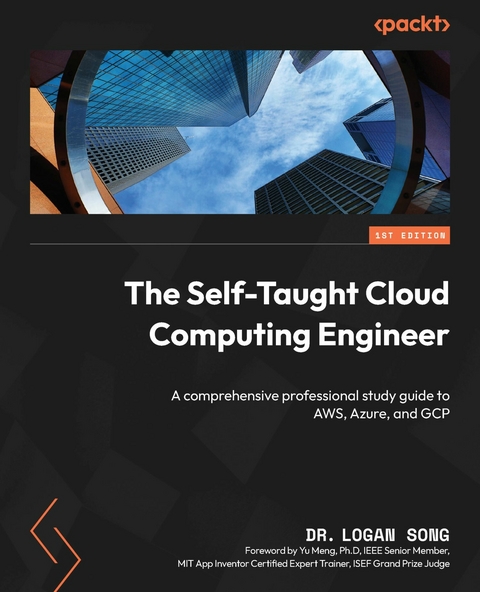
Self-Taught Cloud Computing Engineer (eBook)
480 Seiten
Packt Publishing (Verlag)
978-1-80512-868-7 (ISBN)
As cloud computing continues to revolutionize IT, professionals face the challenge of keeping up with rapidly evolving technologies. This book provides a clear roadmap for mastering cloud concepts, developing hands-on expertise, and obtaining professional certifications, making it an essential resource for those looking to advance their careers in cloud computing.
Starting with a focus on the Amazon cloud, you'll be introduced to fundamental AWS cloud services, followed by advanced AWS cloud services in the domains of data, machine learning, and security. Next, you'll build proficiency in Microsoft Azure cloud and Google Cloud Platform (GCP) by examining the common attributes of the three clouds, differentiating their unique features, along with leveraging real-life cloud project implementations on these cloud platforms. Through hands-on projects and real-world applications, you'll gain the skills needed to work confidently across different cloud platforms. The book concludes with career development guidance, including certification paths and industry insights to help you succeed in the cloud computing landscape.
Walking through this cloud computing book, you'll systematically establish a robust footing in AWS, Azure, and GCP, and emerge as a cloud-savvy professional, equipped with cloud certificates to validate your skills.
Transform into a cloud-savvy professional by mastering cloud technologies through hands-on projects and expert guidance, paving the way for a thriving cloud computing careerKey FeaturesGain a solid foundation in cloud computing with a structured, easy-to-follow guideDevelop practical skills across AWS, Azure, and Google Cloud, covering compute, storage, networking, data, security, and AIWork on real life industrial projects, business use cases, and personal cloud career developmentPurchase of the print or Kindle book includes a free PDF eBookBook DescriptionAs cloud computing continues to revolutionize IT, professionals face the challenge of keeping up with rapidly evolving technologies. This book provides a clear roadmap for mastering cloud concepts, developing hands-on expertise, and obtaining professional certifications, making it an essential resource for those looking to advance their careers in cloud computing. Starting with a focus on the Amazon cloud, you ll be introduced to fundamental AWS cloud services, followed by advanced AWS cloud services in the domains of data, machine learning, and security. Next, you ll build proficiency in Microsoft Azure cloud and Google Cloud Platform (GCP) by examining the common attributes of the three clouds, differentiating their unique features, along with leveraging real-life cloud project implementations on these cloud platforms. Through hands-on projects and real-world applications, you ll gain the skills needed to work confidently across different cloud platforms. The book concludes with career development guidance, including certification paths and industry insights to help you succeed in the cloud computing landscape. Walking through this cloud computing book, you ll systematically establish a robust footing in AWS, Azure, and GCP, and emerge as a cloud-savvy professional, equipped with cloud certificates to validate your skills.What you will learnDevelop core skills needed to work with AWS, Azure, and GCPGain proficiency in compute, storage, and networking services across multi-cloud and hybrid-cloud environmentsIntegrate cloud databases, big data, and machine learning services in multi-cloud environmentsDesign and develop data pipelines, encompassing data ingestion, storage, processing, and visualization in the cloudsImplement machine learning pipelines in multi-cloud environmentSecure cloud infrastructure ecosystems with advanced cloud security servicesWho this book is forThis book is ideal for IT professionals looking to transition into cloud computing, as well as experienced cloud practitioners seeking to deepen their knowledge. Whether you're a beginner with basic computing experience or an industry professional aiming to expand your expertise, this comprehensive guide provides the skills and insights needed to excel in the cloud domain.]]>
Preface
Cloud computing came into our world in 2006, about 60 years after the first computer emerged. Cloud computing provides a brand-new concept of computing power services such as elastic, self-provisioning, and on-demand. In a traditional computing data center model, computing infrastructure is conceived as physical hardware with space, compute and network equipment, admin staff, physical security, and capital expenditure – entailing a long procurement cycle, big maintenance costs, and a lumbering structure. The new cloud computing model builds the computing infrastructure as software that matches your business needs: provisioning and terminating computing resources on-demand, scaling the computing resources up and down elastically and automatically, deploying the cloud resources as immutable code with version control, and paying for what you use.
Amazon Web Services (AWS) was the first cloud service, followed by Microsoft Azure and Google Cloud Platform (GCP). These are the three main clouds that are dominating the world, and this book helps you to learn about and master all of them and build a successful career in cloud computing.
Who this book is for
The book is for individuals in the information technology domain, whether you are a beginner looking to start your cloud computing journey or an experienced professional seeking to expand your skills. Our interactive study book is designed to empower you with the knowledge and practical experience necessary to excel in the world of cloud computing. With the detailed roadmap in the book, you will be able to complete a comprehensive cloud learning journey and develop a successful cloud computing career thereafter.
What this book covers
Chapter 1, Amazon EC2 and Compute Services, introduces AWS cloud compute services including EC2, among others.
Chapter 2, Amazon Cloud Storage Services, delves into AWS cloud storage services including EBS, EFS, S3, and so on.
Chapter 3, Amazon Cloud Networking Services, discusses AWS cloud networking services, including VPC, Amazon Direct Connect, Amazon Domain Name Service (DNS), and Content Delivery Network (CDN).
Chapter 4, Amazon Cloud Database Services, covers relational databases, NoSQL databases, and data warehouses in the AWS cloud.
Chapter 5, Amazon Cloud Big Data Services, explores AWS big data services for data ingestion, storing, processing, and visualization in the Amazon cloud.
Chapter 6, Amazon Cloud Machine Learning Services, examines AWS cloud machine learning (ML) services, including SageMaker and AWS ML API services.
Chapter 7, Amazon Cloud Security Services, addresses AWS cloud security services for hardening the Amazon cloud environment.
Chapter 8, Google Cloud Foundation Services, covers Google Compute Engine (GCE), Persistent Disks (PDs), network storage (Filestore), Google Cloud Storage (GCS), Google VPC, and VPC peering.
Chapter 9, Google Cloud Data Services, covers GCP data services such as Cloud SQL, Firestore, Datastore, and Bigtable; and GCP big data services, including BigQuery, Pub/Sub, Dataproc, Dataflow, and so on.
Chapter 10, Google Cloud AI Services, examines GCP ML services, focusing on GCP Vertex AI and AI APIs.
Chapter 11, Google Cloud Security Services, discusses GCP security services including endpoint security, network security, data security, and Security Command Center (SCC), which is the focal point of this chapter.
Chapter 12, Azure Cloud Foundation Services, explores the concepts of Azure cloud virtual machines and disk storage, file storage, Binary Large Object (BLOB) storage, queue storage, table storage, Azure vNets, and peering.
Chapter 13, Azure Cloud Data Services, covers Azure cloud-managed database services such as relational databases (Azure SQL Database), NoSQL databases (Azure Cosmos DB), and cache databases (Azure Cache for Redis), and discusses Azure big data services including Azure Data Factory, Azure Databricks, and Azure HDInsight.
Chapter 14, Azure Cloud AI Services, discusses Azure Machine Learning workspaces and Azure Cognitive Services, including the Azure OpenAI service.
Chapter 15, Azure Cloud Security Services, covers Microsoft Azure cloud security, including Azure security best practices, the Azure cloud security reference architecture, and an Azure security case study of a real-life project.
Chapter 16, Achieving Cloud Certification, reviews cloud certification roadmaps for AWS, Azure, and GCP, develops cloud exam strategies, and analyzes practice questions for seven cloud certification exams.
Chapter 17, Building a Successful Cloud Computing Career, discusses the cloud job market and the soft skills in a cloud career, and I share my own cloud story.
To get the most out of this book
To get the most out of this book, study the chapters to master the basic concepts, learn by doing all the lab examples in the chapters, study the certification exam contents, and go on to achieve cloud certifications.
If you are using the digital version of this book, we advise you to type the code yourself or access the code from the book’s GitHub repository (a link is available in the next section). Doing so will help you avoid any potential errors related to the copying and pasting of code.
Download the example code files
You can download the example code files for this book from GitHub at https://github.com/PacktPublishing/Self-Taught-Cloud-computing-Engineer.
If there’s an update to the code, it will be updated in the GitHub repository.
We also have other code bundles from our rich catalog of books and videos available at https://github.com/PacktPublishing/. Check them out!
Conventions used
There are a number of text conventions used throughout this book.
Code in text: Indicates code words in text, database table names, folder names, filenames, file extensions, pathnames, dummy URLs, user input, and Twitter handles. Here is an example: “Using putty to connect to a Linux instance, install mysql client pkg and connect to the RDS endpoint.”
A block of code is set as follows:
Create database school; Create table school.students ( StudentID int primary key, LastName varchar(100), FirstName varchar(100), City varchar(100) );When we wish to draw your attention to a particular part of a code block, the relevant lines or items are set in bold:
Create database school; Create table school.students ( StudentID int primary key, LastName varchar(100), FirstName varchar(100), City varchar(100) );Any command-line input or output is written as follows:
gcloud functions deploy image_checking --trigger-resource z04092023-upload --trigger-event google.storage.object.finalize --runtime python37Bold: Indicates a new term, an important word, or words that you see on screen. For instance, words in menus or dialog boxes appear in bold. Here is an example: “Click Explore table items.”
Tips or important notes
Appear like this.
Get in touch
Feedback from our readers is always welcome.
General feedback: If you have questions about any aspect of this book, email us at customercare@packtpub.com and mention the book title in the subject of your message.
Errata: Although we have taken every care to ensure the accuracy of our content, mistakes do happen. If you have found a mistake in this book, we would be grateful if you would report this to us. Please visit www.packtpub.com/support/errata and fill in the form.
Piracy: If you come across any illegal copies of our works in any form on the...
| Erscheint lt. Verlag | 22.9.2023 |
|---|---|
| Vorwort | Yu Meng |
| Sprache | englisch |
| Themenwelt | Mathematik / Informatik ► Informatik ► Datenbanken |
| Mathematik / Informatik ► Informatik ► Netzwerke | |
| Mathematik / Informatik ► Informatik ► Theorie / Studium | |
| Mathematik / Informatik ► Informatik ► Web / Internet | |
| Technik ► Elektrotechnik / Energietechnik | |
| ISBN-10 | 1-80512-868-X / 180512868X |
| ISBN-13 | 978-1-80512-868-7 / 9781805128687 |
| Informationen gemäß Produktsicherheitsverordnung (GPSR) | |
| Haben Sie eine Frage zum Produkt? |
 EPUB (Ohne DRM)
Digital Rights Management: ohne DRM
Dieses eBook enthält kein DRM oder Kopierschutz. Eine Weitergabe an Dritte ist jedoch rechtlich nicht zulässig, weil Sie beim Kauf nur die Rechte an der persönlichen Nutzung erwerben.
Dateiformat: EPUB (Electronic Publication)
EPUB ist ein offener Standard für eBooks und eignet sich besonders zur Darstellung von Belletristik und Sachbüchern. Der Fließtext wird dynamisch an die Display- und Schriftgröße angepasst. Auch für mobile Lesegeräte ist EPUB daher gut geeignet.
Systemvoraussetzungen:
PC/Mac: Mit einem PC oder Mac können Sie dieses eBook lesen. Sie benötigen dafür die kostenlose Software Adobe Digital Editions.
eReader: Dieses eBook kann mit (fast) allen eBook-Readern gelesen werden. Mit dem amazon-Kindle ist es aber nicht kompatibel.
Smartphone/Tablet: Egal ob Apple oder Android, dieses eBook können Sie lesen. Sie benötigen dafür eine kostenlose App.
Geräteliste und zusätzliche Hinweise
Buying eBooks from abroad
For tax law reasons we can sell eBooks just within Germany and Switzerland. Regrettably we cannot fulfill eBook-orders from other countries.
aus dem Bereich


