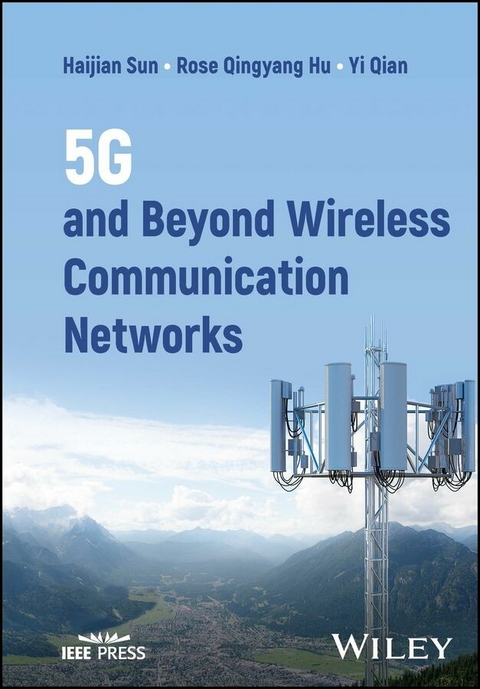
5G and Beyond Wireless Communication Networks (eBook)
John Wiley & Sons (Verlag)
978-1-119-08950-6 (ISBN)
5G and Beyond Wireless Communication Networks
A comprehensive and up-to-date survey of 5G technologies and applications
In 5G and Beyond Wireless Communication Networks, a team of distinguished researchers deliver an expert treatment of the technical details of modern 5G wireless networks and the performance gains they make possible. The book examines the recent progress in research and development in the area, covering related topics on fundamental 5G requirements and its enabling technologies.
The authors survey 5G service architecture and summarize enabling technologies, including highly dense small cell and heterogeneous networks, device-to-device communications underlaying cellular networks, fundamentals of non-orthogonal multiple access in 5G new radio and its applications. Readers will also find:
- A thorough introduction to 5G wireless networks, including discussions of anticipated growth in mobile data traffic
- Comprehensive explorations of dense small cell and heterogeneous networks
- Practical discussions of the most recent developments in 5G research and enabling technologies
- Recent advancement of non-orthogonal multiple access and its role in current and future wireless systems
Perfect for graduate students, professors, industry professionals, and engineers with an interest in wireless communication, 5G and Beyond Wireless Communication Networks will also benefit undergraduate and graduate students and researchers seeking an up-to-date and accessible new resource about 5G networks.
Haijian Sun, PhD, is an Assistant Professor in the School of Electrical and Computer Engineering at the University of Georgia in Athens, USA. His research interests include wireless communications for 5G and beyond, efficient edge computing, wireless security, and wireless for distributed learning.
Rose Qingyang Hu, PhD, is a Professor in the Department of Electrical and Computer Engineering at Utah State University in Logan, USA. Her research interests include next-generation wireless communications, wireless network design and optimization, and more.
Yi Qian, PhD, is a Professor in the Department of Electrical and Computer Engineering at the University of Nebraska-Lincoln in Omaha, USA. His research interests include cyber security and communication network security, computer networks, and wireless networks.
5G and Beyond Wireless Communication Networks A comprehensive and up-to-date survey of 5G technologies and applications In 5G and Beyond Wireless Communication Networks, a team of distinguished researchers deliver an expert treatment of the technical details of modern 5G wireless networks and the performance gains they make possible. The book examines the recent progress in research and development in the area, covering related topics on fundamental 5G requirements and its enabling technologies. The authors survey 5G service architecture and summarize enabling technologies, including highly dense small cell and heterogeneous networks, device-to-device communications underlaying cellular networks, fundamentals of non-orthogonal multiple access in 5G new radio and its applications. Readers will also find: A thorough introduction to 5G wireless networks, including discussions of anticipated growth in mobile data traffic Comprehensive explorations of dense small cell and heterogeneous networks Practical discussions of the most recent developments in 5G research and enabling technologies Recent advancement of non-orthogonal multiple access and its role in current and future wireless systems Perfect for graduate students, professors, industry professionals, and engineers with an interest in wireless communication, 5G and Beyond Wireless Communication Networks will also benefit undergraduate and graduate students and researchers seeking an up-to-date and accessible new resource about 5G networks.
Haijian Sun, PhD, is an Assistant Professor in the School of Electrical and Computer Engineering at the University of Georgia in Athens, USA. His research interests include wireless communications for 5G and beyond, efficient edge computing, wireless security, and wireless for distributed learning. Rose Qingyang Hu, PhD, is a Professor in the Department of Electrical and Computer Engineering at Utah State University in Logan, USA. Her research interests include next-generation wireless communications, wireless network design and optimization, and more. Yi Qian, PhD, is a Professor in the Department of Electrical and Computer Engineering at the University of Nebraska-Lincoln in Omaha, USA. His research interests include cyber security and communication network security, computer networks, and wireless networks.
1
Introduction to 5G and Beyond Network
We have witnessed an unprecedented development of wireless technology for the past few decades. Starting from 1980s, when the first mobile phone was released, major wireless technology advanced almost every decade. From first generation (1G) to 4G. The invention of smart devices, such as phones, tablets, and home appliances, is the main driving force for the ever‐increasing mobile traffic today. It is not surprising that mobile traffic increased 10‐fold between 2014 and 2019 globally. The mobile data traffic is expected to grow much faster than fixed IP traffic in the upcoming years [34]. Wireless technologies dramatically changed the way people interact, communicate, and collaborate, especially at post‐Covid era. The need for faster, more efficient and secure, and intelligent communication technique remains strong. While the current wireless communication systems such as 4G long term evolution (LTE) have been pushed to their theoretic capacity limit, different air interface and radio access technologies including heterogeneous network (HetNet) [76, 77], multiuser multi‐input multi‐output (MU‐MIMO) [105], and device‐to‐device (D2D) communication [51] have become potential paradigms to fulfill the gap between demands from end users and the capacity that current air interface can provide.
1.1 5G and Beyond System Requirements
In their pioneering work [10], Andrews et al. evaluated the requirements for 5G. In short, 5G wireless communication system should provide 1,000 times aggregate data improvement over 4G, support for as low as 1 ms round‐trip latencies, 10 times longer battery life for low‐power devices, and also support 10,000 times or more low‐rate devices in a single macro cell, see Figure 1.1 for a brief illustration. Due to those high requirements, the transformation from 4G to 5G cannot be simply fulfilled by extensions of current technologies. In general, 5G and beyond system should support or deliver the following aspects. Notably, (i) more bandwidth. Currently commercial cellular systems use frequencies below 6 GHz (sub‐6 GHz); in fact, there is abundant bandwidth in the millimeter‐wave (mmWave) band, for example in 28 GHz and above, which can provide more bandwidth that previously have not been applied in cellular networks. (ii) More antennas. Higher frequency also brings smaller form factor of large antenna arrays. Additionally, the signal processing techniques in terms of massive MIMO and transceiver design also improved significantly. (iii) New radios (NR). The physical layer in 5G will change dramatically, specifically the 5G NR, which includes the new multiple access technology, the new air interface, and a combination of several existing techniques. (iv) New schemes. It is expected that ultra dense networks (UDN) will be heavily deployed. The density of small base station (BS), such as micro BS, femto cell, and pico cells, will be much higher than that in 4G. But they share the similarity in terms of deploying BSs with different powers to provide seamless coverage, as well as performance improvements from short‐range communications. (v) High intelligence. It is expected that beyond 5G systems should support higher level of intelligence. Emerging applications such as Artificial intelligence (AI), semantic communication, and robots will surely benefit from AI‐friendly wireless technology. (vi) Pervasive wireless. It is anticipated that each person will carry more personal devices for enhanced life style and health monitoring. To support ubiquitous wireless connectivity, those devices need be connected. Current network architecture can hardly support such high number of devices simultaneously.
Figure 1.1 Four main goals for 5G.
1.1.1 Technical Challenges
The above promising technologies are able to deliver ambitious goals of 5G, but they ultimately encounter some challenges. First of all, even though high‐frequency bands have major vacancy, mmWave signals are notorious for weak penetration and vulnerable blockage; hence, the transmission characteristics are big concerns. Moreover, studies also have shown mmWave signals have high attenuation due to atmospheric gaseous, rain, concrete structure, glasses, even foliage. The real‐world deployment of such mmWave systems needs to be carefully studied and planned. Secondly, from the transceiver design perspective, higher‐frequency signals impose challenges in circuit design, materials, and heating issues. Nyquist theorem sets the lower boundary for sampling rate in communication systems. With wide bandwidth in mmWave spectrum, sampling rate can reach up to 10 Gbit/s level, and high‐speed circuit design becomes very difficult. It is also reported that the energy efficiency for components (power amplifier, analog‐to‐digital converter, digital‐to‐analog converter) in high frequency is low, only around 10%. One of the major concerns from network operators is that power consumption will hike due to 5G. Furthermore, the low efficiency in these components also brings thermal issues in hand‐held devices, degrading user experiences. Thirdly, with mmWave band, performance gain largely comes from large‐scale antenna array, current design can integrate hundreds of antenna elements in a small area (due to small wavelength of mmWave signals). Even though this can facilitate the beamforming, which generates narrow but stronger signals toward desired direction, the overhead for channel estimation, precoding, and beam tracking is too large. Fourthly, in UDN networks, since the transmitter density is high, signals can cause higher interferences with each other. The problem will be more severe with high‐density users in the same area. Challenges in mobility management, interference management, and heterogeneity nature of devices are severe. Lastly, it is expected to support intelligent applications in beyond 5G systems. For example, conventional communication systems are transparent of message (i.e. they are only responsible for transmitting bits but do not know any further info). Semantic communication, on the other hand, has knowledge of the underlying message, and the communication scheme can be dynamically changed to fit different needs of the message. Besides, ubiquitous wireless signals open door for sensing applications, such as localization, monitoring, and healthcare. In recent years, intelligent communication system has been proposed to accommodate these needs. A notable example is wireless federated learning system to cater the distributed machine learning. However, a deep integration from wireless design perspective is strongly desired.
Recently, there are several emerging technologies which aim to deliver the goal of 5G and beyond, and address the challenges above. Specifically, in this book, our focus is on the physical layer techniques, such as 5G NR non‐orthogonal multiple access (NOMA) and physical layer (PHY) mobile edge computing (MEC), high‐level communication architecture for pervasive Internet of Things (IoT) devices, as well as wireless federated learning system design. We have conducted preliminary researches to address the challenges mentioned above. Specifically, we discuss how to utilize NOMA on improving aggregated data rate and supporting more devices simultaneously, propose schemes for wearable IoT communications, discuss the usage of MEC on helping with power consumption and latency, and analyze how wireless design can facilitate distributed machine learning. Below we briefly introduce each enabling technique.
1.2 Enabling Technologies
1.2.1 5G New Radio
1.2.1.1 Non‐orthogonal Multiple Access (NOMA)
Initially proposed by NTT DOCOMO as an enhancement for LTE‐advanced (LTE‐A) in 2013, NOMA has been recognized as one of the most promising techniques for 5G due to its capability of supporting a higher spectral efficiency (SE) and native integration of massive connectivity. The basic principle of NOMA is that at the transmitter side, multiple signals are added up with different powers, forming a superimposed signal (SS). To ensure weak user's quality of service (QoS), at the receiver side, successive interference cancellation (SIC) is used to retrieve each user's signal sequentially from the SS. Specifically, a user can decode the strongest signal by treating other signals as interference. If the decoded signal is its own data, SIC stops. Otherwise, the receiver subtracts the decoded signal from the SS and continues to decode the next strongest signal. Notice that SS with SIC is not new; in information theory, this duo is a capacity‐achieving technique in the uplink communication. However, the difference is in NOMA, the weak user has a stronger power, which is not information‐theoretic optimal. Since its design philosophy may be combined with diverse transceivers, it has drawn tremendous attention in multiple‐antenna systems and in downlink and uplink multi‐cell networks. In contrast to classic orthogonal multiple access...
| Erscheint lt. Verlag | 31.8.2023 |
|---|---|
| Reihe/Serie | IEEE Press | Wiley - IEEE |
| Sprache | englisch |
| Themenwelt | Technik ► Elektrotechnik / Energietechnik |
| Schlagworte | 5G • 5G Communication Networks • 5g developments • 5G Networks • 5g r&d • 5G research • 5G technologies • 5G technology • 5g wireless networks • Communication Technology - Networks • Drahtlose Kommunikation • Electrical & Electronics Engineering • Elektrotechnik u. Elektronik • heterogeneous networks • Kommunikationsnetz • Kommunikationsnetze • Millimeter-wave communications • Mobile & Wireless Communications • Non-orthogonal multiple access • qoe aware • Signal Processing • Signalverarbeitung • Small cell networks |
| ISBN-10 | 1-119-08950-6 / 1119089506 |
| ISBN-13 | 978-1-119-08950-6 / 9781119089506 |
| Informationen gemäß Produktsicherheitsverordnung (GPSR) | |
| Haben Sie eine Frage zum Produkt? |
 EPUB (Adobe DRM)
Kopierschutz: Adobe-DRM
Adobe-DRM ist ein Kopierschutz, der das eBook vor Mißbrauch schützen soll. Dabei wird das eBook bereits beim Download auf Ihre persönliche Adobe-ID autorisiert. Lesen können Sie das eBook dann nur auf den Geräten, welche ebenfalls auf Ihre Adobe-ID registriert sind.
Details zum Adobe-DRM
Dateiformat: EPUB (Electronic Publication)
EPUB ist ein offener Standard für eBooks und eignet sich besonders zur Darstellung von Belletristik und Sachbüchern. Der Fließtext wird dynamisch an die Display- und Schriftgröße angepasst. Auch für mobile Lesegeräte ist EPUB daher gut geeignet.
Systemvoraussetzungen:
PC/Mac: Mit einem PC oder Mac können Sie dieses eBook lesen. Sie benötigen eine
eReader: Dieses eBook kann mit (fast) allen eBook-Readern gelesen werden. Mit dem amazon-Kindle ist es aber nicht kompatibel.
Smartphone/Tablet: Egal ob Apple oder Android, dieses eBook können Sie lesen. Sie benötigen eine
Geräteliste und zusätzliche Hinweise
Buying eBooks from abroad
For tax law reasons we can sell eBooks just within Germany and Switzerland. Regrettably we cannot fulfill eBook-orders from other countries.
aus dem Bereich