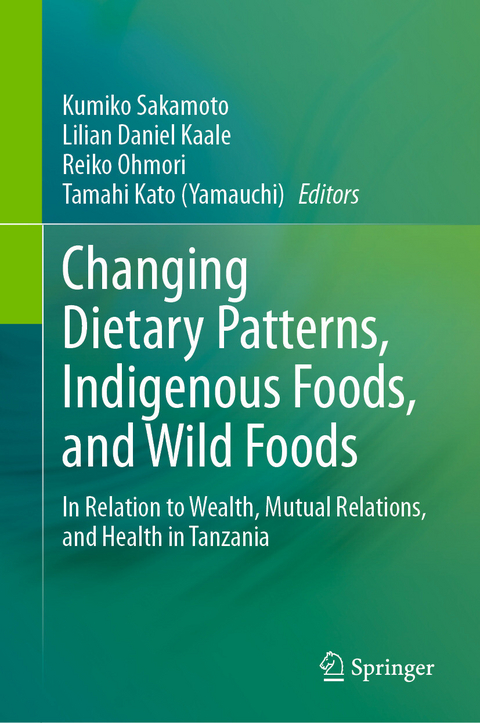
Changing Dietary Patterns, Indigenous Foods, and Wild Foods (eBook)
340 Seiten
Springer Nature Singapore (Verlag)
978-981-99-3370-9 (ISBN)
This book presents different dietary patterns, some utilizing wild foods and others facing drastically changing dietary patterns, and shows their implications for health in terms of wealth, mutual assistance, food sufficiency and food diversity. The book examines these globally important issues through a case study of Tanzania.
Using a novel methodology based on a global standard quality of life indicator, the book sheds light on the relationship between wild food intake and health in Tanzania. Descriptive case studies illustrate the impact of various food patterns and wild food intake on human health. It also highlights the divergence between food production sufficiency and food diversity. It then discusses the influence of wealth, mutual relations, and methods of food access. Finally, the book concludes with recommendations for maintaining good health in various environments.
The intended readers of this book are academicsand professionals in the fields of development, nutrition, and environment in East Africa. These include, but are not limited to, regional and district personnel who are actively engaged in development, relevant ministries of food and agriculture, and international organizations such as FAO, UNICEF, UNDP, and UNEP. In the academic field, students and researchers in international studies, development studies, African studies, social studies, cultural studies, nutrition, agriculture, and environmental studies are targeted.
This book won the 2024 Japan Society for International Development Committee Special Award.
This book presents different dietary patterns, some utilizing wild foods and others facing drastically changing dietary patterns, and shows their implications for health in terms of wealth, mutual assistance, food sufficiency and food diversity. The book examines these globally important issues through a case study of Tanzania. Using a novel methodology based on a global standard quality of life indicator, the book sheds light on the relationship between wild food intake and health in Tanzania. Descriptive case studies illustrate the impact of various food patterns and wild food intake on human health. It also highlights the divergence between food production sufficiency and food diversity. It then discusses the influence of wealth, mutual relations, and methods of food access. Finally, the book concludes with recommendations for maintaining good health in various environments. The intended readers of this book are academicsand professionals in the fields of development, nutrition, and environment in East Africa. These include, but are not limited to, regional and district personnel who are actively engaged in development, relevant ministries of food and agriculture, and international organizations such as FAO, UNICEF, UNDP, and UNEP. In the academic field, students and researchers in international studies, development studies, African studies, social studies, cultural studies, nutrition, agriculture, and environmental studies are targeted. This book won the 2024 Japan Society for International Development Committee Special Award.
| Erscheint lt. Verlag | 30.8.2023 |
|---|---|
| Zusatzinfo | XXIX, 340 p. 1 illus. |
| Sprache | englisch |
| Themenwelt | Medizin / Pharmazie ► Allgemeines / Lexika |
| Medizin / Pharmazie ► Gesundheitsfachberufe ► Diätassistenz / Ernährungsberatung | |
| Naturwissenschaften ► Biologie ► Biochemie | |
| Naturwissenschaften ► Chemie | |
| Sozialwissenschaften ► Politik / Verwaltung | |
| Sozialwissenschaften ► Soziologie ► Spezielle Soziologien | |
| Technik ► Lebensmitteltechnologie | |
| Schlagworte | Africa • Capability Approach • food security • Food System • Household livelihood strategies • Indigenous • Mutual relations • Nutrition • quality of life • Social capital • sustainability • Tanzania • Wild Food |
| ISBN-10 | 981-99-3370-6 / 9819933706 |
| ISBN-13 | 978-981-99-3370-9 / 9789819933709 |
| Informationen gemäß Produktsicherheitsverordnung (GPSR) | |
| Haben Sie eine Frage zum Produkt? |
 PDF (Wasserzeichen)
DRM: Digitales Wasserzeichen
Dieses eBook enthält ein digitales Wasserzeichen und ist damit für Sie personalisiert. Bei einer missbräuchlichen Weitergabe des eBooks an Dritte ist eine Rückverfolgung an die Quelle möglich.
Dateiformat: PDF (Portable Document Format)
Mit einem festen Seitenlayout eignet sich die PDF besonders für Fachbücher mit Spalten, Tabellen und Abbildungen. Eine PDF kann auf fast allen Geräten angezeigt werden, ist aber für kleine Displays (Smartphone, eReader) nur eingeschränkt geeignet.
Systemvoraussetzungen:
PC/Mac: Mit einem PC oder Mac können Sie dieses eBook lesen. Sie benötigen dafür einen PDF-Viewer - z.B. den Adobe Reader oder Adobe Digital Editions.
eReader: Dieses eBook kann mit (fast) allen eBook-Readern gelesen werden. Mit dem amazon-Kindle ist es aber nicht kompatibel.
Smartphone/Tablet: Egal ob Apple oder Android, dieses eBook können Sie lesen. Sie benötigen dafür einen PDF-Viewer - z.B. die kostenlose Adobe Digital Editions-App.
Buying eBooks from abroad
For tax law reasons we can sell eBooks just within Germany and Switzerland. Regrettably we cannot fulfill eBook-orders from other countries.
aus dem Bereich