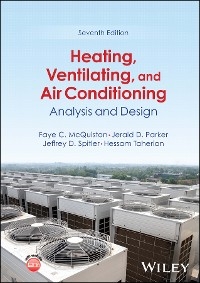
Heating, Ventilating, and Air Conditioning (eBook)
John Wiley & Sons (Verlag)
978-1-119-89416-2 (ISBN)
The authoritative resource providing coverage of all aspects of HVAC, fully updated to align with the latest HVAC technologies and methods
Now in its Seventh Edition, Heating, Ventilating, and Air Conditioning has been fully updated to align with the latest technologies and industry developments while maintaining the balance of theoretical information with practical applications that has prepared many generations of students for their careers.
As they work through the book, students will become familiar with different types of heating and air conditioning systems and equipment, understand processes and concepts involving moist atmospheric air, learn how to provide comfort to occupants in controlled spaces, and gain practice calculating probable heat loss/gain and energy requirements. A companion website includes additional multiple-choice questions, tutorial videos showing problem-solving for R-value calculation, and Excel spreadsheets that can be used for practice calculations.
The Seventh Edition includes new coverage of ductless A/C systems, heat exchangers and hybrid heat pumps, geothermal heat pumps, energy-efficient equipment, and UV principles of air quality treatment of airborne viruses like COVID-19.
Heating, Ventilating, and Air Conditioning includes detailed coverage of topics such as:
- Common HVAC units and dimensions, fundamental physical concepts, and system selection and arrangement
- Types of all-air systems, air-and-water systems, all-water systems, and decentralized cooling and heating
- Moist air and the standard atmosphere, fundamental parameters, adiabatic saturation, and wet bulb temperature and the psychrometric chart
- Outdoor and indoor design conditions, transmission heat losses, infiltration, heat losses from air ducts, auxiliary heat sources, and intermittently heated structures
- Heat gain, cooling load, and heat extraction rate, and application of cooling load calculation procedures
- Selection of pumps and fans, and duct HVAC sizing
Heating, Ventilating, and Air Conditioning helps prepare students for the industry by connecting the content to ASHRAE standards and by introducing coverage of software tools commonly used in HVAC design. The text is suitable for one- or two-semester HVAC courses taught at junior to graduate levels in various engineering departments.
The late Faye C. McQuiston was Professor Emeritus of Mechanical and Aerospace Engineering at Oklahoma State University.
The late Jerald D. Parker was Professor Emeritus at Oklahoma Christian University who also spent 33 years on the faculty at Oklahoma State University.
Jeffrey D. Spitler is Regents Professor and OG&E Energy Technology Chair in the School of Mechanical and Aerospace Engineering at Oklahoma State University.
Hessam Taherian is Assistant Teaching Professor at Penn State Harrisburg.
The late Faye C. McQuiston was Professor Emeritus of Mechanical and Aerospace Engineering at Oklahoma State University. The late Jerald D. Parker was Professor Emeritus at Oklahoma Christian University who also spent 33 years on the faculty at Oklahoma State University. Jeffrey D. Spitler is Regents Professor and OG&E Energy Technology Chair in the School of Mechanical and Aerospace Engineering at Oklahoma State University. Hessam Taherian is Assistant Teaching Professor at Penn State Harrisburg.
Chapter 1
Introduction
Many of our homes and most offices and commercial facilities would not be comfortable without year‐round control of the indoor environment. The “luxury label” attached to air conditioning in earlier decades has given way to appreciation of its practicality in making our lives healthier and more productive. Along with rapid development in improving human comfort came the realization that goods could be produced better, faster, and more economically in a properly controlled environment. In fact, many goods today could not be produced if the temperature, humidity, and air quality were not controlled within very narrow limits. The development and industrialization of the United States, especially the southern states, would never have been possible without year‐round control of the indoor climate. One has only to look for a manufacturing or printing plant, electronics laboratory, or other high‐technology facility or large office complex to understand the truth of that statement. Virtually every residential, commercial, industrial, and institutional building in the industrial countries of the world has a controlled environment year‐round.
Many early systems were designed with little attention to energy conservation, since fuels were abundant and inexpensive. Escalating energy costs in more recent times have caused increased interest in efficiency of operation. The need for closely controlled environments in laboratories, hospitals, and industrial facilities has continued to grow. There has also been an increasing awareness of the importance of comfort and indoor air quality for both health and performance.
Present practitioners of the arts and sciences of heating, ventilating, and air‐conditioning (HVAC) system design and simulation are challenged as never before. Developments in electronics, controls, computers, and artificial intelligence have furnished the tools allowing HVAC to become a high‐technology industry. Tools and methods continue to change, and there has been a better understanding of the parameters that define comfort and indoor air quality. Many of the fundamentals of good system design have not changed and still depend heavily on basic engineering matter. These basic elements of HVAC system design are emphasized in this text. They furnish a basis for presenting some recent developments, as well as procedures for designing functional, well‐controlled, and energy‐efficient systems.
1.1 HISTORICAL NOTES
Historically, air conditioning has implied cooling and humidity control for improving the indoor environment during the warm months of the year. In modern times, the term has been applied to year‐round heating, cooling, humidity control, and ventilating required for desired indoor conditions. Stated another way, air conditioning refers to the control of temperature, moisture content, cleanliness, air quality, and air circulation as required by occupants, a process, or a product in the space. This definition was first proposed by Willis Carrier, an early pioneer in air conditioning. Interesting biographical information on Carrier is given in his own book (1) and Ashley's article (2). Carrier is credited with the first successful attempt, in 1902, to reduce the humidity of air and maintain it at a specified level. This marked the birth of true environmental control as we know it today. Developments since that time have been rapid.
A compilation of a series of articles produced by the ASHRAE Journal that document HVAC history from the 1890s to the present is available in book form (3). (ASHRAE is an abbreviation for the American Society of Heating, Refrigerating and Air‐Conditioning Engineers1, Incorporated.) Donaldson and Nagengast (4) also give an interesting historical picture. Because of the wide scope and diverse nature of HVAC, literally thousands of engineers have developed the industry. Their accomplishments have led to selection of material for the ASHRAE Handbooks, consisting of four volumes entitled HVAC Systems and Equipment (5), Fundamentals (6), Refrigeration (7), and HVAC Applications (8). Research, manufacturing practice, and changes in design and installation methods lead to updating of handbook materials on a four‐year cycle. Much of this work is sponsored by ASHRAE and monitored by ASHRAE members, and one handbook is revised each year in sequence. The handbooks are also available on CDs from ASHRAE Society Headquarters. This textbook follows material presented in the ASHRAE handbooks very closely.
As we prepared this seventh edition, great changes were taking place in the United States and throughout the world, changes that affect both the near and distant future. HVAC markets are undergoing worldwide changes (globalization), and environmental concerns such as ozone depletion and global warming are leading to imposed and voluntary restrictions on some materials and methods that might be employed in HVAC systems including significant changes in the acceptable practices in manufacturing refrigerants. There is increasing consumer sophistication, which places greater demands upon system performance and reliability. Occupant comfort and safety are increasingly significant considerations in the design and operation of building systems. The possibility of terrorist action and the resulting means needed to protect building occupants in such cases cause the designer to consider additional safety features not previously thought important. The possibility of litigation strongly influences both design and operation, as occupants increasingly blame the working environment for their illnesses and allergies. Dedicated outdoor air systems (DOAS) are becoming a more common method of assuring that a system always provides the required amount of suitable ventilation air. Mold damage to buildings and mold effect on human health have given increased interest in humidity control by design engineers, owners, and occupants of buildings.
HVAC system modification and replacement is growing at a rapid pace as aging systems wear out or cannot meet the new requirements of indoor air quality, global environmental impact, and economic competition. Energy service companies (ESCOs) with performance contracting are providing ways for facility owners to upgrade their HVAC systems within their existing budgets (9). Design and construction of the complete system or building by a single company (design–build) is becoming more common. Quality assurance for the building owner is more likely to occur through new building commissioning (8), a process with the objective of creating HVAC systems that can be properly operated and maintained throughout the lifespans of buildings.
Computers are used in almost every phase of the industry, from conceptual study to design to operating control of the building. HVAC component suppliers and manufacturers furnish extensive amounts of software and product data on CDs or on the internet. Building automation systems (BAS) now control the operation of most large buildings, including the HVAC functions. A recent trend is the development of web‐based tools that enable the sharing of information between the BAS and the general business applications of the building (10). Computer consoles will soon replace thermostats in many buildings as the means to control the indoor environment. Web‐accessible control systems (WACS) and Demand Response provide full accessibility to BAS through an ordinary browser without proprietary software in the control and monitoring computers (11). The security of networks has suddenly become important as buildings increasingly become controlled over internet systems (12). Deregulation of the gas and electric utility industries in the United States as well as instability in most of the major oil‐producing countries have left many questions unanswered. Future costs and availability of these important sources of energy will have significant effects on designs and selections of HVAC systems.
Graduates entering the industry will find interesting challenges as forces both seen and unforeseen bring about changes likely to amaze even the most forward‐thinking and optimistic among us.
1.2 COMMON HVAC UNITS AND DIMENSIONS
In all engineering work, consistent units must be employed. A unit is a specific, quantitative measure of a physical characteristic in reference to a standard. Examples of units to measure the physical characteristic length are the foot and meter. A physical characteristic, such as length, is called a dimension. Other dimensions of interest in HVAC computations are force, time, temperature, and mass.
In this text, as in the ASHRAE handbooks, two systems of units will be employed. The first is called the English Engineering System, and is most commonly used in the United States with some modification, such as use of inches instead of feet. The system is sometimes referred to as the inch–pound or IP system. The second is the International System or SI, for Système International d'Unitès, which is the system in use in engineering practice throughout most of the world and widely adopted in the United States.
Equipment designed using IP units will be operational for years and even decades. For the foreseeable future, then, it will be necessary for many engineers to work in either IP or SI systems of units and to be able to make conversion from one system to another. This...
| Erscheint lt. Verlag | 14.8.2023 |
|---|---|
| Sprache | englisch |
| Themenwelt | Technik ► Maschinenbau |
| Schlagworte | Common HVAC units • COVID-19 air quality treatment • ductless A/C systems • duct sizing • energy-efficient equipment • geothermal heat pumps • Heat Exchangers • hybrid heat pumps • Maschinenbau • Maschinenbau - Entwurf • mechanical engineering • Mechanical Engineering - Design • Mechanical Engineering Special Topics • pump selection • Spezialthemen Maschinenbau • UV principles of air quality treatment of airborne viruses |
| ISBN-10 | 1-119-89416-6 / 1119894166 |
| ISBN-13 | 978-1-119-89416-2 / 9781119894162 |
| Informationen gemäß Produktsicherheitsverordnung (GPSR) | |
| Haben Sie eine Frage zum Produkt? |
 EPUB (Adobe DRM)
Kopierschutz: Adobe-DRM
Adobe-DRM ist ein Kopierschutz, der das eBook vor Mißbrauch schützen soll. Dabei wird das eBook bereits beim Download auf Ihre persönliche Adobe-ID autorisiert. Lesen können Sie das eBook dann nur auf den Geräten, welche ebenfalls auf Ihre Adobe-ID registriert sind.
Details zum Adobe-DRM
Dateiformat: EPUB (Electronic Publication)
EPUB ist ein offener Standard für eBooks und eignet sich besonders zur Darstellung von Belletristik und Sachbüchern. Der Fließtext wird dynamisch an die Display- und Schriftgröße angepasst. Auch für mobile Lesegeräte ist EPUB daher gut geeignet.
Systemvoraussetzungen:
PC/Mac: Mit einem PC oder Mac können Sie dieses eBook lesen. Sie benötigen eine
eReader: Dieses eBook kann mit (fast) allen eBook-Readern gelesen werden. Mit dem amazon-Kindle ist es aber nicht kompatibel.
Smartphone/Tablet: Egal ob Apple oder Android, dieses eBook können Sie lesen. Sie benötigen eine
Geräteliste und zusätzliche Hinweise
Buying eBooks from abroad
For tax law reasons we can sell eBooks just within Germany and Switzerland. Regrettably we cannot fulfill eBook-orders from other countries.
aus dem Bereich