Thermal Spreading and Contact Resistance (eBook)
946 Seiten
John Wiley & Sons (Verlag)
978-1-394-18754-6 (ISBN)
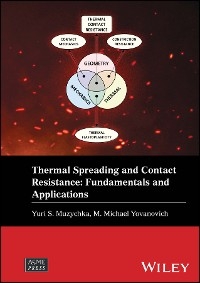
Thermal Spreading and Contact Resistance: Fundamentals and Applications
Single source reference on how applying thermal spreading and contact resistance can solve problems across a variety of engineering fields
Thermal Spreading and Contact Resistance: Fundamentals and Applications offers comprehensive coverage of the key information that engineers need to know to understand thermal spreading and contact resistance, including numerous predictive models for determining thermal spreading resistance and contact conductance of mechanical joints and interfaces, plus detailed examples throughout the book.
Written by two of the leading experts in the field, Thermal Spreading and Contact Resistance: Fundamentals and Applications includes information on:
- Contact conductance, mass transfer, transport from super-hydrophobic surfaces, droplet/surface phase change problems, and tribology applications such as sliding surfaces and roller bearings
- Heat transfer in micro-devices and thermal spreaders, orthotropic systems, and multi-source applications for electronics thermal management applications
- Fundamental principles, thermal spreading in isotropic half-space regions, circular flux tubes and disc spreaders, and rectangular flux channels and compound spreaders
- Systems with non-uniform sink plane conductance, transient spreading resistance, and contact resistance between both non-conforming and conforming rough surfaces
Providing comprehensive coverage of the subject, Thermal Spreading and Contact Resistance: Fundamentals and Applications is an essential resource for mechanical, aerospace, and chemical engineers working on research in the fields of heat transfer, thermal management of electronics, and tribology, as well as thermal engineers and researchers in the field of thermal physics.
Yuri S. Muzychka is a Professor of Mechanical Engineering at Memorial University of Newfoundland, Canada. He is a Fellow of ASME, CSME, and the Engineering Institute of Canada (EIC) and has published over 250 journal and conference proceedings papers, in addition to three handbook chapters.
M. Michael Yovanovich is a Distinguished Professor Emeritus at the University of Waterloo, Canada. He is a fellow of ASME, CSME, AIAA, AAAS, and RSC. He has published seven handbook chapters and over 350 journal and conference proceedings papers, and has given over 150 keynote lectures.
Thermal Spreading and Contact Resistance: Fundamentals and Applications Single source reference on how applying thermal spreading and contact resistance can solve problems across a variety of engineering fields Thermal Spreading and Contact Resistance: Fundamentals and Applications offers comprehensive coverage of the key information that engineers need to know to understand thermal spreading and contact resistance, including numerous predictive models for determining thermal spreading resistance and contact conductance of mechanical joints and interfaces, plus detailed examples throughout the book. Written by two of the leading experts in the field, Thermal Spreading and Contact Resistance: Fundamentals and Applications includes information on: Contact conductance, mass transfer, transport from super-hydrophobic surfaces, droplet/surface phase change problems, and tribology applications such as sliding surfaces and roller bearings Heat transfer in micro-devices and thermal spreaders, orthotropic systems, and multi-source applications for electronics thermal management applications Fundamental principles, thermal spreading in isotropic half-space regions, circular flux tubes and disc spreaders, and rectangular flux channels and compound spreaders Systems with non-uniform sink plane conductance, transient spreading resistance, and contact resistance between both non-conforming and conforming rough surfaces Providing comprehensive coverage of the subject, Thermal Spreading and Contact Resistance: Fundamentals and Applications is an essential resource for mechanical, aerospace, and chemical engineers working on research in the fields of heat transfer, thermal management of electronics, and tribology, as well as thermal engineers and researchers in the field of thermal physics.
Yuri S. Muzychka is a Professor of Mechanical Engineering at Memorial University of Newfoundland, Canada. He is a Fellow of ASME, CSME, and the Engineering Institute of Canada (EIC) and has published over 250 journal and conference proceedings papers, in addition to three handbook chapters. M. Michael Yovanovich is a Distinguished Professor Emeritus at the University of Waterloo, Canada. He is a fellow of ASME, CSME, AIAA, AAAS, and RSC. He has published seven handbook chapters and over 350 journal and conference proceedings papers, and has given over 150 keynote lectures.
Nomenclature
- linear dimensions (m)
- radial dimensions (m)
- semi‐axes of an ellipse or rectangle (m)
- contact spot radius (m)
- elastic contact spot radius (m)
- elastic–plastic contact spot radius (m)
- Hertz contact spot radius (m)
- plastic contact spot radius (m)
- contact spot radius for layer (m)
- contact spot radius for substrate (m)
- area ()
- apparent contact area ()
- contact area ()
- gap area ()
- real contact area ()
- flux tube cross‐sectional area ()
- Fourier coefficients
- hydrodynamic slip length
- thermal slip length
- effective CLA roughness ()
- modified Fourier coefficients
- Biot number ()
- specific heat ()
- Fourier coefficients
- equation coefficients
- concentration ()
- dimensionless contact conductance ()
- Center Line Average roughness (m)
- plate separation (m)
- diameter of contacting sphere (m)
- mass diffusivity of in ()
- influence coefficient (K/W)
- exponential function ()
- eccentricity (m)
- Gaussian error function
- complementary error function
- inverse complementary error function
- complete elliptic integral of the second kind
- modulus of elasticity (GPa)
- effective modulus of elasticity (GPa)
- exponential integral
- elastic–plastic contact parameter
- applied load (force) (N)
- incomplete elliptic integral of the first kind
- effective radiative surface factor
- Fourier number ()
- superposition functions
- convection film coefficient or conductance ()
- sink plane conductance ()
- contact conductance ()
- edge conductance ()
- gap conductance ()
- joint conductance ()
- maximum conductance ()
- equivalent elastic micro‐hardness (GPa)
- elasto‐plastic micro‐hardness (GPa)
- Brinell hardness (GPa)
- layer hardness (GPa)
- micro‐hardness of softer substrate (GPa)
- Vickers micro‐hardness (GPa)
- equivalent plastic micro‐hardness (GPa)
- effective micro‐hardness of coated surface (GPa)
- integrated complementary error function
- polar second moment of area
- modified Bessel functions of the first kind of order 0 and 1
- gap conductance integral
- gap conductance integral for line contact
- gap conductance integral for point contact
- mass flux in ‐direction ()
- Bessel functions of the first kind of order 0 and 1
- thermal conductivity ratio
- modified Bessel functions of the second kind of order 0 and 1
- thermal conductivities ()
- gas thermal conductivity ()
- polymer thermal conductivity ()
- effective contact spot thermal conductivity ()
- reaction rate ()
- complete elliptic integral of the first kind
- Kirchoff transform
- Knudsen number ()
- arbitrary depth (m)
- arbitrary length scale (m)
- length (m)
- latent heat of fusion (J/kg)
- indices for summations
- Hertz parameters
- surface slope
- rarefaction parameter (m)
- dimensionless rarefaction parameter ()
- normal direction (m)
- hyper‐ellipse shape parameter
- contact spot density ()
- number of contact spots
- number of heat sources
- number of sides of a polygon
- contact pressure (MPa)
- gap gas pressure (Pa)
- Peclet number ()
- sink plane conductance distribution parameter
- thermal conductivity coefficients
- constant uniform heat flux ()
- heat flux ()
- dimensionless heat flux ()
- heat flow rate (W)
- heat flow rate per unit depth (W/m)
- cylindrical or spherical radial coordinate (m)
- inscribed radius of a polygon
- thermal resistance (K/W)
- gap thermal resistance (K/W)
- radiation thermal resistance (K/W)
- contact thermal resistance (K/W)
- joint thermal resistance (K/W)
- thermal spreading resistance (K/W)
- total thermal resistance (K/W)
- bulk resistance thermal resistance (K/W)
- dimensionless thermal spreading resistance
- specific thermal resistance ( [])
- shape factor (m)
- material flow stress (GPa)
- Stefan number ()
- time (s)
- integration variable
- total and layer thicknesses (m)
- temperature (K)
- bulk material temperature (K)
- contact temperature (K)
- joint temperature (K)
- source temperature (K)
- contact plane surface temperature (K)
- sink temperature (K)
- velocity (m/s)
- elastic displacement (m)
- velocity (m/s)
- Kirchoff transform variable
- velocity of heat sliding heat source (m/s)
- Cartesian coordinate (m)
- heat source centroid (m)
- mean plane separation (m)
- Cartesian coordinate (m)
- Bessel function of the second kind of order zero
- Cartesian coordinate (m)
- thermal spreading zone for circle ()
- thermal spreading zone for ellipse ()
Greek Symbols
- thermal diffusivity ()
- dimensionless conductivity ratio
- accommodation coefficient
- semi‐axes of an ellipse (m)
- equation coefficients
- eigenvalues
- eigenvalues ()
- angular measurement
- Beta function
- orthotropic conductivity variable ()
- specific heat ratio
- Gamma function
- eigenvalues
- perpendicular (m)
- local gap thickness (m)
- penetration depth (m)
- aspect ratio ()
- relative contact area ()
- surface emissivity
- dimensionless contact strain
- dummy variable
- dimensionless length ()
- temperature excess ( [K])
- mean temperature excess (K)
- centroidal temperature excess (K)
- constant uniform temperature excess (K)
- source temperature excess (K)
- complementary modulus ()
- relative conductivity ()
- integration variable
- eigenvalues
- relative mean plane separation ()
- mean free path (m)
- heat flux shape parameter
- coefficient of dynamic friction
- dynamic viscosity (Pa s)
- Poisson's ratio
- dimensionless length ()
- denotes arbitrary eigenvalue in spreading function
- orthotropic coordinate transformation variable
- hydrodynamic spreading factor
- density ()
- segment length
- relative position in polar coordinates ()
- radius of curvature (m)
- radii of curvature of contacting bodies (m)
- RMS surface roughness (m)
- Stefan–Boltzmann constant ()
- wall shear stress (Pa)
- dimensionless wall shear ()
- relative thickness ()
- area contact ratio ()
- thermal spreading function
- reciprocal of thermal spreading function
- thermal constriction (spreading) parameter
- angular measurement
- thermal elastoconstriction parameter
- angular measurement
- thermal conductivity coefficients
- omega function in point source method
Subscripts
- 0
- denotes at centroid or reference value
- denotes layer number
- length scale used to define dimensionless resistance
- ...
| Erscheint lt. Verlag | 9.8.2023 |
|---|---|
| Reihe/Serie | Wiley-ASME Press Series | Wiley-ASME Press Series |
| Sprache | englisch |
| Themenwelt | Technik ► Maschinenbau |
| Schlagworte | circular flux tubes • Contact conductance • disc spreaders • droplet phase change • joint conductance • Maschinenbau • mass transfer • mechanical engineering • Mechanical Engineering Special Topics • orthtropic materials • rectangular flux channels • Spezialthemen Maschinenbau • super-hydrophobic surfaces • thermal spreading in isotropic half-space regions • thermal spreading resistance • thermodynamics • Thermodynamik • Tribology |
| ISBN-10 | 1-394-18754-8 / 1394187548 |
| ISBN-13 | 978-1-394-18754-6 / 9781394187546 |
| Informationen gemäß Produktsicherheitsverordnung (GPSR) | |
| Haben Sie eine Frage zum Produkt? |
 EPUB (Adobe DRM)
Kopierschutz: Adobe-DRM
Adobe-DRM ist ein Kopierschutz, der das eBook vor Mißbrauch schützen soll. Dabei wird das eBook bereits beim Download auf Ihre persönliche Adobe-ID autorisiert. Lesen können Sie das eBook dann nur auf den Geräten, welche ebenfalls auf Ihre Adobe-ID registriert sind.
Details zum Adobe-DRM
Dateiformat: EPUB (Electronic Publication)
EPUB ist ein offener Standard für eBooks und eignet sich besonders zur Darstellung von Belletristik und Sachbüchern. Der Fließtext wird dynamisch an die Display- und Schriftgröße angepasst. Auch für mobile Lesegeräte ist EPUB daher gut geeignet.
Systemvoraussetzungen:
PC/Mac: Mit einem PC oder Mac können Sie dieses eBook lesen. Sie benötigen eine
eReader: Dieses eBook kann mit (fast) allen eBook-Readern gelesen werden. Mit dem amazon-Kindle ist es aber nicht kompatibel.
Smartphone/Tablet: Egal ob Apple oder Android, dieses eBook können Sie lesen. Sie benötigen eine
Geräteliste und zusätzliche Hinweise
Buying eBooks from abroad
For tax law reasons we can sell eBooks just within Germany and Switzerland. Regrettably we cannot fulfill eBook-orders from other countries.
aus dem Bereich