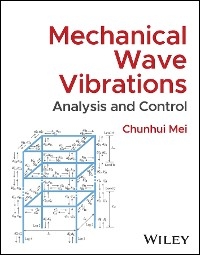
An elegant and accessible exploration of the fundamentals of the analysis and control of vibration in structures from a wave standpoint
In Mechanical Wave Vibrations: Analysis and Control, Professor Chunhui Mei delivers an expert discussion of the wave analysis approach (as opposed to the modal-based approach) to mechanical vibrations in structures. The book begins with deriving the equations of motion using the Newtonian approach based on various sign conventions before comprehensively covering the wave vibration analysis approach. It concludes by exploring passive and active feedback control of mechanical vibration waves in structures.
The author discusses vibration analysis and control strategies from a wave standpoint and examines the applications of the presented wave vibration techniques to structures of various complexity. Readers will find in the book:
- A thorough introduction to mechanical wave vibration analysis, including the governing equations of various types of vibrations
- Comprehensive explorations of waves in simple rods and beams, including advanced vibration theories
- Practical discussions of coupled waves in composite and curved beams
- Extensive coverage of wave mode conversions in built-up planar and spatial frames and networks
- Complete treatments of passive and active feedback wave vibration control
- MATLAB® scripts both in the book and in a companion solutions manual for instructors
Mechanical Wave Vibrations: Analysis and Control is written as a textbook for both under-graduate and graduate students studying mechanical, aerospace, automotive, and civil engineering. It will also benefit researchers and educators working in the areas of vibrations and waves.
Chunhui Mei is a Professor in the Department of Mechanical Engineering at the University of Michigan-Dearborn. She has over twenty years' research and teaching experience on vibrations, controls, and instrumentation and measurement systems. She served as an Associate Editor for ASME Journal of Vibration and Acoustics.
Mechanical Wave Vibrations An elegant and accessible exploration of the fundamentals of the analysis and control of vibration in structures from a wave standpoint In Mechanical Wave Vibrations: Analysis and Control, Professor Chunhui Mei delivers an expert discussion of the wave analysis approach (as opposed to the modal-based approach) to mechanical vibrations in structures. The book begins with deriving the equations of motion using the Newtonian approach based on various sign conventions before comprehensively covering the wave vibration analysis approach. It concludes by exploring passive and active feedback control of mechanical vibration waves in structures. The author discusses vibration analysis and control strategies from a wave standpoint and examines the applications of the presented wave vibration techniques to structures of various complexity. Readers will find in the book: A thorough introduction to mechanical wave vibration analysis, including the governing equations of various types of vibrations Comprehensive explorations of waves in simple rods and beams, including advanced vibration theories Practical discussions of coupled waves in composite and curved beams Extensive coverage of wave mode conversions in built-up planar and spatial frames and networks Complete treatments of passive and active feedback wave vibration control MATLAB scripts both in the book and in a companion solutions manual for instructors Mechanical Wave Vibrations: Analysis and Control is written as a textbook for both under-graduate and graduate students studying mechanical, aerospace, automotive, and civil engineering. It will also benefit researchers and educators working in the areas of vibrations and waves.
Chunhui Mei is a Professor in the Department of Mechanical Engineering at the University of Michigan-Dearborn. She has over twenty years' research and teaching experience on vibrations, controls, and instrumentation and measurement systems. She served as an Associate Editor for ASME Journal of Vibration and Acoustics.
1
Sign Conventions and Equations of Motion Derivations
Sign conventions and coordinate systems play important roles in wave vibration analysis and in the derivation of governing equations of motion for bending, longitudinal, and torsional vibrations.
In this book, Cartesian coordinate system is adopted. For a planar structure, the x- and y-axis of a two-dimensional Cartesian coordinate system are chosen to be in the plane of the structure. The x-axis is always chosen to be along the longitudinal axis of a member. The axial and shear force are parallel to the x- and y-axis, respectively. Angle is defined by the right hand rule rotation from the x-axis to the y-axis.
For an in depth understanding of sign conventions, which are often a source of error for engineering analysis, the governing equations of motion are derived using the Newtonian approach following various sign conventions.
1.1 Derivation of the Bending Equations of Motion by Various Sign Conventions
Figure 1.1 shows the positive sign directions for internal resistant shear force V and bending moment M of four possible sets of conventions. In the figure, subscripts L and R denote parameters related to the left and right side of the cut section, respectively. The set shown in Figure 1.1a is a convention that has been popularly adopted by many authors in textbooks and research papers, while the remaining sets presented in Figures 1.1b to 1.1d are less often adopted.
Figure 1.1 Definitions of positive sign directions for internal resistant shear force and bending moment by various sign conventions: (a) sign convention 1, (b) sign convention 2, (c) sign convention 3, and (d) sign convention 4.
The best way to interpret a sign convention is to look at how the internal resistant forces and moments deform or rotate the corresponding element. In Sets (a) and (b) shown in Figure 1.1, the shear force is positive when it rotates its element along the positive direction of angle . The convention for the bending moment is defined differently. In Set (a) the bending moment is positive when it bends its element concave towards the positive y-axis direction; however, in Set (b) the positive bending moment is when it bends its element convex towards the positive y-axis direction. In Sets (c) and (d) in Figure 1.1, the shear force is positive when it rotates its element along the negative direction of angle . The convention for the bending moment is defined differently, in Set (c) the bending moment is positive when it bends its element concave towards the positive y-axis direction; while in Set (d) the positive bending moment is when it bends its element convex towards the positive y-axis direction.
This deformation and rotation based interpretation holds regardless of the orientation of the beam; one only needs to be consistent with the choice of the coordinate system and the definition of positive sign directions.
Consider now, as shown in Figure 1.2, a beam of length L that is subjected to an external distributed transverse load of per unit length. The x-axis is chosen to be along the neutral axis of the beam, t is the time, and is the transverse deflection of the beam.
Figure 1.2 A beam in bending vibration.
In the absence of axial loading, the bending equations of motion of the beam derived using the four sets of sign conventions shown in Figure 1.1 are presented below. Figures 1.3a to 1.3d are the free body diagrams of a differential element of the beam according to the four sets of sign conventions of Figures 1.1a to 1.1d, respectively. The bending moments and shear forces on both sides of the differential element are with positive sign directions by the corresponding sign conventions.
Figure 1.3 Free body diagram of a beam element in bending vibration by the various sign conventions defined in Figure 1.1: (a) sign convention 1, (b) sign convention 2, (c) sign convention 3, and (d) sign convention 4.
1.1.1 According to Euler–Bernoulli Bending Vibration Theory
The bending equations of motion in the Euler–Bernoulli (or thin beam) theory are derived based on the following three assumptions. First, the neutral axis does not experience any change in length. Second, all cross sections remain planar and perpendicular to the neutral axis. Third, deformation at the cross section within its own plane is negligibly small. In other words, the rotation of cross sections of the beam is neglected compared to the translation, and the angular distortion due to shear is neglected compared to the bending deformation.
The concept of curvature of a beam is central to the understanding of beam bending. Mathematically, the radius of curvature of a curve can be found using the following formula
For a beam element in a practical engineering structure that undergoes bending vibration, the transverse deflection of the centerline normally forms a shallow curve because of limitations set forth by engineering design codes on allowable deflection of engineering structures. Consequently, the slope of the deformation curve is normally very small, and its square is negligible when compared to unity. Therefore, the radius of curvature as defined above can be approximated by
By definition, the neutral axis, which lies on the x-axis, does not experience any change in length. Consequently, the lengths of the neutral axis of the differential element remain the same amount of dx before and after deformation, as shown in Figure 1.4.
Figure 1.4 Strain and radius of curvature: (a) before deformation, (b) after concave bending deformation, and (c) after convex bending deformation.
In the absence of axial loading, the longitudinal strain in the beam is produced only from bending and by definition of strain,
There are two types of bending deformations with reference to the positive y-axis, concave and convex, because of internal bending moments and , respectively. The normal strains and on the differential element that is a distance z above the neutral axis correspond to the concave and convex deformations shown in Figures 1.4b and 1.4c are
where is the radius of curvature of the transverse deflection of the centerline , and is the angle of rotation of the cross section due to bending. Subscripts 1, 2, 3, and 4 denote parameters related to sign conventions 1, 2, 3, and 4 defined in Figure 1.1.
For concave deformation, strains are negative above the neutral axis (where z is positive) because of compressive normal stress in the region caused by the internal resistant bending moment at the given direction. Strains are positive below the neutral axis (where z is negative) because of tensile normal stress in the region caused by the internal resistant bending moment at the given direction. This explains the negative sign in Eq. (1.4a). For convex deformation, the region above the neutral axis (where z is positive) is subject to positive strain, and below the neutral axis (where z is negative) is subject to negative strain; hence, strains carry the same sign as z, as reflected in Eq. (1.4b).
For homogeneous materials behaving in a linear elastic manner, the stress and strain are related by the Young’s modulus E,
From Eqs. (1.4a), (1.4b), and (1.5),
Balancing the internal normal stress and the internal bending moment M requires
Substituting Eqs. (1.6a) and (1.6b) into Eq. (1.7) gives
In Eqs. (1.7), (1.8a), and (1.8b), A is the area of the cross section and is the area moment of inertia about the centroidal axis that is normal to the plane of bending.
Substituting Eq. (1.2) into Eqs. (1.8a) and (1.8b) gives
From the free body diagrams of Figure 1.3, the force equations along the y-axis direction obtained by sign conventions 1, 2, 3, and 4 are
where is the volume mass density of the beam. Note that Eqs. (1.10a) and (1.10b) are identical, so are Eqs. (1.10c) and (1.10d).
Simplifying the above equations gives
From the free body diagrams of Figure 1.3, the moment equations by sign conventions 1, 2, 3, and 4, under the assumption that the rotary inertia is negligibly small,...
| Erscheint lt. Verlag | 13.7.2023 |
|---|---|
| Sprache | englisch |
| Themenwelt | Technik ► Maschinenbau |
| Schlagworte | Bauingenieur- u. Bauwesen • Baustatik • Baustatik u. Baumechanik • Civil Engineering & Construction • Control Process & Measurements • Festkörpermechanik • Maschinenbau • mechanical engineering • mechanical structural vibration • Mechanical vibration • Mess- u. Regeltechnik • solid mechanics • Structural Theory & Structural Mechanics • Structural Vibration • Structural Vibration Control • Vibration • vibration in beams • vibration in plates • vibration in rods • vibration in structures • wave analysis approach • wave analysis fundamentals |
| ISBN-13 | 9781119135050 / 9781119135050 |
| Informationen gemäß Produktsicherheitsverordnung (GPSR) | |
| Haben Sie eine Frage zum Produkt? |
 EPUB (Adobe DRM)
Kopierschutz: Adobe-DRM
Adobe-DRM ist ein Kopierschutz, der das eBook vor Mißbrauch schützen soll. Dabei wird das eBook bereits beim Download auf Ihre persönliche Adobe-ID autorisiert. Lesen können Sie das eBook dann nur auf den Geräten, welche ebenfalls auf Ihre Adobe-ID registriert sind.
Details zum Adobe-DRM
Dateiformat: EPUB (Electronic Publication)
EPUB ist ein offener Standard für eBooks und eignet sich besonders zur Darstellung von Belletristik und Sachbüchern. Der Fließtext wird dynamisch an die Display- und Schriftgröße angepasst. Auch für mobile Lesegeräte ist EPUB daher gut geeignet.
Systemvoraussetzungen:
PC/Mac: Mit einem PC oder Mac können Sie dieses eBook lesen. Sie benötigen eine
eReader: Dieses eBook kann mit (fast) allen eBook-Readern gelesen werden. Mit dem amazon-Kindle ist es aber nicht kompatibel.
Smartphone/Tablet: Egal ob Apple oder Android, dieses eBook können Sie lesen. Sie benötigen eine
Geräteliste und zusätzliche Hinweise
Buying eBooks from abroad
For tax law reasons we can sell eBooks just within Germany and Switzerland. Regrettably we cannot fulfill eBook-orders from other countries.
aus dem Bereich