Industrial Automation from Scratch (eBook)
496 Seiten
Packt Publishing (Verlag)
978-1-80056-690-3 (ISBN)
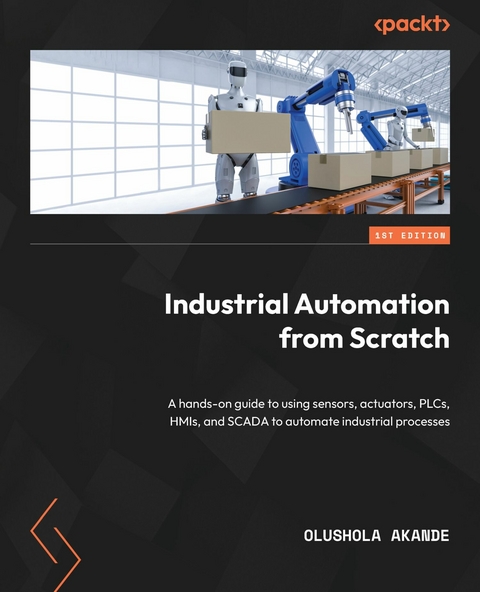
Industrial automation has become a popular solution for various industries looking to reduce manual labor inputs and costs by automating processes. This book helps you discover the abilities necessary for excelling in this field.
The book starts with the basics of industrial automation before progressing to the application of switches, sensors, actuators, and motors, and a direct on-line (DOL) starter and its components, such as circuit breakers, contactors, and overload relay. Next, you'll explore VFDs, their parameter settings, and how they can be wired and programmed for induction motor control. As you advance, you'll learn the wiring and programming of major industrial automation tools - PLCs, HMIs, and SCADA. You'll also get to grips with process control and measurements (temperature, pressure, level, and flow), along with analog signal processing with hands-on experience in connecting a 4-20 mA transmitter to a PLC. The concluding chapters will help you grasp various industrial network protocols such as FOUNDATION Fieldbus, Modbus, PROFIBUS, PROFINET, and HART, as well as emerging trends in manufacturing (Industry 4.0) and its empowering technologies (such as IoT, AI, and robotics).
By the end of this book, you'll have gained a practical understanding of industrial automation concepts for machine automation and control.
Explore industrial automation and control-related concepts like the wiring and programming of VFDs and PLCs, as well as smart factory (Industry 4.0) with this easy-to-follow guidePurchase of the print or Kindle book includes a free PDF eBookKey FeaturesLearn the ins and outs of industrial automation and control by taking a pragmatic approachGain practical insights into automating a manufacturing process using PLCsDiscover how to monitor and control an industrial process using HMIs and SCADABook DescriptionIndustrial automation has become a popular solution for various industries looking to reduce manual labor inputs and costs by automating processes. This book helps you discover the abilities necessary for excelling in this field. The book starts with the basics of industrial automation before progressing to the application of switches, sensors, actuators, and motors, and a direct on-line (DOL) starter and its components, such as circuit breakers, contactors, and overload relay. Next, you'll explore VFDs, their parameter settings, and how they can be wired and programmed for induction motor control. As you advance, you'll learn the wiring and programming of major industrial automation tools PLCs, HMIs, and SCADA. You ll also get to grips with process control and measurements (temperature, pressure, level, and flow), along with analog signal processing with hands-on experience in connecting a 4 20 mA transmitter to a PLC. The concluding chapters will help you grasp various industrial network protocols such as FOUNDATION Fieldbus, Modbus, PROFIBUS, PROFINET, and HART, as well as emerging trends in manufacturing (Industry 4.0) and its empowering technologies (such as IoT, AI, and robotics). By the end of this book, you ll have gained a practical understanding of industrial automation concepts for machine automation and control.What you will learnGet to grips with the essentials of industrial automation and controlFind out how to use industry-based sensors and actuatorsKnow about the AC, DC, servo, and stepper motorsGet a solid understanding of VFDs, PLCs, HMIs, and SCADA and their applicationsExplore hands-on process control systems including analog signal processing with PLCsGet familiarized with industrial network and communication protocols, wired and wireless networks, and 5GExplore current trends in manufacturing such as smart factory, IoT, AI, and roboticsWho this book is forThis book is for both graduates and undergraduates of electrical, electronics, mechanical, mechatronics, chemical or computer engineering, engineers making a career switch, or anyone looking to pursue their career in the field of industrial automation. The book covers topics ranging from basic to advanced levels, and is a valuable reference for beginner-level electrical, IIoT, automation, process, instrumentation and control, production, and maintenance engineers working in manufacturing and oil and gas industries, among others.]]>
Preface
This book is designed to provide what you need to know as an industrial automation engineer, from basic to advanced – beneficial for both beginners and professionals in the field of industrial automation. It is an indispensable book for industrial automation engineers or anyone that wants to start or build a career in industrial automation. This book is a valuable resource for both undergraduates and graduates in the engineering, physics, and computer departments of tertiary institutions as well as staff in electrical, mechanical, production, process control, and instrumentation engineering departments in the manufacturing, food processing, chemical, oil and gas, and other industries where automated machines are used. You will learn about and be able to use sensors, actuators, and Programmable Logic Controllers (PLCs) for industrial automation. The book is loaded with hands-on step-by-step guides on PLC wiring and programming, HMI design and development, SCADA system setup, and process control.
The book is organized into three parts. Each part contains several chapters on important topics.
Part 1 is devoted to the concepts and skills required to get started in industrial automation. This is an introductory part where you will learn what industrial automation is all about and how to identify electrical control components and wire them for basic industrial control operations. You will also learn how to draw a schematic/wiring diagram using CAD software.
Part 2 will take you through the major tools in industrial automation (PLC, HMI, and SCADA). You will learn by doing by following the step-by-step guide provided. Simulation is also possible in some of the steps, which makes it easy for those without the actual device to have an understanding of how it works. What seems complex is made simple using a hands-on approach.
Part 3 is devoted to process control, industrial networks, and smart factories, which you will gain fundamental knowledge about.
Who this book is for
I strongly believe that this book will be of great benefit to readers who are new to the field of industrial automation, as well as those who are experienced and practicing in the field as it covers topics from a beginner level to an advanced level in a simplified and practical way. You can further advance your skills in a specific area through articles, books, or resources that specifically relate to the topic you would like to go into in more depth after reading this book.
What this book covers
Chapter 1, Introduction to Industrial Automation, provides an overview of industrial automation.
Chapter 2, Switches and Sensors – Working Principles, Applications, and Wiring, deals with switches and sensors. Knowledge of switches and sensors is important in industrial automation. Switches and sensors provide information about the environment for a controller to process. In this chapter, you will learn what switches and sensors really are and how they work, as well as learning about their wiring.
Chapter 3, Actuators and Their Applications in Industrial Automation, explains various actuators used in industrial automation. You will learn about their basic principles of operation and their applications in industries.
Chapter 4, Overview of AC and DC Motors, deals with electric motors, such as AC motors, DC motors, servo motors, and stepper motors, used in industrial automation. Electric motors play a big role in industries. Therefore, it is necessary for automation engineers to have good knowledge of them.
Chapter 5, Introduction to Variable Frequency Drive (VFD), focuses on the basic practical use of VFD to control the speed and direction of an induction motor. Induction motors are the most widely used electric motors in manufacturing industries and there is always a need to vary their speed and direction to suit various applications.
Chapter 6, Drawing Schematic/Wiring Diagrams Using CAD Software, shows how to use CAD software (PCSCHEMATIC automation software) to draw schematic/wiring diagrams relating to industrial automation. You will learn how to create a control system drawing using the software.
Chapter 7, Understanding PLC Hardware and Wiring, focuses on the hardware aspect of PLCs. You will gain fundamental knowledge of PLCs and learn how to wire sensors and actuators.
Chapter 8, Understanding PLC Software and Programming with TIA Portal, focuses on the software aspect of PLCs. You will learn the basic things you need to know to start programming PLCs with the most common PLC programming language (ladder diagram).
Chapter 9, Deep Dive into PLC Programming with TIA Portal, delves deeper into the software aspect of PLCs. You will learn more about PLC programming using the step-by-step guide provided.
Chapter 10, Understanding Human Machine Interfaces (HMIs), deals with HMIs and how to interface with PLCs to give commands to machines and also get feedback from the machines.
Chapter 11, Exploring Supervisory Control And Data Acquisition (SCADA), focuses on SCADA systems. SCADA is an interesting and advanced aspect of industrial automation that’s widely used in oil and gas, manufacturing, and other industries for monitoring, control, and other functions in large plants where machines to be controlled or monitored are in remote locations.
Chapter 12, Process Control – Essentials, deals with the control of industrial processes. Process control is also an important area in industrial automation. You cannot have a quality product without control. This chapter explains process control and the various measurements and devices applicable to industrial process control. You will learn how to control temperature using a temperature controller. You will understand the wiring and programming of analog input of Siemens S7 1200 PLCs through a step by step guide.
Chapter 13, Industrial Network and Communication Protocols Fundamentals, explores the fundamentals of industrial networks. Industrial networks connect industrial automation and control devices. SCADA and other advanced controls rely on industrial networks. It is therefore necessary to learn what an industrial network is and the common protocols available. The chapter also explains the basics of wireless networks and what 5G really is.
Chapter 14, Exploring Smart Factory (Industry 4.0) with 5G, gives an overview of smart factories, which are the current trend in manufacturing and allow automated machines or equipment in the factory to be controlled and monitored from anywhere in the world via the internet. The chapter explains smart factories and the technologies that power them (IoT, AI, robotics, cloud computing, and so on) in a comprehensive way.
To get the most out of this book
This book is written to accommodate beginners or those who are new to the field of industrial automation, just as the book title Industrial Automation from Scratch implies. However, it will be advantageous for readers to have basic electrical knowledge and computer skills to be able to follow simple steps on a computer with the Windows operating system. Also, the book requires you to have a personal computer, which can either be a desktop or a laptop with the Windows operating system installed.
The following hardware is required to get your hands dirty with some of the practical exercises but is not a must:
- SIMATIC S7-1200 PLC (CPU 1211C AC/DC/RELAY)
- SIMATIC HMI (KTP 400)
- Power supply unit (220V AC - 24V DC)
- RTD temperature transmitter for Pt100
- RTD temperature sensor (Pt100)
- 500 Ohm resistor
- Heater
- Circuit breaker
- Ethernet cable to connect between the PLC or HMI and PC
- Normally open (NO) and normally closed (NC) push buttons (two or more each)
- Pilot lamps, contactors, wires, and so on
Simulation is available to enable you to get a feel of the hands-on practical exercises even if the above-stated devices and materials are not available. The software required for practicing and also for simulation can be downloaded for free (trial version) or purchase the full version with no restrictions from the manufacturer.. Links to download the trial version of the software are provided in the chapters.
Download the color images
We also provide a PDF file that has color images of the screenshots and diagrams used in this book. You can download it here:...
| Erscheint lt. Verlag | 16.6.2023 |
|---|---|
| Sprache | englisch |
| Themenwelt | Mathematik / Informatik ► Informatik ► Netzwerke |
| Informatik ► Theorie / Studium ► Künstliche Intelligenz / Robotik | |
| Informatik ► Weitere Themen ► CAD-Programme | |
| Informatik ► Weitere Themen ► Hardware | |
| Technik | |
| ISBN-10 | 1-80056-690-5 / 1800566905 |
| ISBN-13 | 978-1-80056-690-3 / 9781800566903 |
| Informationen gemäß Produktsicherheitsverordnung (GPSR) | |
| Haben Sie eine Frage zum Produkt? |
 EPUB (Ohne DRM)
Digital Rights Management: ohne DRM
Dieses eBook enthält kein DRM oder Kopierschutz. Eine Weitergabe an Dritte ist jedoch rechtlich nicht zulässig, weil Sie beim Kauf nur die Rechte an der persönlichen Nutzung erwerben.
Dateiformat: EPUB (Electronic Publication)
EPUB ist ein offener Standard für eBooks und eignet sich besonders zur Darstellung von Belletristik und Sachbüchern. Der Fließtext wird dynamisch an die Display- und Schriftgröße angepasst. Auch für mobile Lesegeräte ist EPUB daher gut geeignet.
Systemvoraussetzungen:
PC/Mac: Mit einem PC oder Mac können Sie dieses eBook lesen. Sie benötigen dafür die kostenlose Software Adobe Digital Editions.
eReader: Dieses eBook kann mit (fast) allen eBook-Readern gelesen werden. Mit dem amazon-Kindle ist es aber nicht kompatibel.
Smartphone/Tablet: Egal ob Apple oder Android, dieses eBook können Sie lesen. Sie benötigen dafür eine kostenlose App.
Geräteliste und zusätzliche Hinweise
Buying eBooks from abroad
For tax law reasons we can sell eBooks just within Germany and Switzerland. Regrettably we cannot fulfill eBook-orders from other countries.
aus dem Bereich