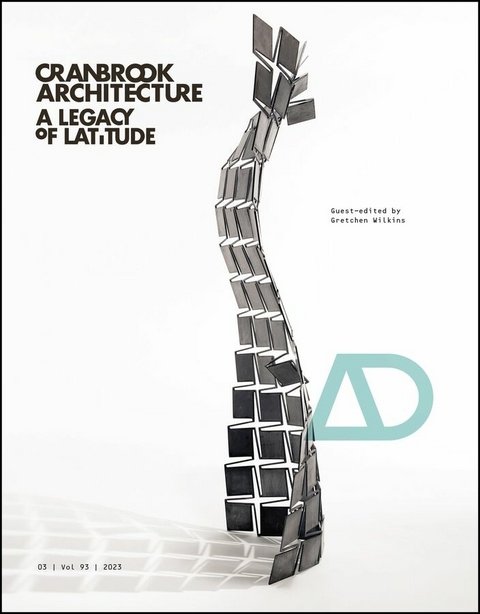
Cranbrook Architecture (eBook)
John Wiley & Sons (Verlag)
978-1-119-83443-4 (ISBN)
Guest-edited by Gretchen Wilkins
The renowned Cranbrook Academy of Art near Detroit, Michigan, has been described as the epicentre of American Modernism. When it opened in 1932 it combined a stunning Eliel Saarinen-designed campus with a radically open educational philosophy to attract and produce some of the most influential artists, designers and architects in US history, including Charles and Ray Eames, Fumihiko Maki, Florence Knoll and Edmund Bacon. Often compared to other experimental schools such as the Bauhaus, Black Mountain College and Taliesin, Cranbrook's sustained purpose has been advancing a wide, interdisciplinary latitude and self-directed design research to expand and diversify its approaches to architectural practice. There is a deep and persistent idea that open and experimental acts of making should define pedagogy, and by extension that education should shape practice, not the other way around. Cranbrook's rigorous defiance of dogma and loose grip on the disciplines enables an educational model that combines the practices of art, design, making and urbanism. In this issue, alumni, faculty and scholars reflect on Cranbrook's model in light of contemporary and challenging questions in architectural education, practice and the profession.
Contributors: Kevin Adkisson, Emily Baker, Peggy Deamer, Pia Ednie-Brown, Ronit Eisenbach, Dan Hoffman, Yu-Chih Hsiao, Peter Lynch, Bill Massie, Hani Rashid, Jesse Reiser, Lois Weinthal, and Tod Williams.
Featured architects: Asymptote Architecture, Building Culture PLA, Reiser+Umemoto (RUR), Studio Libeskind, and Tod Williams Billie Tsien.
Gretchen Wilkins is the Head of Architecture / Architect-in-Residence at Cranbrook Academy of Art. She has been practicing and teaching architecture for nearly twenty years based in Michigan, Australia and Vietnam. Previously, she was an Assistant Professor at the University of Michigan and Associate Professor at RMIT University Melbourne & Ho Chi Minh City. At RMIT she served as Head of Department for Design, overseeing programs in Architecture, Fashion, Digital Media and Design Studies at the Vietnam campus, and was Program Director for the Master of Urban Design program based in Melbourne, Barcelona and Ho Chi Minh City. Her practice is interested in the making and unmaking of cities through design, manufacturing and mobility. This work has been supported by the Japan Foundation, Australia-China Council, James L. Knight Foundation and the Holcim Foundation for Sustainable Construction. She is the editor of Distributed Urbanism, Cities after Google Earth (Routledge), and has contributed to Architectural Design (AD), Princeton Architectural Press, the Storefront for Art & Architecture, Architecture Australia, the University College London and Architecture and Culture. Wilkins received her Master of Architecture from the University of Michigan and PhD in Architecture from RMIT University, Melbourne.
Guest-edited by Gretchen Wilkins The renowned Cranbrook Academy of Art near Detroit, Michigan, has been described as the epicentre of American Modernism. When it opened in 1932 it combined a stunning Eliel Saarinen-designed campus with a radically open educational philosophy to attract and produce some of the most influential artists, designers and architects in US history, including Charles and Ray Eames, Fumihiko Maki, Florence Knoll and Edmund Bacon. Often compared to other experimental schools such as the Bauhaus, Black Mountain College and Taliesin, Cranbrook s sustained purpose has been advancing a wide, interdisciplinary latitude and self-directed design research to expand and diversify its approaches to architectural practice. There is a deep and persistent idea that open and experimental acts of making should define pedagogy, and by extension that education should shape practice, not the other way around. Cranbrook s rigorous defiance of dogma and loose grip on the disciplines enables an educational model that combines the practices of art, design, making and urbanism. In this issue, alumni, faculty and scholars reflect on Cranbrook s model in light of contemporary and challenging questions in architectural education, practice and the profession. Contributors: Kevin Adkisson, Emily Baker, Peggy Deamer, Pia Ednie-Brown, Ronit Eisenbach, Dan Hoffman, Yu-Chih Hsiao, Peter Lynch, Bill Massie, Hani Rashid, Jesse Reiser, Lois Weinthal, and Tod Williams. Featured architects: Asymptote Architecture, Building Culture PLA, Reiser+Umemoto (RUR), Studio Libeskind, and Tod Williams Billie Tsien.
Gretchen Wilkins is the Head of Architecture / Architect-in-Residence at Cranbrook Academy of Art. She has been practicing and teaching architecture for nearly twenty years based in Michigan, Australia and Vietnam. Previously, she was an Assistant Professor at the University of Michigan and Associate Professor at RMIT University Melbourne & Ho Chi Minh City. At RMIT she served as Head of Department for Design, overseeing programs in Architecture, Fashion, Digital Media and Design Studies at the Vietnam campus, and was Program Director for the Master of Urban Design program based in Melbourne, Barcelona and Ho Chi Minh City. Her practice is interested in the making and unmaking of cities through design, manufacturing and mobility. This work has been supported by the Japan Foundation, Australia-China Council, James L. Knight Foundation and the Holcim Foundation for Sustainable Construction. She is the editor of Distributed Urbanism, Cities after Google Earth (Routledge), and has contributed to Architectural Design (AD), Princeton Architectural Press, the Storefront for Art & Architecture, Architecture Australia, the University College London and Architecture and Culture. Wilkins received her Master of Architecture from the University of Michigan and PhD in Architecture from RMIT University, Melbourne.
Chapter 1 Introduction Hive of Education: Reflections on a Model of Architectural Education
Chapter 2 Evolution Over Revolution: Eliel Saarinen as Architect and Educator
Chapter 3 Provoking the Outliers: Trajectories for the Near Future Drawn from the Enigmatic Past
Chapter 4 'The Unmeasurable': Lessons from Cranbrook
Chapter 5 Schooling Fishy Knowledge
Chapter 6 Postgraduate Architectural Education In Situ
Chapter 7 Unprompted: Open-ended Investigations in the Choreography of Construction
Chapter 8 Building A Dream: Fertile Ground for Social Good
Chapter 9 Unbuilding and the Recovery of Craft in Architecture: Cranbrook Department of Architecture 1986-1996
Chapter 10 An Architecture of Marks: Reading Histories and Writing Futures
Chapter 11 Methods of Inspiration: A Pedagogical Approach Based on Singularity
Chapter 12 The Interior Within Hand's Reach: Tactile Proximity
Chapter 13 Arrows: The Long Lines of Influence in Architecture
Chapter 14 Forming Action: The Subject in the Object
Chapter 15 The Agency of Making: An Anatomy of Practice-based Pedagogy
Chapter 16 From Another Perspective - Adept and Apprentices: Contributors
About Architectural Design
| Erscheint lt. Verlag | 15.5.2023 |
|---|---|
| Reihe/Serie | Architectural Design |
| Architectural Design | Architectural Design |
| Sprache | englisch |
| Themenwelt | Technik ► Architektur |
| Schlagworte | American • Architectural History & Styles • Architecture • Architektur • Architektur- u. Stilgeschichte • ART • craft • Cranbrook • Cranbrook Academy of Art • Design • Education • Making • Modern • Practice |
| ISBN-10 | 1-119-83443-0 / 1119834430 |
| ISBN-13 | 978-1-119-83443-4 / 9781119834434 |
| Informationen gemäß Produktsicherheitsverordnung (GPSR) | |
| Haben Sie eine Frage zum Produkt? |
 PDF (Adobe DRM)
Kopierschutz: Adobe-DRM
Adobe-DRM ist ein Kopierschutz, der das eBook vor Mißbrauch schützen soll. Dabei wird das eBook bereits beim Download auf Ihre persönliche Adobe-ID autorisiert. Lesen können Sie das eBook dann nur auf den Geräten, welche ebenfalls auf Ihre Adobe-ID registriert sind.
Details zum Adobe-DRM
Dateiformat: PDF (Portable Document Format)
Mit einem festen Seitenlayout eignet sich die PDF besonders für Fachbücher mit Spalten, Tabellen und Abbildungen. Eine PDF kann auf fast allen Geräten angezeigt werden, ist aber für kleine Displays (Smartphone, eReader) nur eingeschränkt geeignet.
Systemvoraussetzungen:
PC/Mac: Mit einem PC oder Mac können Sie dieses eBook lesen. Sie benötigen eine
eReader: Dieses eBook kann mit (fast) allen eBook-Readern gelesen werden. Mit dem amazon-Kindle ist es aber nicht kompatibel.
Smartphone/Tablet: Egal ob Apple oder Android, dieses eBook können Sie lesen. Sie benötigen eine
Geräteliste und zusätzliche Hinweise
Buying eBooks from abroad
For tax law reasons we can sell eBooks just within Germany and Switzerland. Regrettably we cannot fulfill eBook-orders from other countries.
aus dem Bereich