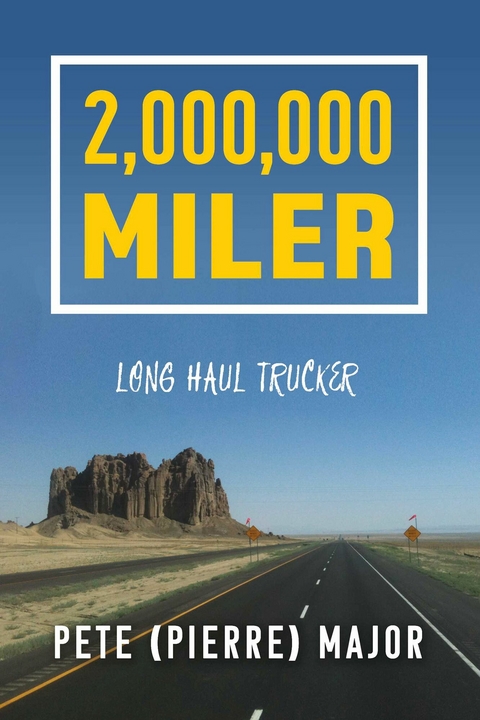
2,000,000 Miler (eBook)
172 Seiten
Bookbaby (Verlag)
978-1-6678-8511-7 (ISBN)
Trucking is one part of a multifaceted logistical industry that is global in reach and integrated to the extent few can imagine. Air freight, container ships, rail, they all play a part in working together in ways few people appreciate and for the most part are unaware of. The overarching taskmaster for all these carriers is the clock which is forever pushing the limits of their capabilities. Disruptions caused by war,weather, broken treaties, pandemics, you name it - any one of these can cause everyone's best laid time schedule to crumble.
Chapter 2:
Trucking 101
Glossary
Air lines – Coiled flex tubing lines that conduct the air from the air compressor to the braking system, air suspension (air bags) and air ride seats. The coupling system to lock the lines from the tractor to the trailer are called the “glad hands.” One colored line is blue, the other red which is called the emergency line. The blue line is the active one and should it break or come disconnected the emergency line takes over. An air gauge on the dashboard monitors the air pressure and reserves.
Air compressor – The unit that generates and provides air to the needed air system used by the tractor-trailer. It is up by the engine compartment and pumps compressed air that is stored in air tanks which are positioned on the frame of the tractor and the trailer.
Glad hands – A coupling mechanism that provides the connection point between air lines from the tractor to the trailer.
O-rings – A round rubber sealing ring that fits into the mating portions of the glad hands. They are subject to wear (or are stolen) and I always made sure to have spares on hand to pop in as needed.
Electrical cord – Along with the air lines, this third critical connection is a heavy-duty electrical cord that runs from the tractor and plugs into a receptacle in the trailer to provide power to all the marker and tail brake lights on the trailer. These can come loose if not “seated” properly causing the trailer lights to flicker or not work at all.
5th wheel – A heavy-duty circular steel plate that sits in the middle of the tractor frame over the tandem axles with a locking mechanism in the middle to couple with the trailer’s kingpin. When backing into the trailer it will slide under the trailer and “hook” onto the trailer kingpin and lock in place. Holland Fifth Wheels is the biggest manufacturer of these in the trucking industry, if you want to check them out online and see images.
Tractor – The actual truck pulling the trailer by means of a 5th wheel which connects to the trailer kingpin. Most OTR trucks are tandem tractors with three axles, a steering axle in the front and tandem drive axles in the rear, making for a total of ten wheels. But wait a minute! Newer “super single tires” as they are called are a larger single tire replacing two individual tires. Tractor (or trailers) using super singles can now have four tires on the rear of the tractor in place of the eight they had before. The weight of a highway tractor, (without trailer) is 20,000 lbs.
Fuel – Almost all highway tractors use diesel fuel, one gallon of diesel fuel is seven pounds. This weight can be a factor on a fully loaded tractor-trailer and affect what is a legal or illegal load. I had 2 x 100-gallon fuel tanks on my tractor. That weight adds up!
Side box(s) – These are additional storage areas on each side of the tractor below the sleeper area that store chains, tools, straps, tie downs, crowbars, toolboxes, cleaning equipment, boots, rain gear, windshield washer fluid and anything else that you might want to squeeze in there. A sort of storage shed for the truck.
Trailer – The unit that hooks to the back of the tractor that carries the freight. For most truck load carriers, the standard lengths have increased from 45 feet to 48 feet and eventually to the present-day standard of 53 feet. There are two axles at the rear of the trailer whose position can be adjusted by means of locking pins to better balance the overall weight if need be. Most trailers these days have air ride suspension, a big improvement on the older spring suspension.
Common tractor-trailer combinations – Though a tandem tractor pulling a 53-foot (dry box) trailer is the industry standard when it comes to truckload carriers, many other configurations exist depending on the nature of the company and goods hauled.
Shorter (pup) trailers linked together in chains or sets of two or three trailers are common among LTL companies. These include tanker trailers hauling chemicals, flatbed trailers, grain trailers, gravel and sand trailers, logging trailers, oversize trailers, container chassis, furniture haulers, car haulers, the list goes on.
Landing gear – Toward the front of the trailer is a set of “legs” known as the landing gear that supports the trailer when it is unhooked and set-out on its own. They are adjustable in height to prevent the trailer from dropping on its nose when unhooked from the tractor (yes, it happens!). A crank handle connected to the landing gear manually cranks the legs up and down in either high or low gears. When not in use this crank handle is folded over to the side of the trailer and slotted into a securing bracket. The trailer doors are latched shut with heavy duty bars that clip into notches at the top and bottom of the trailer doors after which a padlock and/or seal is set in place to prevent tampering.
An empty trailer normally weighs around 20,000 lbs. A standard trailer can carry up to 45,000 lbs. of freight on top of that.
Pogo sticks – When a trailer is backed to a loading dock or warehouse a heavy-duty piece of steel pipe, (pogo stick) is placed under the nose of the trailer to prevent it from tipping over in case there is too much weight towards the front. These are provided by some warehousing receiving areas and are often mandatory when unhooking from a trailer. A “nosedive” can occur when unloading and weight is removed at the rear of the trailer. The center of gravity will be shifted to the front and then Boom! Nosedive. Warehouse personnel have been seriously injured in these situations.
Dry boxes – Another name for our trailers as opposed to reefer trailers. CFI used only dry boxes at the time I was there.
Reefer trailers – These are climate-controlled trailers that have units protruding at the upper front of the trailers. They are costly trailers commonly used to haul temperature sensitive goods such as produce, fresh meats, whose settings can be set to a required temperature. These trailers also have a self-contained fuel tank to maintain the running of their reefers. We rarely hauled any of these trailers during my time with CFI.
CDL – Commercial driver’s license required to drive tractor-trailers, a.k.a. semis. It may or may not have a Haz-mat endorsement.
Haz-mat endorsement – An endorsement on your CDL that authorizes the driver to haul hazardous materials. A special exam is given to make this happen. Some drivers don’t want the hassle (or have trouble passing the test) of hauling Haz-mat goods and decline the offer to get the endorsement.
Usually having a Haz-mat endorsement expands one’s employment opportunities and comes with higher pay.
Air horn – Most everyone knows what this is. It is the loud horn used on trucks that can be operated either by air or off an electrical system.
Sleeper – A general name for the bunk behind the driver or passenger seat. Most tractors—such as mine—have two bunks, an upper and lower one. As a solo driver not needing the upper bunk, I kept it folded and locked in the up position allowing me more headroom. My truck had a “stand up sleeper,” meaning you could stand upright on the floor by the sleeper without having to stoop or bend over. This wasn’t the case in my earlier model trucks where headroom was non-existent due to the limited clearing.
Daycab – Basically a tractor, but without a sleeper added. It is usually used to operate around town or within a “day’s” travel to a terminal.
Dunnage – A term for anything that blocks, braces, supports or secures the freight.
Switcher, yard goat – A specialized tractor whose sole purpose is to move trailers in and out of loading docks and park them in the yard to be later picked up and delivered by the OTR drivers. Because of the constant hooking and unhooking to trailers and to lessen the stress of having to get out and crank the landing gear up and down, many of these switchers have an air pressurized fifth wheel to raise and lower the fifth wheel so they just need to hook up to a trailer, raise it a bit and go. Once they lower it, an auto release button unhooks the fifth wheel from the kingpin.
Swampers, lumpers and day laborers – A name given to someone whose sole job is to load and unload trailers.
Air ride seats – Just what the name says. These driver seats have an adjustable air-controlled suspension, greatly adding to the comfort of the ride. I wish I had one on my pickup!
Jewelry – Slang for the chains that are placed on the tractor and trailer tires in areas of heavy snow, usually mountain passes.
Gross Vehicle weights (GVW) – Gross weight includes the weight of the tractor-trailer plus freight. The standard load limit for a fully loaded highway truck is 80,000 lbs. Most loads over this need special permits.
CB radios – Most every truck has them. It is a two-way radio with a limited range that truckers use to communicate with each other. Their antennas are normally mounted outside somewhere on the cab, most likely the side mirror brackets. CB’s are a necessary item in trucks and serve a purpose though often misused.
Logs (paper/electronic) – A requirement of every OTR...
| Erscheint lt. Verlag | 3.4.2023 |
|---|---|
| Sprache | englisch |
| Themenwelt | Technik |
| ISBN-10 | 1-6678-8511-1 / 1667885111 |
| ISBN-13 | 978-1-6678-8511-7 / 9781667885117 |
| Informationen gemäß Produktsicherheitsverordnung (GPSR) | |
| Haben Sie eine Frage zum Produkt? |
 EPUB (Ohne DRM)
Größe: 1,3 MB
Digital Rights Management: ohne DRM
Dieses eBook enthält kein DRM oder Kopierschutz. Eine Weitergabe an Dritte ist jedoch rechtlich nicht zulässig, weil Sie beim Kauf nur die Rechte an der persönlichen Nutzung erwerben.
Dateiformat: EPUB (Electronic Publication)
EPUB ist ein offener Standard für eBooks und eignet sich besonders zur Darstellung von Belletristik und Sachbüchern. Der Fließtext wird dynamisch an die Display- und Schriftgröße angepasst. Auch für mobile Lesegeräte ist EPUB daher gut geeignet.
Systemvoraussetzungen:
PC/Mac: Mit einem PC oder Mac können Sie dieses eBook lesen. Sie benötigen dafür die kostenlose Software Adobe Digital Editions.
eReader: Dieses eBook kann mit (fast) allen eBook-Readern gelesen werden. Mit dem amazon-Kindle ist es aber nicht kompatibel.
Smartphone/Tablet: Egal ob Apple oder Android, dieses eBook können Sie lesen. Sie benötigen dafür eine kostenlose App.
Geräteliste und zusätzliche Hinweise
Buying eBooks from abroad
For tax law reasons we can sell eBooks just within Germany and Switzerland. Regrettably we cannot fulfill eBook-orders from other countries.
aus dem Bereich