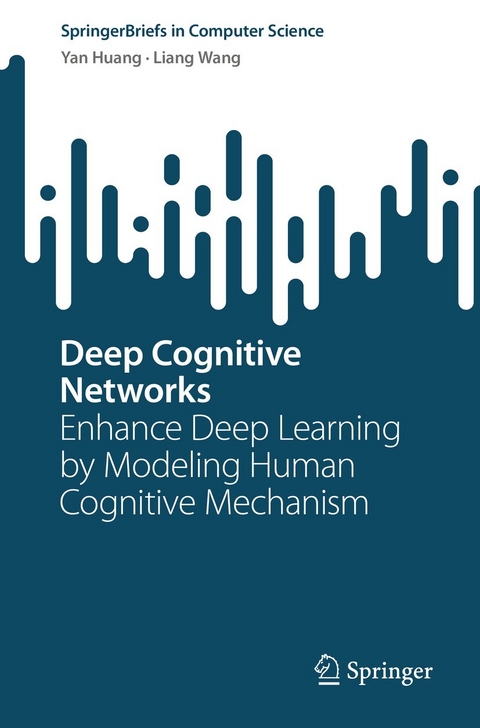
Deep Cognitive Networks (eBook)
62 Seiten
Springer Nature Singapore (Verlag)
978-981-99-0279-8 (ISBN)
Although deep learning models have achieved great progress in vision, speech, language, planning, control, and many other areas, there still exists a large performance gap between deep learning models and the human cognitive system. Many researchers argue that one of the major reasons accounting for the performance gap is that deep learning models and the human cognitive system process visual information in very different ways.
To mimic the performance gap, since 2014, there has been a trend to model various cognitive mechanisms from cognitive neuroscience, e.g., attention, memory, reasoning, and decision, based on deep learning models. This book unifies these new kinds of deep learning models and calls them deep cognitive networks, which model various human cognitive mechanisms based on deep learning models. As a result, various cognitive functions are implemented, e.g., selective extraction, knowledge reuse, and problem solving, for more effective information processing.
This book first summarizes existing evidence of human cognitive mechanism modeling from cognitive psychology and proposes a general framework of deep cognitive networks that jointly considers multiple cognitive mechanisms. Then, it analyzes related works and focuses primarily but not exclusively, on the taxonomy of four key cognitive mechanisms (i.e., attention, memory, reasoning, and decision) surrounding deep cognitive networks. Finally, this book studies two representative cases of applying deep cognitive networks to the task of image-text matching and discusses important future directions.
Although deep learning models have achieved great progress in vision, speech, language, planning, control, and many other areas, there still exists a large performance gap between deep learning models and the human cognitive system. Many researchers argue that one of the major reasons accounting for the performance gap is that deep learning models and the human cognitive system process visual information in very different ways.To mimic the performance gap, since 2014, there has been a trend to model various cognitive mechanisms from cognitive neuroscience, e.g., attention, memory, reasoning, and decision, based on deep learning models. This book unifies these new kinds of deep learning models and calls them deep cognitive networks, which model various human cognitive mechanisms based on deep learning models. As a result, various cognitive functions are implemented, e.g., selective extraction, knowledge reuse, and problem solving, for more effective information processing.This book first summarizes existing evidence of human cognitive mechanism modeling from cognitive psychology and proposes a general framework of deep cognitive networks that jointly considers multiple cognitive mechanisms. Then, it analyzes related works and focuses primarily but not exclusively, on the taxonomy of four key cognitive mechanisms (i.e., attention, memory, reasoning, and decision) surrounding deep cognitive networks. Finally, this book studies two representative cases of applying deep cognitive networks to the task of image-text matching and discusses important future directions.
| Erscheint lt. Verlag | 30.3.2023 |
|---|---|
| Reihe/Serie | SpringerBriefs in Computer Science | SpringerBriefs in Computer Science |
| Zusatzinfo | X, 62 p. 1 illus. |
| Sprache | englisch |
| Themenwelt | Informatik ► Grafik / Design ► Digitale Bildverarbeitung |
| Informatik ► Theorie / Studium ► Künstliche Intelligenz / Robotik | |
| Technik ► Elektrotechnik / Energietechnik | |
| Schlagworte | Attention Modeling • computer vision • decision modeling • deep cognitive networks • memory modeling • reasoning modeling |
| ISBN-10 | 981-99-0279-7 / 9819902797 |
| ISBN-13 | 978-981-99-0279-8 / 9789819902798 |
| Informationen gemäß Produktsicherheitsverordnung (GPSR) | |
| Haben Sie eine Frage zum Produkt? |
 PDF (Wasserzeichen)
DRM: Digitales Wasserzeichen
Dieses eBook enthält ein digitales Wasserzeichen und ist damit für Sie personalisiert. Bei einer missbräuchlichen Weitergabe des eBooks an Dritte ist eine Rückverfolgung an die Quelle möglich.
Dateiformat: PDF (Portable Document Format)
Mit einem festen Seitenlayout eignet sich die PDF besonders für Fachbücher mit Spalten, Tabellen und Abbildungen. Eine PDF kann auf fast allen Geräten angezeigt werden, ist aber für kleine Displays (Smartphone, eReader) nur eingeschränkt geeignet.
Systemvoraussetzungen:
PC/Mac: Mit einem PC oder Mac können Sie dieses eBook lesen. Sie benötigen dafür einen PDF-Viewer - z.B. den Adobe Reader oder Adobe Digital Editions.
eReader: Dieses eBook kann mit (fast) allen eBook-Readern gelesen werden. Mit dem amazon-Kindle ist es aber nicht kompatibel.
Smartphone/Tablet: Egal ob Apple oder Android, dieses eBook können Sie lesen. Sie benötigen dafür einen PDF-Viewer - z.B. die kostenlose Adobe Digital Editions-App.
Buying eBooks from abroad
For tax law reasons we can sell eBooks just within Germany and Switzerland. Regrettably we cannot fulfill eBook-orders from other countries.
aus dem Bereich