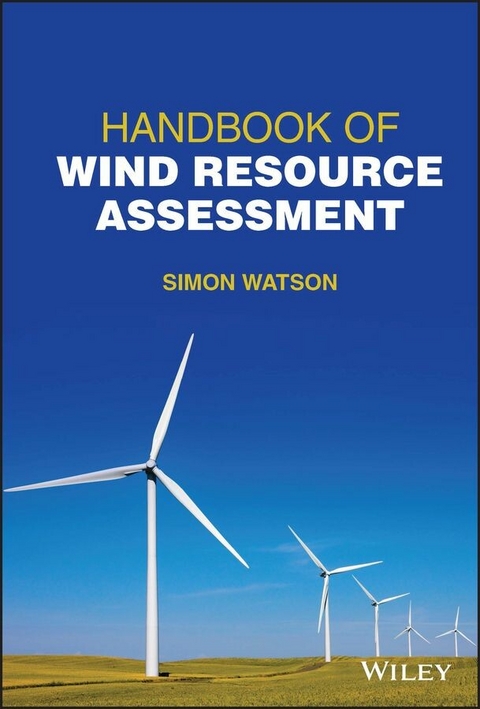
Handbook of Wind Resource Assessment (eBook)
320 Seiten
Wiley (Verlag)
978-1-119-05539-6 (ISBN)

Useful reference text underpinning the theory behind wind resource assessment along with its practical application
Handbook of Wind Resource Assessment provides a comprehensive description of the background theory, methods, models, applications, and analysis of the discipline of wind resource assessment, covering topics such as climate variability, measurement, wind distributions, numerical modeling, statistical modeling, reanalysis datasets, applications in different environments (onshore and offshore), wind atlases, and future climate.
The text provides an up-to-date assessment of the tools available for wind resource assessment and their application in different environments. It also summarizes our present understanding of the wind climate and its variability, with a particular focus on its relevance to wind resource assessment.
Written by a highly qualified professional in the fields of wind resource assessment, wind turbine condition monitoring, and wind turbine wake modeling, sample topics included in Handbook of Wind Resource Assessment are as follows:
- Climate variability, covering temporal scales of variation, power spectrum, short term variation and turbulence, the spectral gap, and long-term variation
- Measurement, covering history of wind speed measurement, types of measurement, terrestrial measurements, anemometers, wind vanes, lidars, sodars and remote sensing
- Distributions, covering synoptic scale wind distributions, turbulent scale distributions, contrast between mean and extreme values, and extreme value statistics
- Physical modeling, covering spatial scales of variability, the governing equations, models of varying complexity, mass consistent models, linearized models and semi-empirical models
- Statistical modeling, covering the use of measure-correlate-predict (MCP), wind indices and spatial interpolation
Handbook of Wind Resource Assessment serves as a comprehensive text that brings together the different aspects of wind resource assessment in one place. It is an essential resource for anyone who wishes to understand the underlying science, models, or applications of wind resources, including postgraduates, academics, and wind resource professionals.
Simon Watson is Head of the Wind Energy Section for the Faculty of Aerospace Engineering, Delft University of Technology. He has been working in the field of wind energy for over 30 years and is the Editor-in-Chief of the Wiley Wind Energy journal.
Simon Watson is Head of the Wind Energy Section for the Faculty of Aerospace Engineering, Delft University of Technology. He has been working in the field of wind energy for over 30 years and is the Editor-in-Chief of the Wiley Wind Energy journal.
Preface ix
Acknowledgements xi
About the Author xiii
1 Introduction 1
2 The Atmospheric Boundary Layer 11
3 Measurement 33
4 Wind Speed Variability and Distributions 85
5 Numerical Modelling 111
6 Wind Resource Estimation in Complex Terrain, Offshore, and in Urban Areas 157
7 Orographic Test Cases 179
8 Statistical Methods 199
9 Atmospheric Reanalyses and Wind Atlases 227
10 Mesoscale Phenomena 263
11 Long-term Wind Climate Trends 281
Index 291
1
Introduction
1.1 Early Wind Measurements
Wind power has come a long way since the earliest windmills were built to grind corn for flour or wind pumps installed to drain the marshes for growing crops. The siting of these early machines was driven more by the practical necessity to be close to the local populace than for maximum economic benefit. Estimates of the local wind climate could mostly be obtained from local informed opinion or visual clues such as the angle of growth of trees, or indeed the complete absence of trees at extremely windy sites. Measurement of wind direction, as opposed to wind speed, has been made for far longer. One of the earliest-known examples of this is a weathervane in the shape of the god Triton which stood atop the Tower of the Winds in Athens when it was first built around 50 BCE or possibly earlier (see Figure 1.1). Weathervanes on buildings such as churches in the Western world have also been a common sight for centuries. Although giving an indication of the local wind direction at the time of observation, such early devices were not generally used in the recording of historical wind direction distribution. Before the development of instruments to measure the magnitude of the wind speed, human perception or slightly more objective visual indicators were used to provide a wind speed scale. For example, the famous English writer Daniel Defoe, following the Great Storm of 1703 which caused significant destruction in southern England, proposed an 11-point scale based on common phrases, as detailed in Table 1.1 (The Weather Window, n.d.). Scale point 6, describing ‘a top sail gale’, gives a clue to the importance of such information for the maritime community, and several such empirical wind speed scales devised by sailors were known to exist in the seventeenth century and probably much earlier. Possibly the most famous such scale was developed in 1805 by the Irish hydrographer Francis Beaufort, a Royal Navy officer who later became a rear admiral and trained Robert FitzRoy who, in turn, founded what later became the UK Meteorological Office. The so-called Beaufort scale was designed as a 13-point scale based on the impact the wind speed had on the sails of a ship. These initial visual descriptors would be later converted into an actual measurement scale, which is still in use today for some applications (e.g. shipping broadcasts) and is detailed in Table 1.2.
Figure 1.1 The Tower of Winds in Athens. Source: Joanbanjo / Wikipedia Commons / CC BY-SA 3.0.
Table 1.1 Daniel Defoe’s proposed verbal wind speed scale from around 1704.
| Scale point | Description |
|---|
| 0 | Stark calm |
| 1 | Calm weather |
| 2 | Little wind |
| 3 | A fine breeze |
| 4 | A small gale |
| 5 | A fresh gale |
| 6 | A top sail gale |
| 7 | Blows fresh |
| 8 | A hard gale of wind |
| 9 | A fret of wind |
| 10 | A storm |
| 11 | A tempest |
Table 1.2 The Beaufort scale with modern equivalent units of wind speed.
| Wind force | Description | Wind speed | Specifications (italics refer to conditions at sea) | Wave height | Sea state |
|---|
| km/h | mph | knots | Probable (m) | Max. (m) |
| 0 | Calm | <1 | <1 | <1 | Smoke rises vertically Sea like a mirror | — | — | 0 |
| 1 | Light air | 1–5 | 1–3 | 1–3 | Direction shown by smoke drift but not by wind vanes Sea rippled | 0.1 | 0.1 | 1 |
| 2 | Light breeze | 6–11 | 4–7 | 4–6 | Wind felt on face; leaves rustle; wind vane moved by wind Small wavelets on sea | 0.2 | 0.3 | 2 |
| 3 | Gentle breeze | 12–19 | 8–12 | 7–10 | Leaves and small twigs in constant motion; light flags extended Large wavelets on sea | 0.6 | 1.0 | 3 |
| 4 | Moderate breeze | 20–28 | 13–18 | 11–16 | Raises dust and loose paper; small branches moved Small waves, fairly frequent white horses | 1.0 | 1.5 | 3–4 |
| 5 | Fresh breeze | 29–38 | 19–24 | 17–21 | Small trees in leaf begin to sway; crested wavelets form on inland waters Moderate waves, many white horses | 2.0 | 2.5 | 4 |
| 6 | Strong breeze | 38–49 | 25–31 | 22–27 | Large branches in motion; whistling heard in telegraph wires; umbrellas used with difficulty Large waves, extensive foam crests | 3.0 | 4.0 | 5 |
| 7 | Near gale | 50–61 | 32–38 | 28–33 | Whole trees in motion; inconvenience felt when walking against the wind Foam blown in streaks across the sea | 4.0 | 5.5 | 5–6 |
| 8 | Gale | 62–74 | 39–46 | 34–40 | Twigs break off trees; generally impedes progress Wave crests begin to break into spindrift | 5.5 | 7.5 | 6–7 |
| 9 | Strong gale | 75–88 | 47–54 | 41–47 | Slight structural damage (chimney pots and slates removed) Wave crests topple over, spray affects visibility | 7.0 | 10.0 | 7 |
| 10 | Storm | 89–102 | 55–63 | 48–55 | Seldom experienced inland; trees uprooted; considerable structural damage Sea surface largely white | 9.0 | 12.5 | 8 |
| 11 | Violent storm | 103–117 | 64–72 | 56–63 | Very rarely experienced; accompanied by widespread damage Medium-sized ships lost to view behind waves; sea covered in white foam; visibility seriously affected | 11.5 | 16.0 | 8 |
| 12 | Hurricane | ≥118 | ≥73 | ≥64 | Devastation Air filled with foam and spray; very poor visibility | ≥14 | — | 9 |
| Source: taken from The Royal Meteorological Society (n.d.). |
Table 1.2 describes three units of measurement including the knot (often abbreviated to ‘kt’, or ‘kts’ if plural) which may be less familiar. This is a unit of speed derived from the days of sailing ships when sailors would use a long length of rope to which pieces of wood would be tied using knots at regular intervals which would be paid out from the stern (rear) of a ship as it travelled for a defined period of time determined using an hourglass. The number of knotted pieces of wood paid out in this time period would be used to calculate the speed of the ship. The modern knot is defined as one nautical mile (1.852 km) per hour which is equivalent to 0.514 ms−1. This unit is still used to describe the speed of ships or aircraft and is sometimes used by meteorological agencies to measure wind speed, though the unit of ms−1 is more widely used nowadays.
These early wind measurements were primarily of interest for mariners where the wind was an important source of motive power. Today, it is generally only leisure shipping which still uses the wind to provide propulsion. However, now our attention has turned to use of the wind for generating electrical power and the quest to decarbonise the energy system. In this book, we look at the science of wind resource assessment from the point of view of measurement and modelling.
1.2 The Need for Wind Resource Assessment
The need for accurate assessment of the wind conditions at a site has been driven by the rapid expansion of wind power worldwide. By the end of 2020, a total capacity of 743 GW had been installed around the globe (Lee and Zhao, 2021). The global weighted-average installed cost for onshore wind energy in 2020 was $1355 kW−1 (IRENA, 2020). For a 100 MW wind farm this equates to a total investment of $140 million. The equivalent cost offshore is somewhat higher at around $3185 kW−1...
| Erscheint lt. Verlag | 14.3.2023 |
|---|---|
| Sprache | englisch |
| Themenwelt | Naturwissenschaften ► Physik / Astronomie |
| Technik ► Elektrotechnik / Energietechnik | |
| Schlagworte | Energie • Energietechnik • Energy • Power Technology & Power Engineering • Spectral Gap • wind climate variability • Windenergie • Wind Energy • wind long term variation • wind power spectrum • Wind Resource Analysis • wind resource applications • wind resource theory • wind scales of variation • wind variation and turbulence |
| ISBN-10 | 1-119-05539-3 / 1119055393 |
| ISBN-13 | 978-1-119-05539-6 / 9781119055396 |
| Informationen gemäß Produktsicherheitsverordnung (GPSR) | |
| Haben Sie eine Frage zum Produkt? |
 EPUB (Adobe DRM)
Kopierschutz: Adobe-DRM
Adobe-DRM ist ein Kopierschutz, der das eBook vor Mißbrauch schützen soll. Dabei wird das eBook bereits beim Download auf Ihre persönliche Adobe-ID autorisiert. Lesen können Sie das eBook dann nur auf den Geräten, welche ebenfalls auf Ihre Adobe-ID registriert sind.
Details zum Adobe-DRM
Dateiformat: EPUB (Electronic Publication)
EPUB ist ein offener Standard für eBooks und eignet sich besonders zur Darstellung von Belletristik und Sachbüchern. Der Fließtext wird dynamisch an die Display- und Schriftgröße angepasst. Auch für mobile Lesegeräte ist EPUB daher gut geeignet.
Systemvoraussetzungen:
PC/Mac: Mit einem PC oder Mac können Sie dieses eBook lesen. Sie benötigen eine
eReader: Dieses eBook kann mit (fast) allen eBook-Readern gelesen werden. Mit dem amazon-Kindle ist es aber nicht kompatibel.
Smartphone/Tablet: Egal ob Apple oder Android, dieses eBook können Sie lesen. Sie benötigen eine
Geräteliste und zusätzliche Hinweise
Buying eBooks from abroad
For tax law reasons we can sell eBooks just within Germany and Switzerland. Regrettably we cannot fulfill eBook-orders from other countries.
aus dem Bereich