G Protein-Coupled Receptors (eBook)
XII, 91 Seiten
Springer Nature Singapore (Verlag)
978-981-99-0078-7 (ISBN)
Xinfeng Zhao is a Professor in the College of Life Sciences at Northwest University (Xi'an, China) since 2016. He received his B.S. and M.S. in Chemistry from Northwest University in 2001 and Xi'an Jiaotong University in 2005, respectively. He obtained his doctorate in pharmacology in 2009 at Xi'an Jiaotong University and then pursued postdoctoral studies in pharmacology at University of Cambridge (Cambridge, UK) in 2010. In 2009, he joined Northwest University as a Lecturer and was promoted to an Associate Professor in 2013. He has been a Senior Visiting Scholar in the Department of Chemistry at Purdue University (West Lafayette, In) in 2017. His research interests are in the areas of immobilized GPCRs and applications, GPCR-drug interaction analysis, and bioactive compound screening from herbal medicines.
Qian Li received her doctorate in Pharmaceutical Analysis in 2016 and pursued postdoctoral studies in biology at Northwest University (Xi'an, China). Her dissertation focused on the establishment and application of chromatographic methods based on immobilized GPCRs. In 2018, she joined Northwest University as a Lecturer and was appointed to an Associate Professor in the College of Life Sciences in 2020. During 2018 to 2020, she went to the Department of Chemistry at Purdue University (West Lafayette, In) as a visiting scholar. Her current interests lie in the area of immobilized GPCRs and their applications.
Jing Wang joined the faculty as a Lecturer in the College of Life Sciences at Northwest University (Xi'an, China). She received her Ph.D. in Medicinal Chemistry in 2019 from Northwest University under the direction of Professor Xinfeng Zhao. Her research efforts are primarily directed toward the immobilization of GPCRs (e.g. beta2-adrenoceptor and leukotriene receptor) through bioorthogonal reaction and their application in receptor-ligand interaction analysis and lead compound screening from natural products.
Qi Liang received his received his B.S. in Life Sciences and M.S. in Pharmacology from Northeast Forestry University (Harbin, China) in 2010 and Xi'an Jiaotong University (Xi'an, China) in 2013, respectively. In 2021, he obtained his Ph.D. in medicinal chemistry from Northwest University (Xi'an, China) under the direction of Prof. Xinfeng Zhao. Afterwards, he was engaged in his postdoctoral work in the same group. His research interests are screening the ligands of GPCR from DNA-encoded library.
Jia Quan received his B.S. and Ph.D. from Northwest University (Xi'an, China) in 2015 and Wuhan University (Wuhan, China) in 2021, respectively. In 2022, he joined the group of Prof. Xinfeng Zhao at Northwest University as a postdoctoral fellow. His research project focuses on the virus-encoded GPCRs and the screening for new antivirus drugs.
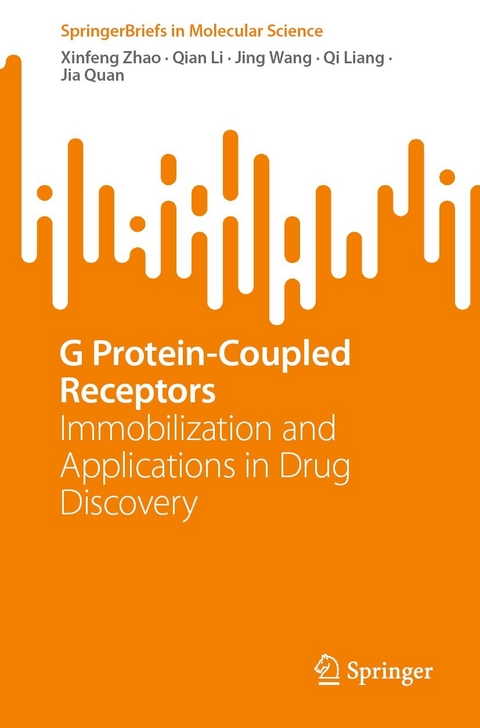
This book summarizes the progress made to functional immobilize G protein-coupled receptors (GPCRs) through site-specific or orientated recognition in both non-covalent and covalent manners. The last decade is the dawn of the "e;post-structural biology"e; era for G protein-coupled receptor research. As an emerging approach for state-of-the-art immobilization, this book discusses efforts to explore the elegance of naturally-occurring biochemical reactions by using their high specificity and robust reactivity in the complex system, such as site-specific conjugation by covalent recognition between enzymes and their substrates. With the perspective of protein-drug interactions, this book also reviews the applications of protein immobilization, with an emphasis on G protein-coupled receptors, in drug discovery and protein-ligand interaction analysis. In addition, the merits, opportunities and disadvantages are analyzed for different immobilization methods, and a perspective for future directions is presented. Given its scope, this book appeals to a broad readership, particularly researchers engaged in the field of analytical chemistry, bioconjugate chemistry, and chemical biology, and other related field, as well as teachers of relevant majors in colleges and universities.
| Erscheint lt. Verlag | 20.2.2023 |
|---|---|
| Reihe/Serie | SpringerBriefs in Molecular Science | SpringerBriefs in Molecular Science |
| Zusatzinfo | XII, 91 p. 7 illus., 6 illus. in color. |
| Sprache | englisch |
| Themenwelt | Naturwissenschaften ► Biologie ► Biochemie |
| Naturwissenschaften ► Chemie ► Analytische Chemie | |
| Technik | |
| Schlagworte | drug discovery • Drug-ligand interaction • GPCRs • Natural Products • Oriented immobilization |
| ISBN-10 | 981-99-0078-6 / 9819900786 |
| ISBN-13 | 978-981-99-0078-7 / 9789819900787 |
| Informationen gemäß Produktsicherheitsverordnung (GPSR) | |
| Haben Sie eine Frage zum Produkt? |
 PDF (Wasserzeichen)
DRM: Digitales Wasserzeichen
Dieses eBook enthält ein digitales Wasserzeichen und ist damit für Sie personalisiert. Bei einer missbräuchlichen Weitergabe des eBooks an Dritte ist eine Rückverfolgung an die Quelle möglich.
Dateiformat: PDF (Portable Document Format)
Mit einem festen Seitenlayout eignet sich die PDF besonders für Fachbücher mit Spalten, Tabellen und Abbildungen. Eine PDF kann auf fast allen Geräten angezeigt werden, ist aber für kleine Displays (Smartphone, eReader) nur eingeschränkt geeignet.
Systemvoraussetzungen:
PC/Mac: Mit einem PC oder Mac können Sie dieses eBook lesen. Sie benötigen dafür einen PDF-Viewer - z.B. den Adobe Reader oder Adobe Digital Editions.
eReader: Dieses eBook kann mit (fast) allen eBook-Readern gelesen werden. Mit dem amazon-Kindle ist es aber nicht kompatibel.
Smartphone/Tablet: Egal ob Apple oder Android, dieses eBook können Sie lesen. Sie benötigen dafür einen PDF-Viewer - z.B. die kostenlose Adobe Digital Editions-App.
Buying eBooks from abroad
For tax law reasons we can sell eBooks just within Germany and Switzerland. Regrettably we cannot fulfill eBook-orders from other countries.
aus dem Bereich