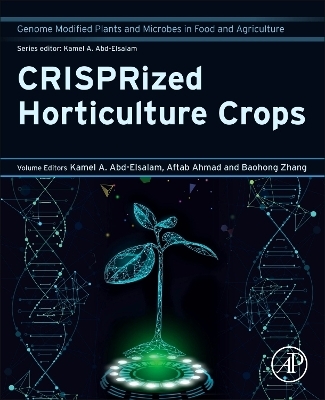
CRISPRized Horticulture Crops
Academic Press Inc (Verlag)
978-0-443-13229-2 (ISBN)
Horticultural crops, including fruit, vegetable and ornamental plants are an important component of agriculture production systems and play an important role in sustaining human life.
Prof. Kamel A. Abd-Elsalam, Ph.D., is currently a research professor at the Plant Pathology Research Institute, Agricultural Research Center, Giza. Kamel earned his Ph.D. in Molecular Plant Pathology from Christian Alberchts University of Kiel (Germany) and Suez Canal University (Egypt). Dr. Kamel’s research interests include developing, improving, and deploying plant biosecurity diagnostic tools; understanding and exploiting fungal pathogen genomes; and developing eco-friendly hybrid nanomaterials for controlling toxicogenic fungi, plant diseases, and agroecosystems applications. He published 20 books related to nano-biotechnology applications in agriculture and plant protection. Since 2019, he has served as the Editor-in-Chief of the Elsevier book series “Nanobiotechnology for Plant Protection. He also serves as the Series Editor of the Elsevier book series “Genome Modified Plants and Microbes in Food and Agriculture. Aftab Ahmad earned his PhD and completed postdoctoral research in plant molecular biology at the University of Shizuoka, Japan, under the prestigious 21st Century Center of Excellence Program. He also served as a Visiting Scientist in the Department of Plant Sciences at the University of California Davis, United States. With over a decade of teaching experience in biochemistry and molecular biology at the University of Agriculture, Faisalabad, Pakistan, Dr. Aftab now continues to advance plant genome editing research aimed at improving crop resilience and productivity at the Natural & Medical Sciences Research Center, University of Nizwa, Oman. He has published in leading international peer-reviewed journals such as Frontiers in Plant Science, Journal of Biomedical Science, Plant Molecular Biology Reporter, Journal of Cereal Science, Genetic Resources and Crop Evolution, and many more. Baohong Zhang is a THCAS Distinguished Professor in the Department of Biology at East Carolina University and an internationally recognized leader in genomics and biotechnology. He earned his bachelor’s degree in Plant Genetics and Breeding from China Agricultural University and his PhD in Environmental Toxicology from Texas Tech University. For over 20 years, Dr. Zhang has conducted pioneering research in transgenic technologies, genome editing, and functional genomics, supported by major funding agencies such as the NSF, NIH, DoD, and USDA, as well as industry partners including the North Carolina Biotechnology Center and DuPont. He is a prolific author, with several publications listed as Highly Cited Papers by the ISI Web of Science. He is Editor-in-Chief, Associate Editor, or Guest Editor for multiple international journals, including Functional & Integrative Genomics, Plants, Scientific Reports, Plant Biotechnology Journal, Molecular Biotechnology, Plant Molecular Biology, and Journal of Cotton Research. A Fellow of the American Association for the Advancement of Science, Dr. Zhang has received numerous honors, including more recently the ECU Achievement in International Research and Creative Activity Award (2017), the Cotton Researcher of the Year (2018), the Lifetime Achievement Research Award (2019), and the Cotton Biotechnology Award (2020).
Part 1: The CRISPR/Cas toolkit for Horticultural Crops
1. Horticultural Crops: Genomic Approaches: A note from Editors
2. Evolution of genome editing technologies
3. CRISPR / Cas: Effectors, mechanism, and classification
4. Bioinformatics tools and databases in genome editing for plants
5. Genome editing reagents and their delivery tools
6. CRISPR Techniques and their applications in plants
7. Base editing and Prime Editing in Horticulture Crops: Potential Applications, Challenges and Prospects
8. Multiplex Genome Editing in plants through CRISPR/Cas
9. CRISPR Edited Crops: The Future of Food and environment Sustainability
Part 2: CRISPR Mediated Genome Editing in Horticultural Crops
10. The CRISPRized Horticultural Crops: How they can transform our food supply
11. Precision breeding techniques for horticultural crops
12. Deep learning for genomics and epi-genomics in horticulture crops improvement
13. Transformation methods in horticulture crops and DNA free genome editing in plants
14. CRISPR vegetables: Challenges and opportunities
15. CRISPR–Cas9-mediated genome editing in tomato, and Potato
16. A CRISPR/Cas Based Improvement of Root and Tuber crops
17. Improvement of ornamental plants through CRISPR/Cas
18. CRISPR approaches for synthetic biology and metabolic engineering in vegetables and fruits
19. CRISPR Cas systems for the improvement of Solanaceous vegetable crops
20. Engineering biotic stress resistance in horticultural plants through CRISPR/Cas
21. Genome editing for abiotic stress resistance in horticultural crops
22. CRISPR/Cas technology for enhancement Genetic Amelioration of Fruits in horticulture crops
23. CRISPR–Cas9-mediated genome editing in Banana, apple and grapevine
24. CRISPR Applications in Medicinal plants
25. CRISPR Edited Floriculture Crops: A Revolutionary Technique to Improve Flower Production, their Color and Longevity
26. CRISPR based improvement of Grasses in horticulture
27. CRISPR genome editing of woody trees: current status and future Trends
Part 3: Regulation and Commercialization of CRISPR edited crops
28. Regulatory, ethical, social, and biosafety concerns in genome edited horticultural crops
29. Social, Ethical and Policy issues in CRISPR Edited Crops
30. Commercialization of CRISPR edited crops: Opportunities and Challenges
31. Global Patent Landscape in CRISPR/Cas
| Erscheinungsdatum | 03.04.2024 |
|---|---|
| Verlagsort | San Diego |
| Sprache | englisch |
| Maße | 216 x 276 mm |
| Gewicht | 450 g |
| Themenwelt | Naturwissenschaften ► Biologie ► Genetik / Molekularbiologie |
| Technik ► Umwelttechnik / Biotechnologie | |
| Weitere Fachgebiete ► Land- / Forstwirtschaft / Fischerei | |
| ISBN-10 | 0-443-13229-1 / 0443132291 |
| ISBN-13 | 978-0-443-13229-2 / 9780443132292 |
| Zustand | Neuware |
| Informationen gemäß Produktsicherheitsverordnung (GPSR) | |
| Haben Sie eine Frage zum Produkt? |
aus dem Bereich