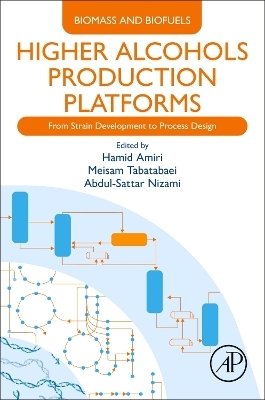
Higher Alcohols Production Platforms
Academic Press Inc (Verlag)
978-0-323-91756-8 (ISBN)
A lifecycle assessment is also presented, addressing the energy, environmental, social and economic factors in the sustainability of higher alcohol production. Readers will find this to be a unique and comprehensive reference on the production of higher alcohols that will be of interest to students, researchers and industry professionals involved in bioenergy and renewable energy, and more.
Hamid Amiri has a master’s in chemical engineering from the Isfahan University of Technology, Isfahan, Iran. He has a Ph.D. in Chemical Engineering-Biotechnology from Isfahan University of Technology. Since 2014, he has worked as an Assistant Professor at the University of Isfahan in breaking the chemical and engineering barriers to the production of waste-based biofuels and value-added biochemicals by process design, integration, optimization, and analysis in the way of developing future biorefineries. He has published more than 30 papers on the topics of renewable energy, alternative fuels, waste-to-energy, ABE fermentation, pretreatment of lignocellulose, and resource recovery. He has completed a number of funded research projects and played the leading role in the development of the Environmental Research Institute and Biotechnology Lab Complex in University of Isfahan. Meisam Tabatabaei is a Professor of Environmental Biotechnology at Universiti Malaysia Terengganu, Malaysia. From 2010 to 2019, he worked closely with the United Nations Development Program (UNDP) to promote waste-oriented biofuels in the developing world. Since 2016, he has been the lead collaborator of the Lancet Commission on Public Health and Climate Change (UCL, UK). He has published over 450 works, including original research papers and reviews in leading journals such as The Lancet, Progress in Energy and Combustion Sciences, Nature Food, Trends in Biotechnology, and Renewable and Sustainable Energy Reviews. He currently serves as a Visiting Professor at Henan Agricultural University (China), Visiting Professor & Global Ambassador at the University of Saskatchewan (Canada), and Distinguished Adjunct Professor at Zhengzhou University (China). He has held top editorial roles in journals with impact factors above 30 and is currently Associate Editor of Critical Reviews in Biotechnology and an editorial board member of the International Journal of Life Cycle Assessment. As of June 2025, Prof. Tabatabaei has led and collaborated on 24 research projects with a focus on waste valorisation and biorefineries, sustainable aquaculture, climate change, and food security. Abdul-Sattar Nizami has a master’s in engineering from the Chalmers University of Technology, Göteborg, Sweden. He has a Ph.D. in Sustainable Gaseous Biofuel from the School of Civil and Environmental Engineering, University College Cork, Ireland. Later, he worked at the University of Toronto, Canada as a Postdoctoral Fellow on alternative fuels, life cycle studies under the Institute for Sustainable Energy. He served the Center of Excellence in Environmental Studies (CEES) of King Abdulaziz University, Saudi Arabia, as an Assistant Professor and Head of Solid Waste Management Unit, and is currently an Associate Professor at the Sustainable Development Study Centre (SDSC), Government College University, Pakistan. He has published more than 100 papers on the topics of renewable energy, alternative fuels, waste-to-energy, catalytic pyrolysis, anaerobic digestion, and resource recovery. Dr. Nizami is an Associate Editor in Renewable & Sustainable Energy Reviews, Energy & Environment, and Frontiers in Energy Research. He is serving as an Editorial Board Member in Bioresource Technology Reports, and Energy Sources Part B.
1. Higher alcohols: The fundamentals
2. Alcohol production: Metabolic pathways
3. Alcohol production: Upstream processes
4. Sugar fermentation: C2 (ethanolic) platform
5. Sugar fermentation: C3-C8 platforms
6. Sugar fermentation: C4 (Acetone-Butanol-Ethanol and Isopropanol-Butanol-Ethanol) platform
7. Sugar fermentation: C4 (fermentative and non-fermentative isobutanol) platform
8. Syngas fermentation platforms: Alcohols from syngas by mono- and mixed-cultures
9. Photosynthetic platforms: Alcohols from CO2
10. Electrofuel platforms: Non-photosynthetic alcohol production
11. Alcohol production: Downstream processes
12. Alcohol production: Scale-up
13. Life cycle assessment of higher alcohols production
14. Economic analysis: Prospective market of alcoholic fuels and chemicals
| Erscheinungsdatum | 03.10.2023 |
|---|---|
| Reihe/Serie | Biomass and Biofuels |
| Verlagsort | Oxford |
| Sprache | englisch |
| Maße | 191 x 235 mm |
| Gewicht | 450 g |
| Themenwelt | Technik ► Elektrotechnik / Energietechnik |
| ISBN-10 | 0-323-91756-9 / 0323917569 |
| ISBN-13 | 978-0-323-91756-8 / 9780323917568 |
| Zustand | Neuware |
| Informationen gemäß Produktsicherheitsverordnung (GPSR) | |
| Haben Sie eine Frage zum Produkt? |
aus dem Bereich