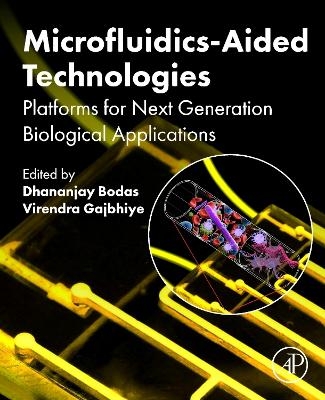
Microfluidics-Aided Technologies
Academic Press Inc (Verlag)
978-0-323-95533-1 (ISBN)
This book offers researchers an interdisciplinary perspective towards biological problems. It is a resource for advanced undergraduate, graduate students, researchers and industry scientists interested in the emergence of advance techniques and next generation microfluidics-aided technologies for applications in the biomedical and medical research.
Dr. Dhananjay Bodas completed his doctoral research in the field of Microelectronics from the Department of Electronic Science, University of Pune in 2004. He is a recipient postdoctoral awards from the Defense ministry of France and the prestigious Alexander von Humboldt Foundation in 2004 and 2006, respectively. He is currently working as a Scientist E in the Nanobioscience Group at the Agharkar Research Institute in Pune, India. He works at the interface of microtechnology, surface chemistry, and application biology. Current areas of interest are understanding flows at microscale by fabricating devices using unconventional techniques and the development of ultra-sensitive and specific diagnostic platforms to detect pathogens and development of organ-on-chip platforms. Dr. Virendra Gajbhiye has been working in the field of nanomedicine for the last 15 years. He has a doctoral degree (Ph.D.) in Pharmaceutical Science with post-doctoral research experience at University of Wisconsin-Madison and Oregon Health and Sciences University. Since 2013 he is working as a Scientist in Nanomedicine at Agharkar Research Institute, Pune, India. He has worked extensively with polymeric nanoparticles specially dendrimers and mesoporous silica nanoparticles. His research interest lies in Nanomedicine, Targeted drug and siRNA delivery, Biomedical application of dendrimers, Biomaterials unimolecular micelles and imaging, Multifunctional polymeric nanoparticles, Nanoparticles in tissue engineering.
Section 1: Introduction to Micro-scale flow enabled systems
1. Fundamentals of Microfluidics
2. Mathematical modelling in microfluidics for biosystems
3. Breakthroughs and Current Limitations in microfluidic systems
Section 2: Methods and Applications of Microfluidics - I
4. Microfluidic Systems in Prognostics and Diagnostics
5. Microfluidics in drug screening and drug delivery
6. Microfluidics assisted cell engineering and manipulation
7. Microfluidics assisted Cellular Analysis
8. Microfluidics in Bioimaging – in vivo and in vitro advancements
Section 3: Methods and Applications of Microfluidics - II
9. Genetic sequencing and editing using microfluidics (system on chip approach)
10. Anaphylactic detection using microfluidic systems
11. Microfluidic systems for bacterial and fungal research
12. Microfluidics in studying disease biology and disease modelling in vitro
13. Microfluidics in bioanalytical chemistry
Section 4: Breakthroughs in Microfluidics
14. Role of Microfluidics in 3D bioprinting
15. Tissue-on-Chip, Organ-on-chip and Organism-on-chip
16. Microfluidics in Regenerative medicine
17. Microfluidics in Protein engineering
18. Microfluidics-enabled Multi-omics analysis system
Section 5: Microfluidics and its applications in Microbe and Plant study
19. Microfluidics assisted study of plant biomechanics
20. Plant-on-chip (root chips, shoot chips, apical chips)
21. Microfluidic device to study the effect of chemical and mechanical cues on cells
22. Investigating diatoms in a microenvironment using microfluidics
| Erscheinungsdatum | 07.12.2024 |
|---|---|
| Verlagsort | Oxford |
| Sprache | englisch |
| Maße | 191 x 235 mm |
| Gewicht | 450 g |
| Themenwelt | Technik ► Umwelttechnik / Biotechnologie |
| ISBN-10 | 0-323-95533-9 / 0323955339 |
| ISBN-13 | 978-0-323-95533-1 / 9780323955331 |
| Zustand | Neuware |
| Informationen gemäß Produktsicherheitsverordnung (GPSR) | |
| Haben Sie eine Frage zum Produkt? |
aus dem Bereich