


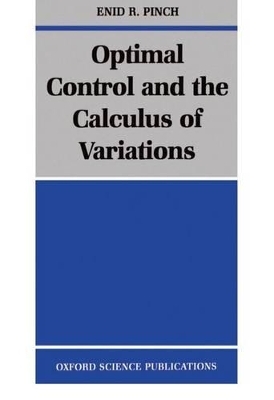
Optimal Control and the Calculus of Variations
Seiten
1995
Oxford University Press (Verlag)
978-0-19-851489-3 (ISBN)
Oxford University Press (Verlag)
978-0-19-851489-3 (ISBN)
This introduction to optimal control theory is intended for undergraduate mathematicians and for engineers and scientists with some knowledge of classical analysis. It includes sections on classical optimization and the calculus of variations.
Optimal Control is a modern development of the calculus of variations and classical optimization theory. For this reason, this introduction to the theory of Optimal Control starts by considering the problem of minimizing a function of many variables. It moves from there, via an exposition of the calculus of variations, to the main subject which is the optimal control of systems governed by ordinary differential equations. This approach should enable the student to see the essential unity of the three important areas of mathematics, and also allow Optimal Control and the Pontryagin Maximum Principle to be placed in a proper context.
A good knowledge of analysis, algebra, and methods, similar to that of a diligent British undergraduate at the start of the final year, is assumed. All the theorems are carefully proved, and there are many worked examples and exercises for the student. Although this book is written for the undergraduate mathematician, engineers and scientists with a taste for mathematics will find it a useful text.
Optimal Control is a modern development of the calculus of variations and classical optimization theory. For this reason, this introduction to the theory of Optimal Control starts by considering the problem of minimizing a function of many variables. It moves from there, via an exposition of the calculus of variations, to the main subject which is the optimal control of systems governed by ordinary differential equations. This approach should enable the student to see the essential unity of the three important areas of mathematics, and also allow Optimal Control and the Pontryagin Maximum Principle to be placed in a proper context.
A good knowledge of analysis, algebra, and methods, similar to that of a diligent British undergraduate at the start of the final year, is assumed. All the theorems are carefully proved, and there are many worked examples and exercises for the student. Although this book is written for the undergraduate mathematician, engineers and scientists with a taste for mathematics will find it a useful text.
PART 2: OPTIMIZATION IN; PART 3: THE CALCULUS OF VARIATIONS; PART 4: OPTIMAL CONTROL I: THEORY; PART 5: OPTIMAL CONTROL II: APPLICATIONS; PART 6: PROOF OF THE MAXIMUM PRINCIPLE OF PONTRYAGIN
| Erscheint lt. Verlag | 7.9.1995 |
|---|---|
| Zusatzinfo | numerous line drawings |
| Verlagsort | Oxford |
| Sprache | englisch |
| Maße | 155 x 233 mm |
| Gewicht | 365 g |
| Themenwelt | Mathematik / Informatik ► Mathematik ► Analysis |
| Mathematik / Informatik ► Mathematik ► Angewandte Mathematik | |
| Technik ► Maschinenbau | |
| ISBN-10 | 0-19-851489-1 / 0198514891 |
| ISBN-13 | 978-0-19-851489-3 / 9780198514893 |
| Zustand | Neuware |
| Informationen gemäß Produktsicherheitsverordnung (GPSR) | |
| Haben Sie eine Frage zum Produkt? |
Mehr entdecken
aus dem Bereich
aus dem Bereich
Festigkeits- und Verformungslehre, Baudynamik, Wärmeübertragung, …
Buch | Hardcover (2025)
De Gruyter Oldenbourg (Verlag)
CHF 125,90


